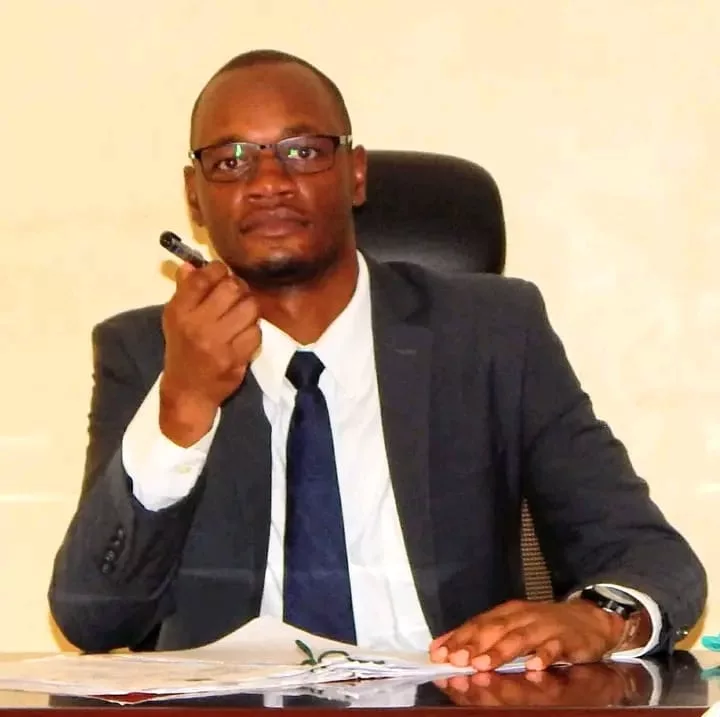
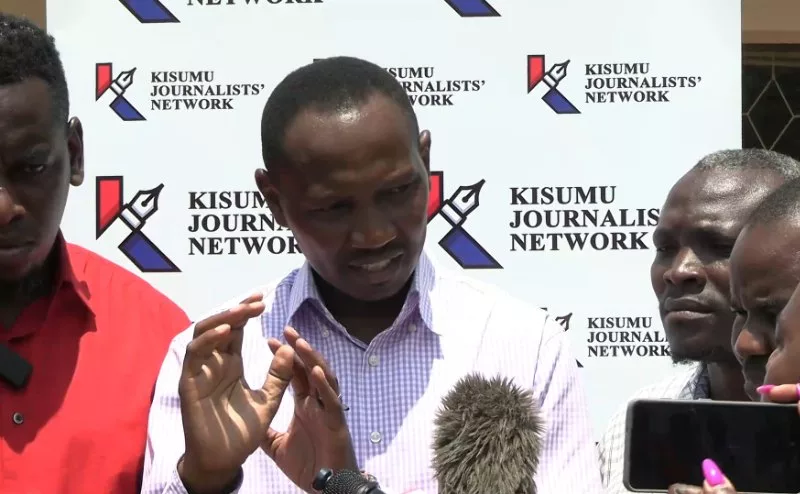
 Standard photographer Michael Mute speaking to the media in Kisumu. He was among the journalists attacked during Linda Mwananchi rally in Homa Bay. Faith Matete
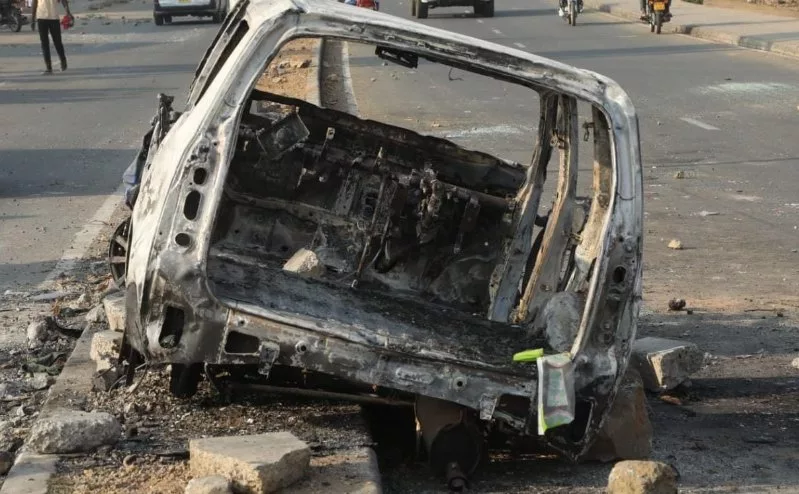 Rocks and debris litter a road in Homa Bay following Sunday’s violence during the Linda Mwananchi tour.
What began as a routine assignment to cover the Linda Mwananchi political rally in Homa Bay on Sunday turned into a fight for survival for journalists who found themselves trapped between angry crowds, flying stones, crude weapons and tear gas.
For journalists travelling with the caravan, the most frightening moments came on the return journey from Sindo as they approached Koduogo Junction on the outskirts of Homa Bay Town.
They had spent the day moving from one rally venue to another, navigating political tensions along the route. But as evening approached, the situation changed dramatically.
Nation photographer Alex Odhiambo said their team had already received a distress call from AFP journalist Fred Ooko, who had been attacked by armed men in Homa Bay Town.
Ooko, who was travelling on a motorcycle, was later found at Olare, bruised, dusty and visibly traumatised. His colleague Brian Ongoro was eventually traced to Homa Bay Police Station.
The journalists then used the Olare-Imbo route after learning that the main road into Homa Bay Town had been blocked. Their journey had already been punctuated by confrontations.
At Ndhiwa, the convoy encountered groups of supporters chanting rival slogans. The situation deteriorated into violence, forcing the convoy to restrategise before proceeding to Nyandiwa.
After the rally in Nyandiwa and another engagement at Sindo Market, the teams began the journey back to Homa Bay Town.
It was at Koduogo that they encountered what Odhiambo described as one of the most terrifying situations he has experienced in the field.
A large group had blocked the road with huge stones. Vehicles were attacked as their occupants struggled to escape.
“Death was glaring. It was traumatic. We thought we would not make it,” KTN journalist Bramwel Bwire recalled.
Bwire said the day had begun in Kisumu before the team travelled towards Homa Bay. At Rodi Kopany and Ndhiwa, they encountered opposing political groups and were forced to turn back at one point as stones were thrown.
Police later intervened and fired tear gas to disperse the crowds. But the most frightening encounter came at around 6 pm as the journalists approached Homa Bay Town.
“There were huge numbers of crowds. Tear gas, rungus and pangas, attacking people left, right and centre,” Bwire said.
One attacker approached their vehicle carrying a panga. The man struck the rear-view mirror near where Bwire was seated, shattering it. Another attacker attempted to open the vehicle door before Bwire’s colleague fought back.
Their driver accelerated, manoeuvring through the chaos as stones smashed into vehicles and windows.
Standard photographer Michael Mute said the attack at Koduogo was equally terrifying. He recalled seeing attackers armed with stones, machetes and pangas descend on vehicles.
Two men approached their vehicle. One attacked the front section where Bwire was seated, tearing apart the window. Another moved towards the rear of the vehicle and forcibly opened the door.
Mute instinctively tore off a loose section of the vehicle’s door cushion and used it as a makeshift shield against the machete-wielding attacker.
“I had to tear off our car door cushion, which was loose, and use it as a shield from a machete-wielding goon,” he recalled.
Nearby, Standard journalist Rodgers Otiso was also fighting for his life. Otiso and colleague Sammy Omingo had stepped out of their vehicle to document the violence. Omingo was taking photographs while Otiso used his phone to record video. Within moments, they found themselves being pursued.
Otiso ran towards a nearby farm.
The two journalists became separated before finding each other again and crossing a barbed-wire fence to reach a homestead. Their first attempt to seek refuge failed. The occupants locked their doors, fearful of the violence outside.
The journalists pleaded with them, explaining that they were members of the media and needed somewhere to hide. They eventually found another homestead where a woman allowed them inside.
For nearly two hours, they remained hidden as attackers moved around the area. Outside, the violence continued.
“During that time, we could hear the goons moving around and searching homes. The fear was overwhelming. We did not know what would happen if they found us,” Otiso said.
At about 8.30 pm, their host told them an ambulance had arrived nearby. She advised them to use the opportunity to leave.
The two journalists boarded the ambulance and were taken to Homa Bay County Referral Hospital. There, the reality of the violence became even more difficult to process.
More than 20 injured people were receiving treatment, many with cuts and other injuries. Otiso had injuries to his knees and elbows and had hurt his back during the escape.
Even inside the hospital, however, the journalists did not immediately feel safe.
Inside another vehicle, Nation reporter Dominic Ombok experienced a similarly terrifying moment.
As stones hit their car, he recalled his colleague Alex shouting: “We are finished!”
Their vehicle was near the back of the convoy. Behind them were attackers, just metres away. In front was a line of stalled vehicles.
“There was nowhere to move. Nowhere to go,” Ombok recalled.
Then came the first loud bang as a stone struck their vehicle.
Ombok dropped below the car seat. Stone after stone hit the vehicle as their driver eventually diverted onto a rough road, not knowing where it would lead.
“We were lying on the seats as stones battered the car,” he said.
For the journalists, the assignment ended not with the usual filing of stories and photographs, but with injuries, damaged vehicles, frightening memories and a long journey home.