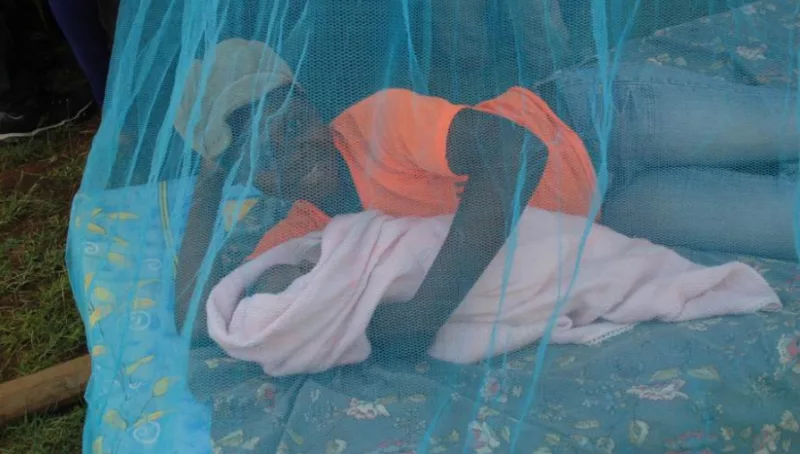
 A woman with her baby inside a mosquito net /FILE
Hot weather is making people less likely to sleep under mosquito nets, putting one of Kenya’s most important malaria prevention tools at risk, a new study has found.
The study, which examined data from 28 malaria-endemic countries in Africa, found that people were less likely to use insecticide-treated nets when temperatures became high.
Researchers say this could become an important problem as temperatures rise because of climate change.
The finding is important for Kenya, where malaria remains a major health problem despite years of progress.
The Ministry of Health said in April that malaria prevalence in Kenya had fallen from eight per cent in 2015 to six per cent in 2025. It also reported a 31 per cent fall in malaria cases over the previous three years.
But the disease remains common in many warm parts of the country, especially around Lake Victoria and the Coast. Kenya's 2022 Demographic and Health Survey says malaria risk varies greatly across the country because of differences in altitude, rainfall and temperature.
This makes the new findings especially important.
The study, titled 'The effect of heat on insecticide-treated net use across Africa', analysed information collected between 2011 and 2022 from nearly 732,000 women and more than 524,000 children under five.
The researchers used health survey data together with temperature information to see whether heat affected people's use of mosquito nets.
They found that higher temperatures were linked to lower net use among women and children.
Among women, temperatures above the study's hot-weather levels were linked to a nine per cent lower chance of using a net during the day and a 13 per cent lower chance at night. Among children under five, the reduction was about 13 per cent during the day and 14 per cent at night.
The researchers say the reason may be simple. People find it uncomfortable to sleep under a net when the weather is hot because the net can reduce air movement around the body.
“A common barrier to insecticide-treated net (ITN) use, the backbone of malaria prevention, is heat discomfort. Using multilevel regression models, we quantified the association between temperature and ITN use reported in Demographic and Health and Malaria Indicator Surveys from 2011-2022 across 28 countries in sub-Saharan Africa.”
The finding matters because owning a mosquito net does not mean that someone will use it every night.
Kenya's 2022 survey found that 54 per cent of households had at least one insecticide-treated net.
A 2023 government malaria strategy reported that after mass net distribution in 2022, 79 per cent of households had at least one net. However, only half of households had enough nets for one net for every two people. Among households with a net, 96 per cent of the population used one.
This shows why heat could become an important problem. Even when nets are available, people may leave them unused if sleeping under them becomes too uncomfortable.
The study estimates that heat-related failure to use mosquito nets may have been linked to 25.8 million malaria cases across the countries studied under a model in which temperatures had not crossed the hot-weather thresholds. The researchers stress that this is an estimate based on their model, not a count of cases directly caused by hot weather.
They also found the link between heat and lower net use was seen in most of the countries studied. The researchers estimated that excess malaria cases were linked to heat-related net non-use in 20 of the 28 countries.
“Our findings have several implications for malaria control measures. Associations between temperature and ITN use may inform the timing of interventions and the interpretation of malaria trials that span multiple seasons or climate regimes.”
For Kenya, the message is that the malaria fight may need to consider how people live as the climate gets hotter, not just how mosquitoes respond to temperature.
The researchers suggest that better housing and ventilation could make sleeping conditions more comfortable and encourage people to continue using nets. They also suggest that other mosquito-control tools may be needed in places where very high indoor temperatures make nets difficult to use.
But they warn that cooling homes is not a simple solution. Temperature also affects mosquitoes and the malaria parasite, so changing indoor temperatures could have unexpected effects on malaria transmission.
The study is a preprint and has not yet been peer reviewed, meaning its findings still need to be checked by other scientists.
INSTANT ANALYSIS
Rising temperatures could undermine Kenya’s malaria prevention efforts by discouraging mosquito-net use, particularly in warmer regions. The study suggests heat-related discomfort may contribute to increased malaria cases, highlighting the need for climate-sensitive prevention strategies. However, as a preprint, its findings require peer review before firm conclusions can be drawn about the scale of the risk.