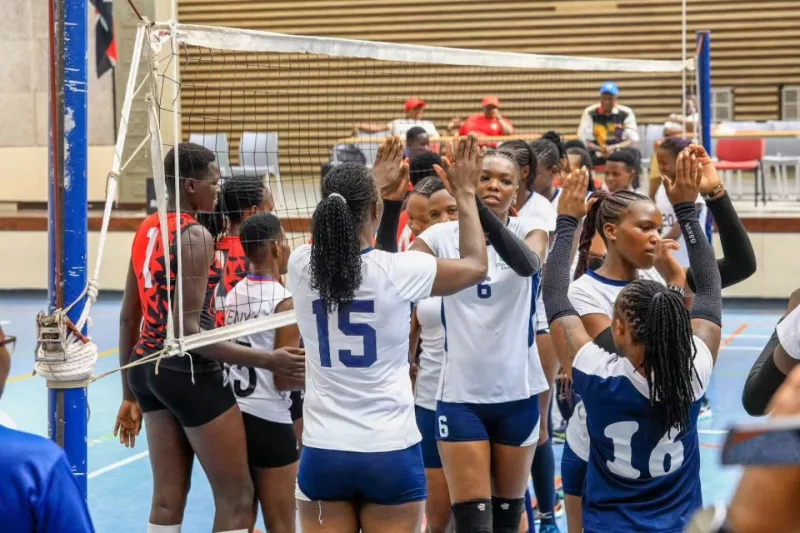
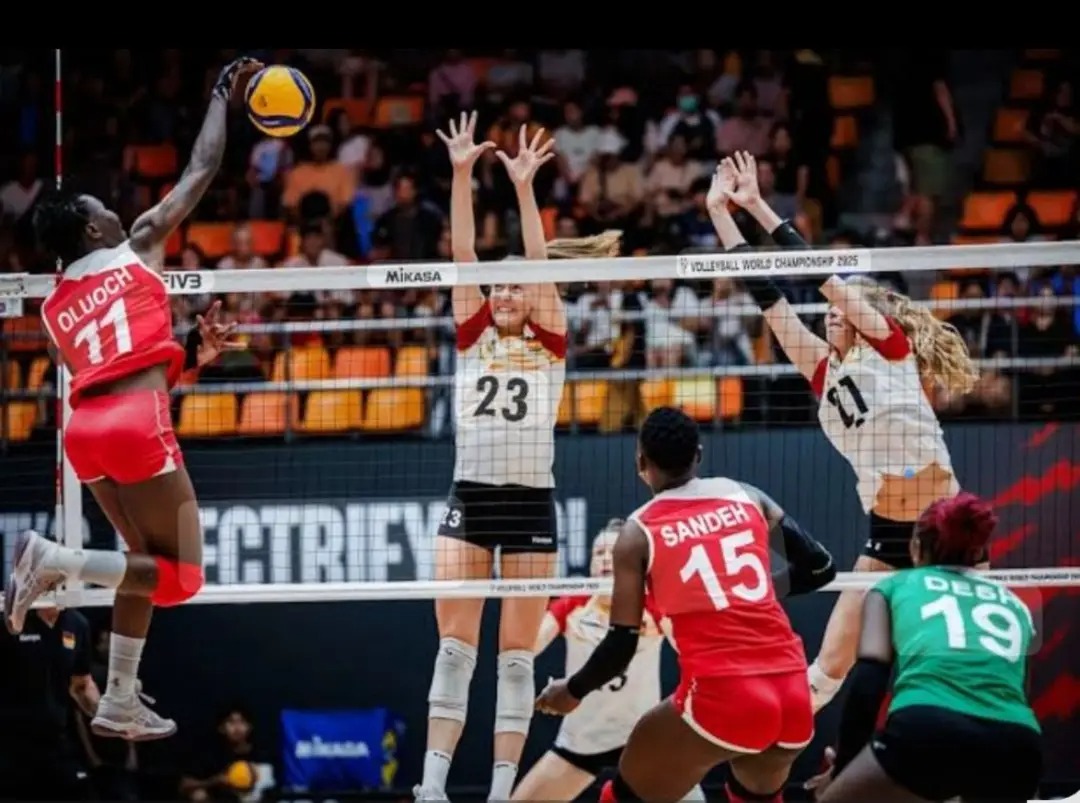
 Malkia Strikers in a past action/ FILE
Next week, Kenya is set to stage the CAVB African Senior Nations Volleyball Championships in Nairobi, a premier continental volleyball showpiece that will bring some of Africa’s finest volleyball talent to the capital.
With the continent’s volleyball fraternity set to converge in Nairobi, today’s episode takes a closer look at the sport to get you, our readers, well-versed with the fundamentals of the game before the action serves off on August 23.
Volleyball is a fast-paced team sport in which two teams of six players are separated by a net, with each side seeking to ground the ball on the opponent’s court while preventing the opposition from doing the same.
An official indoor volleyball court measures 18 metres long and nine metres wide, with each team occupying a 9m by 9m half of the court. The two halves are divided by a centre line and a high net, over which the ball must travel during play.
The action begins with a serve, in which a player positioned behind the back line strikes the ball over the net to start a rally. Once the ball is in play, teams rely on a combination of skill, timing, movement and communication to keep it alive and construct attacks.
A team is allowed a maximum of three touches before returning the ball over the net, while the same player cannot make two consecutive touches. Players are also not permitted to catch, hold or carry the ball, meaning every contact must be a clean hit.
The objective is simple but demanding: to send the ball into the opponent’s court in a way that makes it difficult to return, while protecting your own court from an attacking response. A ball is considered in when any part of it touches the boundary line.
Players also rotate around the court in a clockwise direction when their team wins the right to serve from the opposition, ensuring that every player moves through the different court positions during the match.
One of the most distinctive figures on a volleyball court is the libero, easily identified because they wear a different-coloured uniform from their teammates. The libero is a specialist defensive player whose primary responsibility is to strengthen the team’s reception and defence.
The libero is restricted to playing in the back row and cannot complete an attack hit when the ball is entirely above the top of the net. They are also prohibited from blocking or attempting to block an opponent’s attack, while international rules generally restrict the libero from serving, although serving regulations can vary in some competitions and local leagues.
Volleyball is also a game built around a variety of specialised hits, with each skill playing a crucial role in the establishment of an attack.
A pass, commonly known as a bump, involves using the forearms to control a low or fast-moving ball and is often the team’s first touch after receiving a serve or attack. A set follows, with a player using the fingertips to direct the ball high into the air and place it in an ideal position for an attacker.
The spike, or attack, is one of the sport’s most spectacular weapons, with a player leaping and striking the ball forcefully downwards into the opponent’s court in an attempt to beat the defence and score. On the other side of the net is the block, where players jump close to the net with their arms raised to stop or deflect an opponent’s attacking hit.
Volleyball uses a rally-point scoring system, meaning a point is awarded after every rally regardless of which team served. The first team to reach 25 points with a minimum two-point advantage wins a set.
A match is won by the first team to take three sets. If the teams are tied at two sets apiece, a deciding fifth set is played to 15 points, again with a team required to win by at least two points.
The sport has a rich history dating back to February 9, 1895, when William G. Morgan invented the game in Holyoke, Massachusetts, in the United States. Morgan initially called the sport Mintonette, as it borrowed elements from games such as tennis and badminton, before the name volleyball became widely adopted.
Volleyball continued to grow internationally and eventually reached the Olympic stage, becoming an official Olympic medal sport at the 1964 Summer Games in Tokyo after the International Olympic Committee (IOC) voted to include it in the programme in 1957.
Today, the global governing body for volleyball is the Fédération Internationale de Volleyball (FIVB), headquartered in Lausanne, Switzerland, and responsible for overseeing and developing the sport worldwide.
In Kenya, the Kenya Volleyball Federation (KVF) is the official governing body, charged with overseeing, developing and organising volleyball competitions.