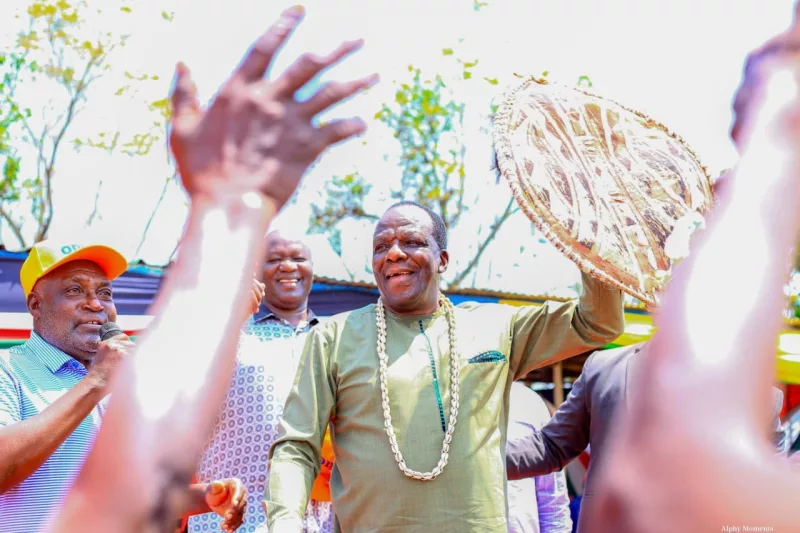
The prospect of Oparanya becoming Deputy President would introduce a new centre of political influence.
In Western, Prime CS Musalia Mudavadi and National Assembly Speaker Moses Wetang’ula have for years been regarded as the dominant national political figures.
Oparanya has emerged as a preferred choice among a faction of leaders in the Orange Democratic Movement, who believe his elevation to the second-highest office would give Western Kenya a stronger claim to the presidency when Ruto completes his second term.
The argument is gaining traction among some leaders from the region, who view the 2027 contest not only as an election to secure Ruto’s re-election but also as an opportunity to position Western Kenya for the 2032 succession.
Navakholo MP Emmanuel Wangwe has argued that the region should not pursue the Deputy President’s position merely for the sake of occupying the office but should use it to build a pathway towards the presidency.
“We mean no harm when we say we want Oparanya to deputise Ruto. We want it so that Western can get an opportunity to produce a President in 2032,” he said.
Such an arrangement, however, could complicate the political calculations of Mudavadi and Wetang’ula, who have both been viewed as key figures in discussions around Western Kenya’s long-term presidential ambitions.
Mudavadi and Wetang’ula played a central role in mobilising support for Ruto in Western Kenya during the 2022 presidential election, helping the then Kenya Kwanza presidential candidate make significant inroads into a region that had traditionally been difficult for him to penetrate.
The two have subsequently remained among Ruto’s most important political anchors in the region.
As the 2027 election approaches, the two leaders have been expected to once again play a prominent role in consolidating Western Kenya behind Ruto.
But Oparanya’s elevation to the running mate position would potentially change that equation.
Political commentator Fred Sasia believes the appointment would create a new centre of political influence in Western Kenya and could alter the balance between the region’s leading politicians.
“As the President’s potential deputy, Oparanya would naturally be expected to become Ruto’s most prominent pointman in Western Kenya, raising questions about the future roles of Mudavadi and Wetang’ula within the political hierarchy,” he said.
He argued that the position would give Oparanya an unparalleled platform to prepare for the 2032 succession contest.
For decades, leaders and voters from Western Kenya have complained that the region has wielded considerable electoral influence but has often played a supporting role in presidential politics.
Sasia said appointing Oparanya as Deputy President could provide Western Kenya with an opportunity to place one of its own at the heart of government, while simultaneously preparing him for the next presidential contest.
“For years, political leaders and voters from the region have argued that Western Kenya has played a supporting role in national politics despite having a significant voter base and a pool of experienced leaders,” he said.
He added that Oparanya’s elevation would significantly enhance his national profile and potentially transform him into a serious contender in the post-Ruto succession race.
“As Deputy President, Oparanya would gain access to a nationwide platform, state-level experience and an opportunity to build alliances beyond his traditional Western Kenya base,” Sasia said.
The prospect is already generating debate among leaders who see the 2027 election as part of a longer political calculation.
Kakamega Deputy Governor Ayub Savula, who serves as deputy coordinator of Ruto’s 2027 Western Region Presidential Re-Election Coordination Team, has maintained that Western Kenya should first concentrate on helping Ruto secure a second term before turning its attention to the 2032 succession.
He dismissed the pursuit of what he described as “small” political positions, arguing that the region's immediate priority should be ensuring Ruto completes his two terms.
“Here in Western, we are not interested in small seats. We are focused on helping our neighbouring son from Sugoi to complete his second term as President of Kenya,” Savula said.
He said Western Kenya would focus on its own leaders when the 2032 succession contest begins.
Political commentator Alex Khamasi said Oparanya’s possible elevation could fundamentally alter competition within Western Kenya.
“Rather than a broad push for a regional presidential candidate, the debate could shift towards whether Oparanya should carry the region’s ambitions or whether other leaders should challenge his claim to the mantle,” Khamasi said.
He argued that the significance of Oparanya becoming Ruto’s running mate would extend beyond the 2027 election.
“His selection as running mate would, therefore, not only be about the 2027 election,” Khamasi said.
“It could be interpreted as a strategic investment in the 2032 succession politics, giving Oparanya a rare opportunity to build a national coalition, while potentially redefining who speaks for Western Kenya at the highest level.”
Oparanya’s political background could also give him an advantage in such a contest. Having served as Kakamega governor and played a senior role within ODM, he has an established political network in Western Kenya and experience working with leaders from different parts of the country.
Mudavadi and Wetang’ula would have to navigate a new political reality in which Oparanya could emerge as the most visible Western Kenyan leader in the national government.