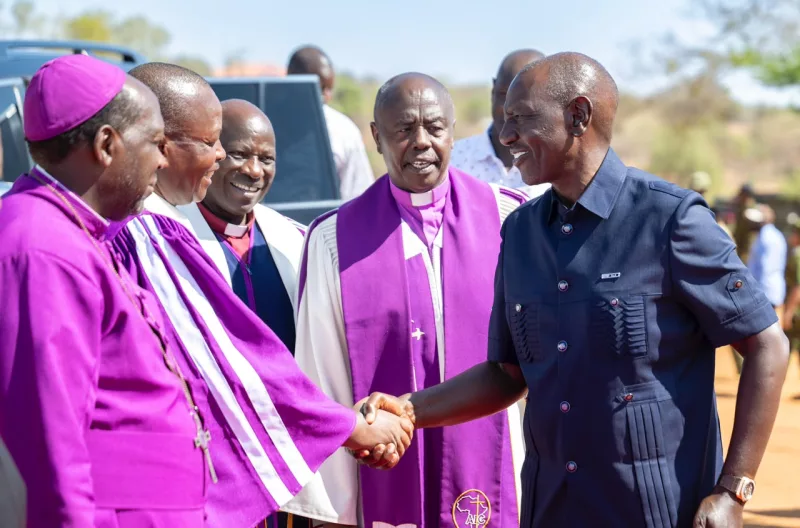
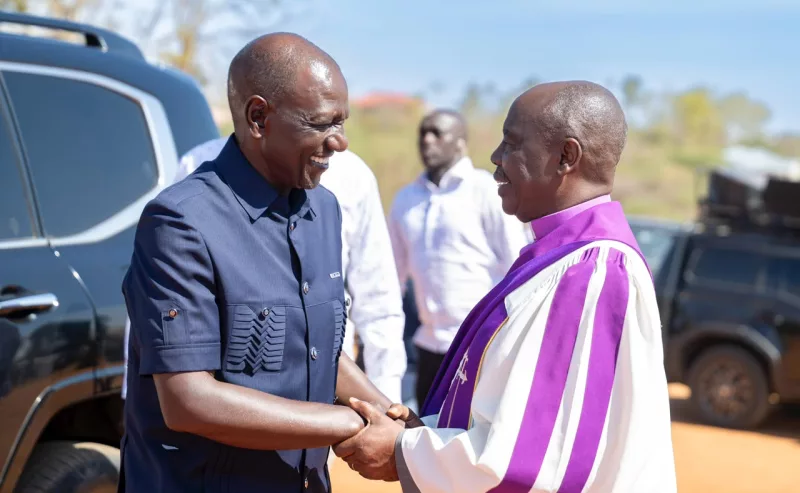
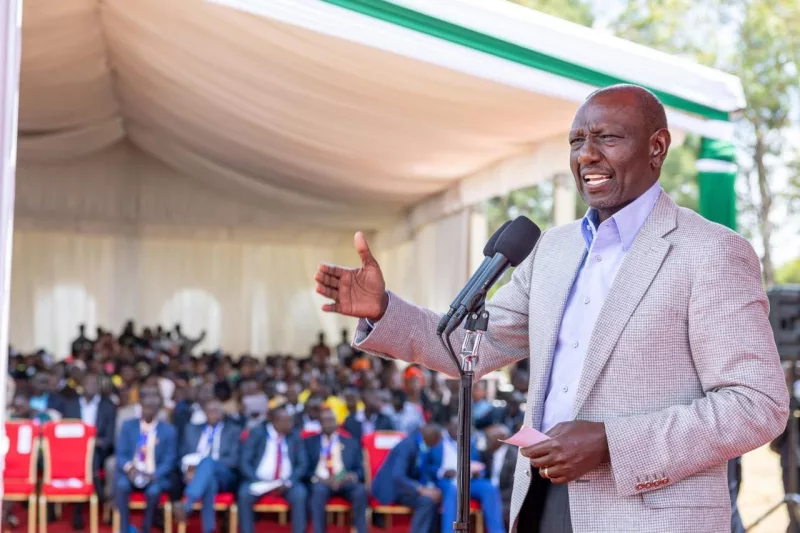
 President William Ruto at ACK St Stephen’s Church, Chepkoilel, in Moiben Constituency, Uasin Gishu County, on August 2, 2026
The sustained erosion of support could force the President to look beyond Mt Kenya and consider a new political anchor – with Western Kenya emerging as a leading contender.
The possibility of a political realignment was heightened after Ruto’s United Democratic Alliance (UDA) suffered a major setback in the Ol Kalou parliamentary by-election.
Political observers interpreted the results as evidence of growing dissatisfaction within parts of Mt Kenya.
After the polls, there have been high-profile defections led by Nyandarua Governor Moses Kiarie Badilisha.
The outcome has raised questions over whether the president can still rely on the region to deliver the overwhelming numbers it provided during the 2022 presidential contest.
According to Independent Electoral and Boundaries Commission (IEBC) records, about 47 per cent of the votes that made Ruto president in 2022 came from Mt Kenya.
However, the impeachment of former Deputy President Rigathi Gachagua and the subsequent political fallout in the region have complicated the President’s relationship with a region that was once considered his strongest political base.
The challenge for Ruto is whether his current deputy, Professor Kithure Kindiki, can rebuild that support if retained as his running mate.
Some political strategists argue that Kindiki may not be able to deliver the numbers required from Mt Kenya, forcing the president to search for a broader coalition partner.
City lawyer Ahmednasir Abdullahi has openly advised Ruto to reconsider relying heavily on Mt Kenya and instead look toward other populous regions.
He argued that the President should make a strategic shift by picking a running mate from either the Luo or Luhya communities, with a preference for Western Kenya.
“Act the political fox you always have been, pick a Luo or a Luhya running mate (preferably the latter) and hit the road running. The choices are clear. And President Ruto must smell the coffee... by force,” Ahmednasir said.
His argument is that the Ol Kalou outcome showed Mt Kenya can no longer automatically be treated as a guaranteed Kenya Kwanza stronghold.
In his view, Ruto’s path to re-election may require building a new political alliance around communities with significant voting numbers.
Political analyst Mutahi Ngunyi has also argued that Ruto needs to rethink his 2027 strategy following changing political realities in Mt Kenya.
He has suggested that the President should shift attention toward regions where he still has room to grow, particularly Western Kenya and Nyanza.
Western Kenya has increasingly become attractive because of its electoral strength.
In the 2022 General Election, the IEBC final register showed that the Western Kenya voting bloc – comprising Bungoma, Busia, Kakamega, Trans Nzoia and Vihiga – had 2,616,929 registered voters.
Following the 2026 Enhanced Continuous Voter Registration exercise, the region’s voter population has grown to about 2.92 million, making it the country’s second-largest voting bloc after Mt Kenya, which has approximately 5.7 million registered voters.
Analysts say a running mate from Western Kenya would not only add numbers to the Kenya Kwanza ticket but could also help neutralise rising opposition influence in the region.
The emergence of Nairobi Senator Edwin Sifuna as a popular opposition figure in Western Kenya has complicated Ruto’s calculations.
Before Sifuna’s rise, Ruto appeared to have established a strong political foothold in Western through Prime Cabinet Secretary Musalia Mudavadi, National Assembly Speaker Moses Wetang’ula and former Cabinet Secretary Wycliffe Oparanya.
However, Sifuna’s rallies and public engagements have attracted enthusiastic crowds, with supporters presenting him as one of the opposition’s most effective voices.
A Western running mate could therefore serve a dual purpose – expanding Ruto’s national coalition while slowing the momentum of opposition figures seeking to consolidate the region.
Ruto has already increased his focus on Western Kenya. During engagements with leaders from the region, he urged residents to register as voters, warning that political influence depends on participation..
“Mtu unapiga Isukuti na hauna kura, unatusaidia na nini?” he said, loosely translated as, "If you are dancing Isukuti but you do not have a vote, how are you helping us?”
Ruto has also claimed that about 1.5 million eligible Kenyans in Western have national identification cards but are not registered as voters, pointing to further room for growth in the region’s electoral influence.
The calculations are further complicated by developments in Nyanza, traditionally an ODM stronghold.
The emergence of former Interior Cabinet Secretary Fred Matiang’i as a presidential aspirant under the Jubilee Party has introduced a new dynamic.
With his emergence, there is the possibility of dividing opposition support if he succeeds in attracting voters in Kisii and Nyamira.
While some Coast leaders have expressed interest in the deputy presidency, analysts argue that Western’s voter numbers give it a stronger claim in a numbers-driven election.
Political analyst Daniel Orogo says Western Kenya’s electoral weight makes it increasingly difficult for Ruto to ignore the region.
“If the President concludes that rebuilding the coalition’s overwhelming backing in Mt Kenya will be difficult, he could seek to compensate by maximising support in other populous regions, with Western Kenya emerging as the most attractive option,” Orogo says.
He argues that the region’s numbers are likely to influence major Kenya Kwanza decisions, including the choice of a running mate.
"Politics is ultimately a game of numbers. If Western can deliver significant votes while Mt Kenya becomes more competitive, then the region naturally becomes critical in coalition-building,” he says.
However, Orogo cautions that choosing a deputy from Western Kenya alone would not guarantee victory. He argues that success would depend on sustained grassroots mobilisation, strong local alliances and a message that connects with voters.
"A running mate can be a powerful political statement, but elections are won through organisation, messaging and turnout,” Orogo says.