President William Ruto's announcement of a national conversation on the country's next long-term development blueprint has drawn sharp political reactions.
Critics claim the Head of State's priorities are misplaced and that he is attempting to shift attention from what they describe as pressing governance challenges facing his administration.
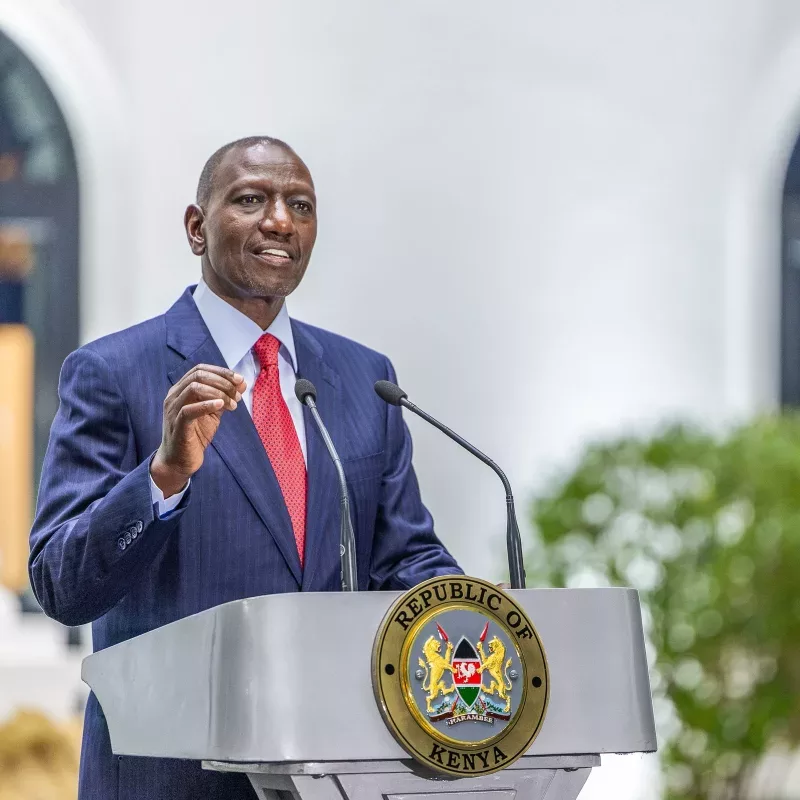
In a televised address on Thursday evening, Ruto announced that a national convention would be held on August 12 to launch discussions on Vision 2060.
The proposed development agenda is expected to succeed Vision 2030, which expires in under four years.
"We must craft a new national development charter that gives effect to the aspirations of our constitution and decide together what kind of Kenya we want to build over the next generation," Ruto said.
The announcement immediately drew criticism from opposition leaders and political commentators.
Some critics argued that the President was seeking to bolster his re-election prospects through the proposed development blueprint.
DCP leader Rigathi Gachagua dismissed the initiative, claiming the President had not delivered on existing promises and should not be talking about a new development vision.
"He is launching Vision 2060, yet he has killed Vision 2030," Gachagua said.
"How can Ruto tell us about 2060 when he has not done the work that we gave him? Four years since you were elected, you have done nothing."
Gachagua also claimed that the President was planning to appoint retired President Uhuru Kenyatta to lead the process.
"I want to tell my elder brother Uhuru Kenyatta, please don't accept. Kenyans will hate you," he said.
Nairobi Senator Edwin Sifuna, who is leading the Linda Mwananchi movement, argued that development could not be separated from constitutional values.
He added that democracy, human rights, freedom, equality, the rule of law and social justice must come before any development agenda.
Jubilee deputy party leader Fred Matiang'i described the proposed national conversation as a "misplaced priority."
He said the President should first address insecurity, alleged violations of the Constitution and what he termed the weakening of public institutions.
"It is a contradiction that Ruto has the temerity to lecture us about human rights when he has failed to address rampant thuggery and the breakdown of law and order," Matiang'i said.
He also cited a growing trust deficit, unfulfilled promises and unresolved political agreements, arguing that these issues should take precedence over a new national blueprint.
Homa Bay Governor Gladys Wanga, however, defended the call for a national conversation, dismissing critics who said the proposal was premature.
The ODM national chairperson said discussions on the country's long-term development agenda should not be politicised.
"Whether or not we agree politically, let us use this national conversation platform to discuss the future and shared prosperity for our nation. A national vision that will outlive all of us and rooted on inclusion and a Kenya that leaves no one behind," she said.
Gem MP Elisha Odhiambo criticised opponents of the proposal, arguing that any forward-looking leader should support the initiative.
"President Ruto is a visionary leader. He sees beyond what the current leaders in the opposition can see. As a country, we must have a clear development blueprint. That is exactly what the President has done. Whoever is criticising the move does not see beyond today," he told the Star.
Political analyst Martin Andati, however, said the timing of the initiative could undermine its success.
"He is trying to take the conversation away from politics, but unfortunately it is not going to work," Andati said.
"The country is already in the mood for politics and electioneering. People have no time for blueprints at this time."
Kitui Senator Enoch Wambua also dismissed Ruto's push for the proposed Vision 2060 development blueprint, arguing that it amounted to an admission that his administration's Bottom-Up Economic Transformation Agenda (BETA) had failed.
Speaking to the Star, Wambua questioned why the government was shifting focus to a new long-term development plan before fully implementing its existing economic agenda, which formed the basis of Ruto's 2022 election campaign.
“The bottom up experiment has miserably failed. If this government has been unable to implement its own blueprint in five years, how can it be the one to initiate and engineer a 30-year roadmap?” posed Wambua.
He faulted the government for abandoning its campaign commitments in favour of launching fresh policy initiatives, insisting that Kenyans were still waiting to see the promised economic transformation under the Bottom-Up model.
Interior Cabinet Secretary Kipchumba Murkomen, however, came to the defence of the proposed blueprint, saying the conversation was aimed at shaping Kenya's socio-economic future.
He lauded the President for launching the process, which seeks to chart the country's development agenda beyond the lifespan of Vision 2030.
“I join fellow Kenyans in congratulating President Ruto on his unveiling of the Beyond Vision 2030 conversation, a bold, inclusive and people-centred initiative that will shape the socio-economic future of our nation,” Murkomen said in a statement.
The remarks came hours after Ruto invited Kenyans to participate in what he described as "the most consequential national conversation" since the promulgation of the 2010 Constitution.
The President said the engagement would help craft a new national development vision to succeed Vision 2030 through an inclusive, citizen-driven process.
"Vision 2030 set a target of Kenya becoming an upper-middle income country by 2030. So far, we are off target. This is not a criticism of Vision 2030. Rather, it is an opportunity to proudly learn from our successes, reflect with honesty on where we have fallen short, and define, together, Kenya's next long-term vision," the President said.
He announced that the exercise would be formally launched on August 12, bringing together political leaders, professionals, civil society, faith groups, the private sector, universities and young people to chart Kenya's post-Vision 2030 future.
Ruto said the proposed national conversation was not intended to produce another government policy document but to forge a long-term national development charter shaped through public participation.
"It is about forging a new national consensus on the country we intend to become and the standards by which we shall measure our progress," he said.