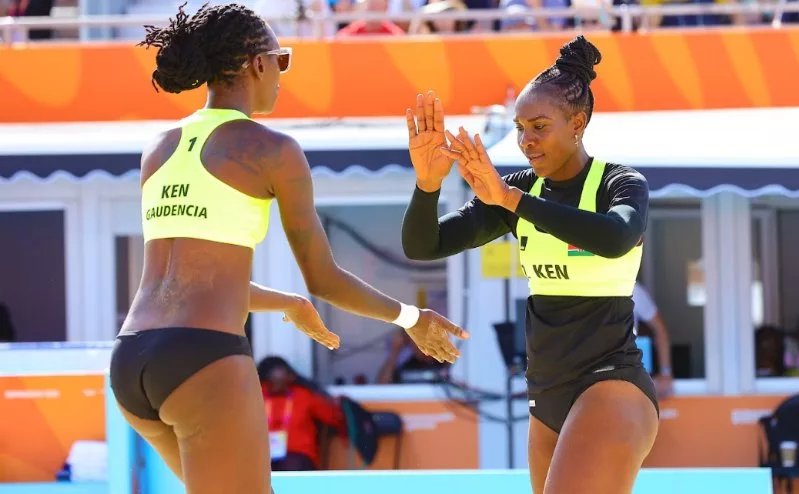
 Kenya's Gaudencia Makokha and Brackcides Agala in a past beach volleyball event/HANDOUT
Beach volleyball in Kenya has grown from a little-known recreational discipline into one of the country's fastest-rising sports, making impressive strides in grassroots development, national competition and international participation.
What was once a non-league sport has evolved into a vibrant national circuit, with Kenyan teams making regular appearances at continental championships.
The sport reached its greatest milestone when Kenya's women's national beach volleyball team made history by qualifying for the delayed 2020 Tokyo Olympic Games, becoming the country's first-ever representatives in Olympic beach volleyball.
The pair of Gaudencia Makokha and Brackcides Khadambifinished tied for 19th, marking a landmark achievement for the sport and inspiring a new generation of players.
In today's Know Your Sport, we take a closer look at beach volleyball; how it is played, its rules and what makes it one of the most exciting spectacles on sand. Beach volleyball, often called beach volley, is a fast-paced team sport played on a sand court divided by a net.
The objective remains similar to indoor volleyball: send the ball over the net and land it on the opponents' side of the court while preventing the opposition from doing the same. Every rally demands teamwork, quick reactions and tactical awareness as both teams battle for every point.
Although beach volleyball shares the same foundation as indoor volleyball, the two disciplines differ considerably.
Beach volleyball is played on a smaller 16m by 8m sand court compared to the 18m by 9m hard court used indoors. It also uses a slightly larger, lighter and more buoyant ball that is more affected by wind, making ball control even more challenging.
Another major difference lies in team size. Indoor volleyball features six specialist players on each side, while beach volleyball is strictly a two-player game at the elite level. There are no substitutions in official and Olympic competition, meaning the same pair must complete the entire match.
With only two players on the court, each athlete must master every aspect of the game. Both players are expected to serve, receive, set, attack, defend and block, making versatility one of the sport's greatest demands.
Beach volleyball matches are played in a best-of-three sets format using the rally scoring system, where every rally produces a point regardless of which team served.
The opening two sets are played to 21 points, while the deciding third set, if required, is played to 15 points. In every set, teams must win by a minimum two-point margin, with no maximum point cap. The first team to win two sets claims the match. Each team is allowed a maximum of three touches before returning the ball across the net.
However, a player may not contact the ball twice consecutively unless the first touch comes from an attempted block.
If a block is made, it counts as one of the team's three touches, leaving only two more contacts before the ball must cross the net.
Every rally begins with a serve delivered from behind the end line, sending the ball over the net into the opponents' court.
A point is awarded whenever the ball lands inside the opposing court, when an opponent commits a fault such as hitting the ball out of bounds or exceeding the three-touch limit, or when a successful block forces an error. The team that wins the rally earns both the point and the right to serve the next rally.
To ensure fair playing conditions, especially against changing wind direction and sunlight, teams switch ends of the court every seven cumulative points during the first and second sets, and every five cumulative points during the deciding third set.
An automatic technical timeout is also taken during the first two sets once the combined score reaches 21 points.
Beach volleyball is believed to have originated in 1915 on Waikiki Beach in Hawaii, while the modern two-player version was later developed in Santa Monica, California, where the first dedicated beach volleyball courts were established.
The sport has featured at every Summer Olympic Games since making its Olympic debut in 1996. Globally, beach volleyball is governed by the Fédération Internationale de Volleyball (FIVB), which organises the Beach Volleyball World Championships and the Beach Pro Tour, the sport's premier international circuit.
In Kenya, the game falls under the Kenya Volleyball Federation (KVF) through its Beach Volleyball Commission, which oversees competitions, player development, officiating and the national teams.
Beach volleyball was officially introduced to Kenya in 1995, and three decades later, the sport continues to gather momentum.