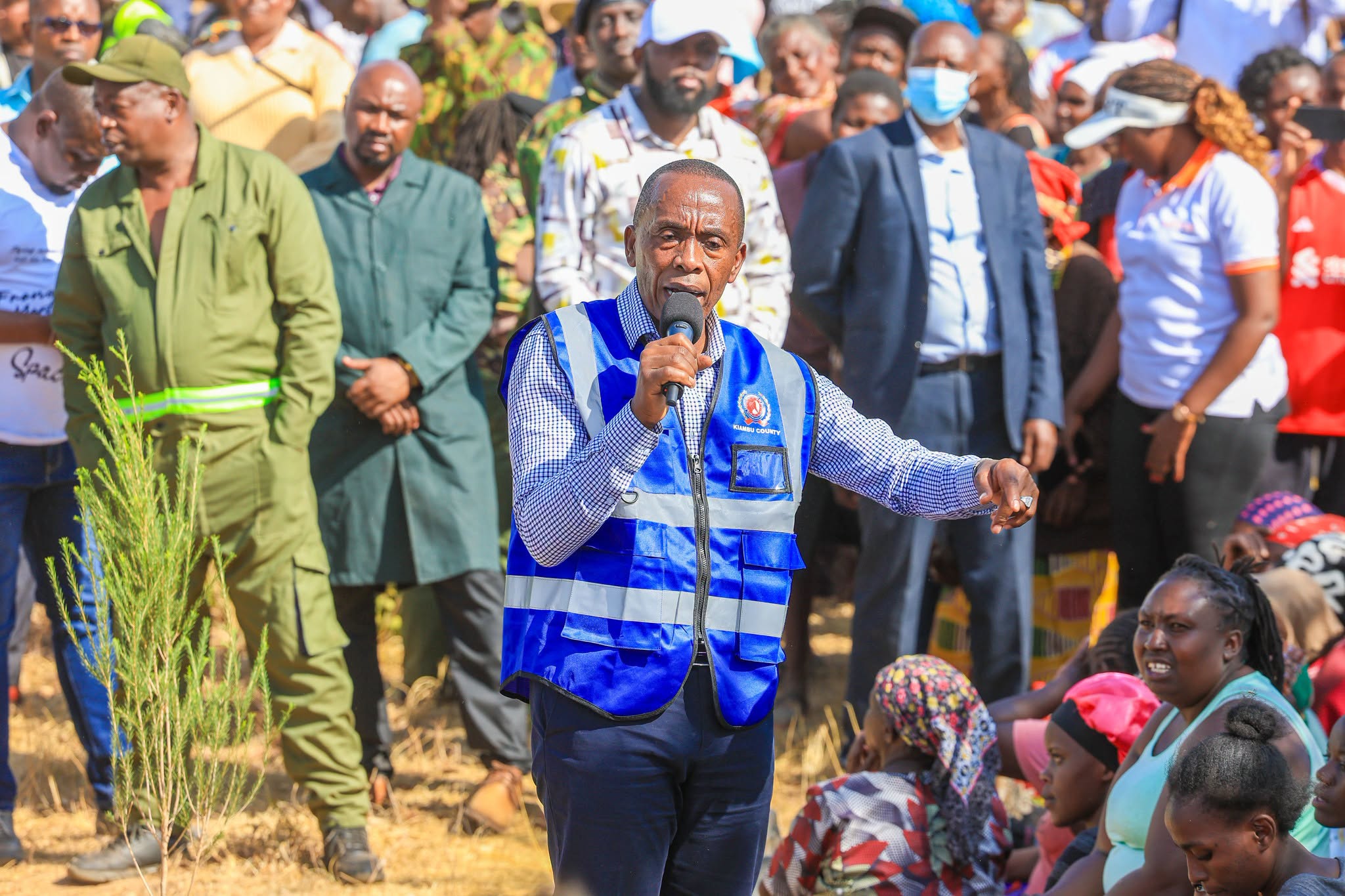
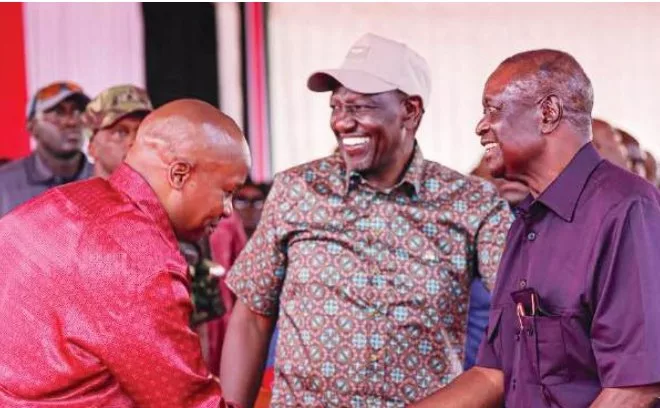
 Deputy President Kithure Kindiki, President William Ruto and ODM Party Leader Oburu Oginga /PCS
President William Ruto's path to re-election in the next year’s general election is increasingly being shaped by a familiar Kenyan political reality, the tyranny of numbers.
While the President has sought to broaden his support base through the UDA-ODM cooperation, emerging voter registration trends suggest Mt Kenya vote could be his troubling headache going into the polls.
The latest IEBC voter registration exercise has reinforced Mt Kenya's position as the country's electoral powerhouse.
Kiambu, Nakuru and Nyeri were among the counties that recorded some of the highest numbers of newly registered voters, alongside Nairobi, further strengthening the influence of the larger Mt Kenya voting bloc.
The 10 Mt Kenya counties account for 7.4 million registered voters according to Independent Electoral and Boundaries Commission figures ahead of 2027.
The projections appear to cancel the estimated voting bloc that comes with Ruto’s new partners – ODM.
The numbers also expose the limitations of relying solely on ODM's support.
While ODM bases remain an important electoral bloc, together they account for fewer registered voters than the broader Mt Kenya region.
Even when Kisii and Nyamira are added to the bloc, the combined total still falls short of the numbers available in Central.
The commission projects to register an additional 6.3 million new voters by next year, pushing the current register from the 22.1 million voters in 2022 to 28.4 million voters by the time the country goes to elections in 2027.
In the IEBC’s projections, the agency estimates new voters number in Nyeri to be 618,969, Meru (992,317), Kirinyaga (483,219), Embu (429,629), Tharaka-Nithi (298,070), Kiambu (1,638,580), Murang'a (797,990), Laikipia (338,009), Nyandarua (464,152), and Nakuru (1,355, 652).
Some counties like Nakuru and Kiambu are however cosmopolitan and may not vote in one direction.
Recent study by Infotrak released this month gives Ruto 12 per cent of the Central Kenya votes, translating to approximately 889,990 votes based on the IEBC projections.
While the poll gives Ruto an overall win of 32 per cent nationally, it suggests a united opposition will further give more trouble to the incumbent.
The opposition is quietly assembling a formidable arithmetic that will see them rally behind one of them against Ruto.
The study gave Kalonzo Musyoka 13 per cent support, Edwin Sifuna (12 per cent), the same as Jubilee’s Fred Matiang’i.
Gachagua scored four per cent, Babu Owino three per cent, David Maraga two per cent and Martha Karua one per cent.
Political analysts argue that this presents a strategic dilemma for Ruto.
His administration has invested heavily in cultivating ODM support following the political cooperation with the Orange party, hoping to secure votes from Nyanza, Coast and parts of Western region.
From IEBC’s projections, the 12 counties in Ruto’s Rift Valley accounts for 5,181,763 votes.
They are Bomet (484,482), Elgeyo- Marakwet (274,873), Kajiado (595,378), Kericho (550,134), Nandi (522,142), Baringo (361,196), Narok (512,498), Samburu (128,536), Trans Nzoia (512,751), Turkana (306,542), Uasin Gishu (650,464) and West Pokot (282,767).
The ODM bases, especially the four Luo Nyanza counties and six Coastal counties bring a total of 5,299,442 votes. Kisumu has 779,772 votes, Migori (602,763), Siaya (685,751), Homa Bay (708,213), Mombasa (824,958), Kwale (421,855), Kilifi (756,444), Tana River (181,329), Lamu (104,680) and Taita Taveta 233,677.
Western used to be under ODM’s grip but with the disruption brought by Edwin Sifuna's Linda Mwananchi, the region now appears more of a battleground between the broad-based government and the united opposition.
Political commentator Wafula Buke says Ruto will have no fighting chances in Western if Sifuna is on the presidential ballot.
“If Edwin Sifuna runs as a presidential candidate in the coming elections, there will be no place for Ruto in Western,” Buke told the Star in a telephone interview.
Beyond Mt Kenya, the opposition is expected to draw support from Ukambani under Kalonzo Musyoka, Kisii courtesy of Matiang’i, and urban voters in Nairobi where Linda Mwananchi is claiming dominance.
Kitui with 684,678 votes, Machakos (883,629) and Makueni (616,104) have a combined projected 2027 voting strength of 2.1 million votes. They form Kalonzo's political bedrock.
Nairobi is estimated to have 3,104, 048 voters by the time of the next elections.
If these regions vote cohesively, they could significantly narrow or even erase the numerical advantage enjoyed by Ruto in 2022.
This explains why both government and opposition strategists continue to invest enormous political capital in Mt Kenya despite extensive campaigns in other regions.
Winning Nyanza or Western may boost national appeal, but losing substantial support in Mt Kenya could outweigh those gains.
Political analyst Prof. Gitile Naituli told the Star the broad-based arrangement with ODM carries no numbers as majority of supporters have joined Edwin Sifuna’s Linda Mwananchi.
“ODM team under Oburu is a shell, the supporters moved with Sifuna, Orengo and Babu to the Linda Mwanachi,” Naituli told the Star.
The ruling UDA party's recent loss in the Ol-Kalou by-election has reinforced the belief that Mt Kenya might not be available to Ruto in the next year’s polls.
Gachagua has described the Ol Kalou parliamentary by-election as a political contest between Ruto and the Kikuyu community.
The former deputy president said the outcome reflected the region's growing opposition to Ruto's re-election bid.
Speaking during a church service at ACK St Thomas Cathedral in Kerugoya, Gachagua said Ruto should expect a similar political verdict in next year's general election.
"The Ol Kalou contest was not about individual candidates. It was a contest between President Ruto and the Kikuyu community and the people have spoken. If nothing changes, he should expect the same outcome in 2027," Gachagua said.
INSTANT ANALYSIS
Mt. Kenya enduring numerical strength means it is likely to remain the single most coveted political battleground, with its eventual choice potentially determining whether Ruto secures a second term or faces his toughest electoral test yet