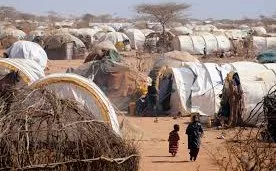
 Daadab Refugee Camp in Garissa County/File
Senior government officials from four African countries will converge in Nairobi this week to discuss barriers preventing refugees and asylum seekers from accessing decent work opportunities.
The regional forum will focus on challenges facing more than 800,000 refugees and asylum seekers in Kenya, including restrictive work permit requirements, limited freedom of movement, financial exclusion and lack of access to digital services.
The Nairobi Regional Forum on Decent Jobs for Refugees and Host Communities will be convened by the International Labour Organisation (ILO) under the Prospects partnership, a multi-agency initiative supporting countries affected by forced displacement.
The three-day Prospects Africa Forum on Decent Work and Forced Displacement will take place from tomorrow to Thursday at the Mövenpick Hotel in Westlands, Nairobi.
The meeting will bring together tripartite delegations from Egypt, Ethiopia, Kenya, Sudan and Uganda, alongside representatives from regional bodies, including the East African Community, the Intergovernmental Authority on Development and the Southern African Development Community.
According to the forum concept note, participants will assess progress made in creating sustainable employment opportunities, strengthen dialogue between governments, employers and workers, and identify policy reforms to guide the implementation of Prospects Phase II (2024–27).
Delegates will also explore ways to improve labour mobility, recognition of skills and qualifications and access to social protection for refugees and host communities.
Kenya is expected to play a central role in the discussions due to its position as one of Africa’s largest refugee-hosting countries.
Latest United Nations High Commissioner for Refugees (UNHCR) statistics show that Kenya hosts 857,065 refugees and asylum seekers, comprising 630,946 refugees and 226,119 asylum seekers.
Garissa county hosts the highest number at 420,058, followed by Turkana with 318,825 and Nairobi with 118,182.
Somalia remains the largest country of origin for refugees in Kenya, with 325,744 people, followed by South Sudan with 208,856, the Democratic Republic of Congo with 45,126 and Ethiopia with 29,131.
The forum comes as Kenya implements the Shirika Plan, a government-backed framework aimed at shifting refugee management from a humanitarian model to a development-focused approach.
The plan seeks to transform refugee camps into integrated settlements with infrastructure, economic opportunities and services benefiting both refugees and host communities. Its implementation involves the government, UNHCR, development partners, NGOs and faith-based organisations.
The meeting also comes amid concerns over declining humanitarian funding, with agencies warning that reduced resources could affect food assistance, education and essential services for displaced populations across East and Southern Africa.
UNHCR has received pledges of $1.5 billion towards its 2026 response, including $1.161 billion from governments and an additional $350 million from private-sector partners. However, the amount covers only a fraction of the agency’s projected funding needs.
The Nairobi forum is expected to strengthen regional cooperation and identify sustainable solutions that promote economic inclusion for refugees while supporting host communities.