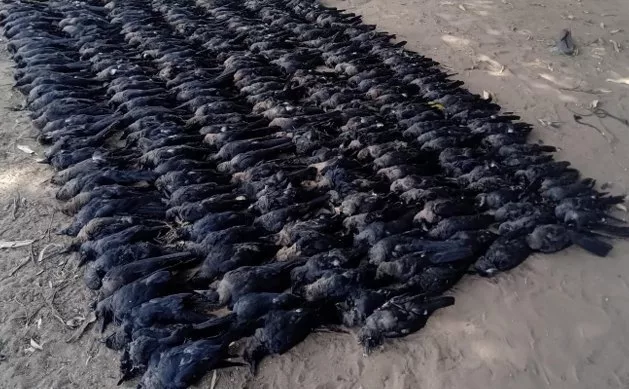
 Indian House Crows that have been eliminated through poisoning/handout.
Dr. Winnie Kiiru, a wildlife biologist with a distinguished career in research, policy, advocacy, and wildlife management said there is an urgent need for action to stop the birds.
“If we do not act immediately, Nairobi’s unique status as a green city under the sun—and its fragile urban ecosystems, including the nearby Nairobi National Park—will face an unprecedented ecological disaster,” she said.
Kiiru said the warning bells are ringing, and they carry a harsh, discordant caw.
“For decades, Nairobians watched from a comfortable distance as the coastal region battled the menace of the Indian House Crow (Corvus splendens). We read about the decimated local bird populations in Mombasa, the fouled hotel patios, and the sheer nuisance of an unstoppable avian invader.”
Already, conservationists have raised the alarm after several Indian house crows were spotted in Nairobi.
They have sparked fears that the destructive birds have expanded their range beyond the Coast.
Nature Kenya – the East Africa Natural History Society (EANHS) – confirmed on Thursday last week that about five Indian house crows had been sighted around the City Stadium area.
Speaking to the Star by phone, Nature Kenya species expert Paul Gacheru said the organisation received reports of the birds on Wednesday.
"Yes, there was a record yesterday (Wednesday). We got a few photographs of someone chasing them away," Gacheru said.
The sighting confirms that the invasive birds have reached Nairobi, prompting conservationists to intensify surveillance to establish how many are already in the city.
"We are also trying to see how best we can start controlling them," he said.
Indian crows are disliked in many places because they are highly aggressive, noisy and highly adaptable birds that often push out native bird species by stealing food, eggs and chicks.
They gather in large numbers around markets, dumps and towns, where they create noise and mess and can spread waste over wide areas. They reproduce quickly and have few natural predators, allowing their numbers to grow rapidly and threaten local wildlife and ecosystems.
Gacheru described the arrival of the birds in Nairobi as a major concern.
Kiiru said the bird is highly intelligent, fiercely adaptable, and aggressively opportunistic, these birds likely hitched a ride along the Mombasa Road or SGR transport corridors.
“They are now eyeing a new kingdom: our trash-heavy, resource-rich capital.”
To date, the primary weapon of choice against the house crow has been Starlicide.
In a coordinated effort by the Kenya Wildlife Service (KWS) and various stakeholders, over 140,000 crows were successfully poisoned at the Coast between January and April of this year.
Kiiru said Starlicide is undeniably effective; it metabolizes within 10 to 12 hours, meaning a poisoned crow poses virtually no secondary poisoning risk to local scavengers like dogs or vultures.
“However, relying solely on a chemical solution is a losing battle. Crows possess a level of cognitive intelligence that rivals primates. They observe, they learn, and they communicate. When crows see their peers drop dead after eating a specific bait, the rest of the flock quickly develops ‘bait shyness’."
Kiiru said the behavioural adaptation is why mainland Tanzania has struggled so profoundly to contain the menace.
“It is why, despite massive culling operations, the coastal population always threatens to bounce back. Poisoning is a vital tool, but it is not a cure.”
Kiiru said Nairobi cannot afford to repeat the slow-response mistakes of the past.
She said the resources are already stretched thin, we must abandon isolated, single-agency approaches.
Kiiru said controlling the invasion requires the immediate assembly of a multidisciplinary expert council—a coalition that brings together a diverse vanguard of specialists.
“We need scientists who understand the psychology of the crow to outsmart them, mapping their roosting behaviors and intercepting them before they establish permanent breeding colonies in the capital.”
Kiiru said Urban Planners and Waste Management Experts are also needed.
She said the house crow is a scavenger that thrives on human filth.
“Nairobi’s county government must be brought to the table to enforce strict waste management. Open-air markets, slaughterhouses, and fast-food dumps must be tightly regulated. If we starve the crows of garbage, we strip them of their power to multiply.”
Kiiru said aviation and public health officials are also need.
She said with JKIA and Wilson Airport operating in close proximity to the city, an explosion in the crow population poses a direct threat of catastrophic bird strikes.
“Public health experts must also weigh in, as these birds are notorious vectors for zoonotic diseases.”
Kiiru said there is also need for regional collaborators.
“We do not need to reinvent the wheel. While mainland Tanzania has struggled, the island of Zanzibar managed to reduce its house crow population by an incredible 95% over two decades using a tightly managed, integrated approach of trapping and Starlicide. Kenya must actively consult with these regional experts to replicate their success.”
Kiiru said the crows spotted near City Stadium represent an advance guard, not an established army.
“It is infinitely cheaper, easier, and more humane to eradicate a handful of invading birds today than it will be to manage millions of them ten years from now.We must implement an Integrated Pest Management (IPM) strategy immediately. This means combining targeted Starlicide use with intensive trapping, physical nest destruction, egg-oiling, and mobilizing the public through "citizen science" tracking apps to report sightings in real-time.”
Kiiru said the invasion of the Indian House Crow is not just a KWS problem, nor is it merely a footnote for nature lovers.
“It is a looming socio-economic and environmental crisis for our capital. Complacency will cost us our native wildlife, our public hygiene, and our peace of mind. It is time to bring in the experts, coordinate our defenses, and reclaim our skies before the cawing becomes deafening.”
Originally native to the Indian subcontinent, the Indian house crow (Corvus splendens) has spread to several parts of the world, including Kenya and Dodoma in Tanzania.
The highly adaptable scavenger thrives in urban environments, particularly around food sources and waste disposal sites.
Studies have shown that the invasive bird threatens local ecosystems by preying on native wildlife, including lizards, which play an important role in pest control and maintaining food webs.
The birds also compete with native and introduced bird species for food and habitat. They prey on a wide range of animals, including small mammals, birds and reptiles, disrupting ecological balance and biodiversity.