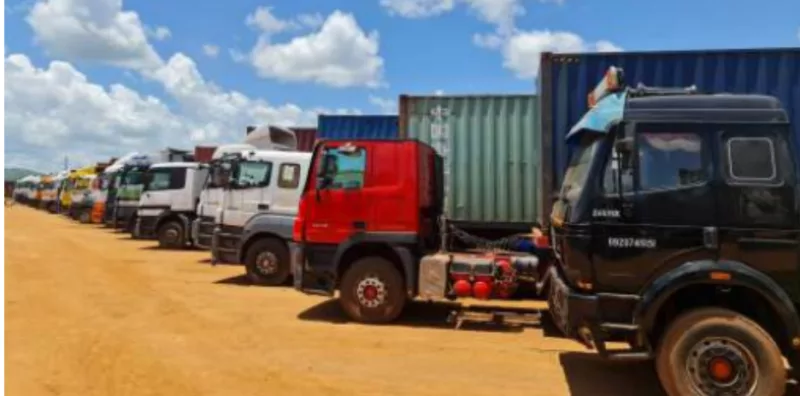
For hundreds of Kenyan long-distance truck drivers, every trip into South Sudan begins with uncertainty and increasingly, fear.
The route from Kenya through Uganda into South Sudan is one of East Africa's most important trade corridors, carrying food, fuel, construction materials and other essential supplies from the Port of Mombasa to Juba, and return trips for potential exports.
This is part of the 1,700 kilometre-long Northern Corridor that runs between Mombasa (Kenya), Uganda Rwanda, Burundi South Sudan and Eastern DRC, the most preferred for transit goods by traders.
Yet behind the billions of shillings worth of cargo that moves along the corridor lies a grim reality of violent attacks, shootings, beatings, extortion and intimidation that drivers say has gone largely unheard.
The latest victim is a Kenyan driver popularly known as Mzee Malalo, who was brutally attacked last week in South Sudan by people believed to be security personnel.
Unable to receive adequate medical treatment in South Sudan, he was evacuated to Elegu in northern Uganda where he is receiving treatment.
His assault came barely weeks after another Kenyan driver was seriously injured in a separate attack, adding to a growing list of incidents that truck drivers say continue despite repeated promises by authorities to improve security.
"We strongly condemn the brutality allegedly inflicted by security personnel who are entrusted with protecting lives and maintaining security," the Kenya Long Distance Truck Drivers Union said in a statement.
The union called on the South Sudan government to conduct thorough investigations and hold those responsible accountable.
"In the meantime, we are consulting with other long-distance drivers' organisations to determine the next course of action. The safety, dignity and rights of all drivers must be respected and protected at all times."
Drivers say attacks have become almost routine. According to the Kenya Long Distance Truck Drivers Union, more than 60 incidents involving attacks, assaults, extortion, flogging and maiming have been reported so far this year.
Many of the cases occur along the Juba-Nimule Highway, South Sudan's main paved road linking the capital to Uganda and the rest of East Africa.
Union officials accuse rogue security officers and armed groups of turning sections of the highway into extortion points where drivers are forced to surrender cash before being allowed to proceed.
"They will ask for your documents, then money which you have to give if you are to continue with your journey. If you don't, they confiscate your documents until you part with cash," Kenya Long Distance Truck Drivers Union official Roman Waema told the Star.
According to the union, foreign truck drivers lose at least $500 (about Sh64, 650) in illegal payments while travelling the 125-kilometre stretch between Aru Junction and Nesitu.
Drivers also complain of criminal gangs operating around parking yards with the alleged knowledge of security officers.
"There is also rising insecurity in Rock City parking yard where criminal gangs rob truck drivers at parking areas with the knowledge of security officers," Waema said.
The harassment extends beyond roadblocks.
Drivers allege they are routinely forced to pay illegal immigration charges, inflated road tolls and unofficial "processing fees."
At Nimule border, they say immigration officers demand 1,000 South Sudanese Pounds (about Sh1,000) to stamp entry documents and another 500 SSP (Sh650) upon exit.
Those using newly issued passports reportedly pay an additional 4,000 SSP (Sh5,160) for their details to be entered into the immigration system, failing which their passports are confiscated.
Truckers also accuse traffic officers of collecting 6,500 SSP (Sh6,451)instead of the official 5,000 SSP road toll.
One such incident is when Kenyan driver Hassan Gedi was allegedly pulled from his truck and beaten after refusing to pay an additional 500 SSP demanded by traffic officers. The violence has at times turned deadly.
Records kept by the drivers' association show that at least 10 foreign truck drivers have been killed in South Sudan since 2021, with more than 33 cases of gunshot wounds or permanent injuries.
Among those killed was Hashim Ismail Abdinoor, who was shot dead in March 2021 between Nesitu and Juba Academy.
Weeks later, Elijah Maiji was killed and his truck burned beyond recognition on the Pageri-Juba road.
Other drivers including Cyrus Musinjiri, Jerald Orange, Vincent Amenya and Joshua Odero survived gun attacks but suffered serious injuries.
Another driver, Jamila Nduku , was killed between Aru Junction and Nesitu, while Abdi Abdullahi was shot dead in 2020 and his truck burned on Mundri Road.
On February 5 this year, another Kenyan driver was assaulted, detained and allegedly forced to pay 1.5 million South Sudanese Pounds after authorities accused him of knocking down a stray dog.
Another driver identified only as Hassan was beaten after refusing to pay money demanded at a roadblock along the Juba-Nimule highway.
Drivers also accuse soldiers of forcing them at gunpoint to transport charcoal from Moli to Juba, exposing them to legal and environmental risks.
"South Sudan government is failing truck drivers," union chairman Sudi Mwatela said.
"Soldiers are extorting drivers and beating those who refuse to give bribes even after a signed agreement to end inhumane acts like extortion and forced charcoal transport. If this abuse continues, we will down our tools. Our lives matter."
The grievances are not new. Truck drivers have staged several strikes over the past six years protesting insecurity, abductions, killings and extortion.
In September 2019, more than 2,000 drivers halted cargo movement at the Elegu-Nimule border, with hundreds of trucks stranded in Uganda and Kenya.
Another major strike followed in August 2021 after two Kenyan drivers were killed, disrupting supplies of food, fuel and other essential goods destined for South Sudan.
Following years of protests, South Sudan authorities held a Joint Operations Technical Committee meeting with representatives of the East African Community Long-Distance Truck Drivers Association in July last year.
The meeting resolved to establish a joint task force to monitor security along the Juba-Nimule highway, remove illegal roadblocks, abolish unlawful immigration and traffic charges, designate official security checkpoints and strengthen communication between authorities and transporters.
Illegal fees including CID charges, manifest fees and traffic collections were declared prohibited with immediate effect.
However, drivers say little has changed on the ground.
"We have had previous meetings and resolutions but nothing is being implemented. The situation is getting even worse," Waema said.
Kenya Long Distance Truck Drivers Association secretary-general Nicholas Mbugua described conditions in South Sudan as "very wanting."
"You have to part with some money to have peace. We are addressing it diplomatically through the South Sudan Embassy in Nairobi but still no official communication," he said.
The security concerns have also attracted the attention of Kenyan authorities.
In January, the Kenyan Embassy in South Sudan issued a security advisory warning Kenyans of worsening armed conflict and general insecurity following renewed fighting since December 2025.
The advisory urged Kenyan nationals to exercise extreme caution while operating in the country.
Northern Corridor Transit and Transport Coordination Authority Executive Secretary John Deng recently told the Star he would engage South Sudan authorities over the continued attacks.
"We must guarantee security and safety in all modes of transport and ensure respect for international standards and regulations," he said.
Drivers however say diplomatic engagements and signed resolutions mean little if they do not translate into safety on the road.
Until then, every journey across the border remains a gamble—one that too many Kenyan truckers say has already cost colleagues their livelihoods, their health and, for some, their lives.