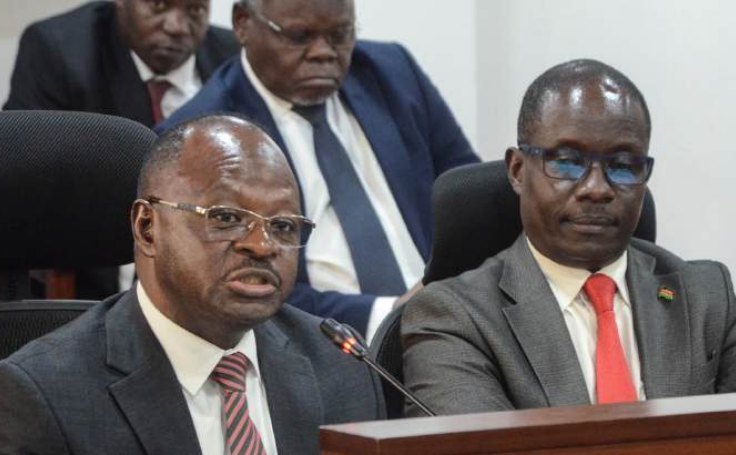
 IEBC commissioners Alutalala Mukhwana, Francis Aduol and acting CEO Moses Sunkuli when they appeared before Public Accounts Committee chaired by Butere MP Tindi Mwale at Bunge Towers yesterday /DOUGLAS OKIDDY
Read Also
The Independent Electoral and Boundaries Commission (IEBC) has vowed to crack down on political goonism.
The poll agency warned that no politician or political party will be spared in a renewed campaign to curb rising violence ahead of the 2027 General Election.
The commission said political intolerance and the use of hired gangs to disrupt rivals' meetings pose a serious threat to peaceful elections. It called on political leaders to take personal responsibility for ending the vice.
The electoral body was speaking during a session with members of the National Assembly's Public Accounts Committee (PAC).
Addressing the oversight committee, Commissioner Dr Alutalala Mukhwana said IEBC had resolved to deal firmly with all politicians linked to violence, regardless of their political affiliation.
Mukhwana chairs the commission's Code of Conduct Committee.
"We have a code of conduct which stipulates what should be done," Mukhwana told MPs, adding that peaceful political competition was a constitutional requirement, not a matter of choice.
"We have decided as a commission we will be very indiscriminate. We will ensure the country gets a peaceful election."
Mukhwana said no political party or candidate would receive special treatment, adding that maintaining peaceful campaigns would be central to delivering a credible election.
"We are going to be unprecedented in the manner IEBC is going to handle the issue of goons in the country," he said.
Under the law, the IEBC has powers to impose sanctions, including warnings, fines, restrictions on campaign activities and, in serious cases, recommending disqualification from an election.
Section 67 of the Elections Act and the Electoral Code of Conduct prohibit candidates and political parties from engaging in or encouraging violence.
Where the IEBC is satisfied, after giving a candidate a fair hearing, that a serious breach has occurred, it may disqualify the candidate from participating in the election.
Mukhwana was responding to a question from PAC chairman and Butere MP Tindi Mwale on what the commission was doing to address rising cases of political goonism ahead of next year's elections.
Also present were commissioners Francis Aduol and acting CEO Moses Sunkuli.
The team was responding to audit queries raised by Auditor General Nancy Gathungu in her 2024-25 audit report.
The tough talk comes against the backdrop of a worrying rise in political violence during public meetings and rallies in recent months.
Among the latest incidents was the attack on Vihiga Senator Godfrey Osotsi in Kisumu, where suspected goons assaulted him at a Java House restaurant, leaving him injured.
Police arrested three suspects in connection with the Kisumu incident.
Interior Cabinet Secretary Kipchumba Murkomen later told Parliament that some suspects had crossed the border into neighbouring countries.
"DCI circulated the pictures, three of them presented themselves. The rest of them, 13 or 14, ran out of the country to the neighbouring country," he told MPs on April 21.
Speaking on April 8, Osotsi said he had sent his security officer to withdraw money from a nearby location while he remained seated at the restaurant. Moments later, a group of between 15 and 20 youths entered the complex.
"I was seated facing the main entrance, so I saw them coming in. They did not look hostile. They were shouting 'Senator'. Two of them greeted me. I did not see any danger.
"All of a sudden, they started hitting me and asking why I was supporting one term... Before long, I was unconscious because they hit me so hard. I tried to run away, I fell, and they continued to hit me," he added.
On June 19, 2026, violent clashes broke out in Kuresoi North, Nakuru county, where rival political camps engaged in running battles that disrupted public meetings and heightened tensions in the area.
At least three people were shot and injured after violence erupted during a women and youth empowerment event at Umoja Secondary School.
The event, led by Governor Susan Kihika, descended into chaos after Kuresoi North MP Alfred Mutai arrived, triggering a confrontation between rival groups of supporters.
The three victims, who sustained gunshot wounds to their hands and legs, were taken to Molo Level 4 Hospital, where they were receiving treatment.
The incidents have reignited concerns over the resurgence of organised political gangs, a phenomenon that has historically fuelled election-related violence in the country.
Yesterday, Mukhwana said the responsibility for ending political violence does not rest with law enforcement agencies alone. He urged politicians to rein in their supporters and conduct issue-based campaigns.
The commissioner accused politicians of speaking out on both sides of the mouth, saying they fuel the vice on the ground even as they publicly condemn goonism.
"We appeal to politicians to help us achieve peaceful elections. If you stop paying these goons, we will stop having these issues," Mukhwana said.
The commission warned that inflammatory rhetoric, mobilisation of armed youth and disruption of opponents' meetings undermine democratic competition and erode public confidence in the electoral process.
The warning came even as MPs accused the electoral agency of applying the law selectively, arguing that some politicians have repeatedly been linked to violent incidents without facing meaningful sanctions.
Lugari MP Nabii Nabwera urged IEBC to apply the law equally, saying the poll agency had at times looked the other way when some political actors committed electoral offences.
Legislators challenged the commission to demonstrate impartiality by acting against offenders from across the political divide instead of appearing to target only certain individuals.
"You are implementing the law selectively. In some cases you look the other way. It is important that you implement the law equally, no matter which side is in the wrong," Nabii said.
With just over a year before the official campaign season begins, the electoral agency said it was working closely with security agencies and other stakeholders to identify emerging hotspots and prevent violence before it escalates.
Teso South MP Mary Emaase called on the commission to consider locking unauthorised persons out of polling stations, saying they are the main cause of chaos during the voting process.
"I plead with IEBC to lock out the goons from polling stations. Those allowed at polling stations should strictly be agents of the candidates," Emaase said.
INSTANT ANALYSIS
The renewed crackdown signals the IEBC's intention to place political accountability at the centre of preparations for the 2027 General Election amid growing concern that unchecked goonism could once again overshadow the country's democratic process.