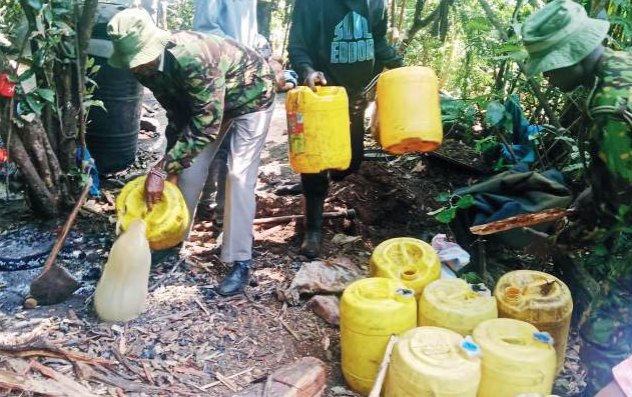
Rift Valley has recorded the highest number of illicit alcoholic brews seized in the country over the past two and a half years, police have said.
The police attributed the trend to the region's vast geographical coverage and proximity to international borders.
Data presented to the National Assembly’s Public Petitions Committee by Deputy Inspector General of Police Eliud Lagat showed security agencies confiscated 254,272 litres of illicit alcohol in the region in 2024.
Some 189,293 litres were confiscated in 2025, and another 49,508 litres has so far been confiscated between January and May this year.
The figures were tabled as the committee considered a public petition on the production, distribution and consumption of illegal alcoholic brews in the country.
Lagat, who appeared before the committee on behalf of the Inspector General of Police, said the downward trend in seizures over the last two years points to gains made in the fight against illicit alcohol, although the vice remains a major national concern.
"Rift Valley is very expansive and close to the borders where this smuggling happens, but we are happy there is a decline in the numbers over the last two years," he told the committee.
Police statistics also showed 16,040 suspects were arrested in the Rift Valley in 2024 for illicit alcohol-related offences. The number dropped sharply to 2,104 arrests in 2025 and 532 arrests between January and May this year.
Despite the improvement in Rift Valley, Lagat warned the problem has spread to other parts of the country, with Western and Nyanza emerging as major hotspots for the manufacture, distribution and consumption of illegal alcohol.
According to the data, authorities seized 134,463 litres of illicit alcohol in the Western region and 160,389 litres in Nyanza during the review period, underscoring the continued challenge facing law enforcement agencies.
The police boss said tackling the illicit alcohol trade requires more than police operations, calling for a well-funded and structured multi-agency strategy involving all government institutions responsible for regulation, enforcement and prosecution.
"The National Police Service firmly holds that no single agency can effectively address the multi-dimensional challenge of illicit alcohol. A coordinated whole-of-government approach is imperative," Lagat said.
He proposed a framework bringing together the National Police Service, Kenya Revenue Authority, Kenya Bureau of Standards, National Authority for the Campaign Against Alcohol and Drug Abuse, Anti-Counterfeit Authority, county governments, the Ministry of Health, the Office of the Director of Public Prosecutions, the Ethics and Anti-Corruption Commission and National Government Administrative Officers.
The committee also examined enforcement trends in Uasin Gishu county, where the number of arrests fluctuated over the three-year period.
Police records showed the county registered 56 arrests in 2024 before the figure rose sharply to 505 in 2025. Between January and May this year, 111 suspects had been arrested.
Similarly, authorities seized 4,417 litres of illicit alcohol in 2024, compared to 37,524 litres in 2025 and 4,442 litres during the first five months of this year.
Of the alcohol seized, 1,407 litres were destroyed in 2024, 35,667 litres in 2025 and another 820 litres this year.
During the session, legislators questioned the effectiveness of enforcement efforts, citing persistent allegations that corrupt law enforcement officers continue to frustrate the fight against illicit brews by accepting bribes from offenders.
Lagat acknowledged that corruption remains a challenge within the security sector but insisted the police service was taking firm action against rogue officers.
"Corruption should not be entertained. I admit there is a small percentage of officers who engage in corruption. As a service, we have no room for corruption.”
“We are working closely with the EACC to establish a dedicated mechanism to detect, investigate and prosecute officials implicated in illicit alcohol protection rackets," he said.
Committee members also stressed the need to involve local administrators and communities in the fight against the illegal alcohol business.
They argued that chiefs, assistant chiefs and residents are better placed to identify illicit brewing dens and supply chains, while regular transfers of police officers stationed in alcohol-prone areas would reduce the risk of collusion with traders.
The legislators further raised concern over the growing popularity of the "Park and Chill" events among young people, saying reports linking some editions to excessive alcohol consumption and drug abuse require urgent attention.
Committee vice chairperson Janet Sitienei, who chaired the meeting, urged security agencies to closely monitor such gatherings and assess their impact on the youth.
In response, Lagat assured the committee police would work with relevant agencies to investigate the concerns and take appropriate action where necessary.
The committee is expected to continue reviewing the petition before making recommendations on measures to strengthen enforcement and curb the production, distribution and consumption of illicit alcoholic brews across the country.