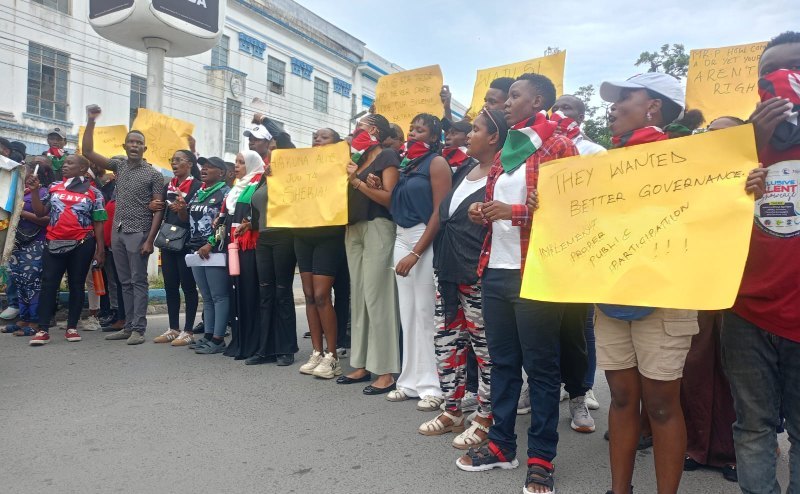
Activists march in Mombasa/John Chesoli
Even before the first rays of sunlight broke over Nairobi on Thursday, police officers were already taking positions across the city.
By 4am, major roads leading to the Central Business District had been barricaded.
Security checkpoints sprang up along key highways; razor wire was rolled out around Parliament and heavily armed officers were deployed at strategic locations.
Public service vehicles were barred from accessing the city centre while private motorists faced extensive searches.
As Kenya marked the anniversary of the June 25, 2024, Gen Z protests that left more than 60 people dead and culminated in the unprecedented breach of Parliament, Nairobi woke up to an atmosphere unlike any ordinary weekday.
The usually vibrant city centre was transformed into a ghost town.
Shops remained closed. Streets that normally teem with office workers, traders and matatus stood largely deserted.
Commuters were forced to walk for kilometres after public transport operators were ordered to terminate their trips far from the CBD.
For many residents, the silence was unsettling.
At the General Post Office roundabout, police officers turned away both motorists and pedestrians seeking access to the city centre.
Along Mombasa Road, traffic built up at checkpoints near Mlolongo as vehicles underwent searches.
Similar scenes were witnessed on Waiyaki Way, Ngong Road, Lang’ata Road and sections of Thika Road.
The restrictions effectively brought large sections of the capital to a standstill.
Yet despite the heavy security deployment, groups of Kenyans remained determined to honour those who lost their lives during the anti-Finance Bill protests that altered the country's political landscape and gave rise to the powerful Gen Z movement.
For many families, the day was deeply personal.
Outside the Serena Hotel, relatives of victims gathered carrying bouquets and photographs of loved ones who never returned home after the demonstrations.
Some held back tears while others openly wept as they prepared for a memorial march to Parliament.
“I need justice, Mr President. I want to face the government that killed my son to see if I can forgive them,” Jacinta Anyango, mother of 12-year-old Kennedy Onyango, who was killed in Rongai, said as she struggled to fight back tears.
They were joined by opposition leaders led by Wiper Party leader Kalonzo Musyoka, People's Liberation Party leader Martha Karua, former Chief Justice David Maraga, former Defence Cabinet Secretary Eugene Wamalwa and veteran rights activists.
The group carried placards bearing messages demanding justice and accountability.
Some read; "Justice for the Fallen," "Accountability for the Killers," and "Uajibike kwa Mauaji."
The procession moved peacefully through the city under tight security as participants sang patriotic songs and observed moments of silence.
But their journey would not reach its intended destination.
Upon arriving near Parliament Road, they found police officers had erected extensive razor-wire barricades blocking access to Parliament.
The symbolic barrier stood between grieving families and the institution that became the focal point of the 2024 protests.
Denied entry, the mourners turned the barricade itself into a memorial.
One by one, they laid flowers and wreaths on the razor wire.
The image of roses resting on sharp coils of metal became one of the defining moments of the anniversary commemorations.
Many participants described the scene as both heartbreaking and symbolic of the unresolved questions surrounding the deaths that occurred during the demonstrations.
"We are very peaceful," Kalonzo told journalists.
He urged demonstrators to remain calm and disciplined despite the restrictions.
"A lot of Kenyans have chosen to stay at home in sympathy with the June 2024 deaths. It truly feels like a public holiday," he said.
Kalonzo expressed confidence that future generations would eventually recognise the date as a National Day of Remembrance.
Karua echoed calls for justice, insisting that Kenyans had a constitutional right to assemble peacefully and honour those who died while exercising their democratic freedoms.
The opposition leaders maintained that the commemorations were intended to celebrate the sacrifices made by young protesters and remind the government that many families were still waiting for accountability.
However, the leaders were soon whisked away by their bodyguards on sensing potential arrests by the heavily armed police officers.
Elsewhere in the capital, police moved swiftly to prevent gatherings.
Several activists and protesters were arrested along Parliament Road and other parts of the city as officers dispersed crowds attempting to stage demonstrations.
Plainclothes officers patrolled the city on foot and on motorcycles, monitoring movements and responding quickly to emerging gatherings.
In Githurai, tension briefly flared after protesters lit bonfires near the busy roundabout.
The bonfires disrupted movement along sections of the road linking Githurai to Thika Road, leaving some commuters stranded. Police moved swiftly to disperse the youths.
In Kitengela, authorities arrested more than 30 youths as security agencies intensified efforts to prevent demonstrations.
Businesses in the town remained largely closed while police maintained a visible presence at strategic locations.
Meanwhile in Mombasa, the anniversary took the form of a peaceful memorial procession led by youth activists and religious leaders.
Tens of young people gathered at ACK Memorial Church before marching through the city centre carrying Kenyan flags and placards. The church hosted prayers, songs and speeches calling for accountability for those who died during the 2024 protests.
"They are only demanding transparency and accountability. Our prayer is that the demonstrations will be peaceful," said Rev Joseph Salim.
Human rights activist Zedekiah Adika urged leaders to listen to young people and ensure the sacrifices of those who died were not forgotten.
"We condemn the spirit of death. Nobody is going to die today. Nobody should lose their lives simply because they are commemorating people who stood up and raised their voices," he said.
Police accompanied the Mombasa procession and helped manage traffic as protesters delivered a petition to the county commissioner's office. Apart from temporary traffic disruptions, the march remained peaceful.
Organisers said they had received assurances from police that the event would proceed peacefully.
Mombasa County Commissioner Mohammed Noor confirmed authorities and organisers had reached an understanding on the route and conduct of the march.
In Kisumu, hundreds of residents turned out not to protest but to apply for national identity cards and register as voters ahead of the 2027 General Election.
Registration centres around Kondele attracted long queues of young people and first-time voters.
"I am so happy that on a day like this one, we can freely walk in town without fear that a bullet may get you or that you may be attacked. This is the Kisumu we all need," said resident Mary Aluoch.
Many residents said meaningful change could be achieved through the ballot rather than street protests.
Officials reported a steady flow of applicants seeking IDs, replacement documents and voter registration services throughout the day.
As the day progressed, Deputy Inspector General of Police Gilbert Masengeli defended the extensive security measures.
He dismissed claims that police had blocked roads, saying officers were simply conducting checks to ensure public safety.
"Our wananchi are safe. No vehicles are being burnt and people are going about their work," he said.
Inspector General of Police Douglas Kanja, Masengeli and Deputy Inspector General Eliud Lagat spent much of the day supervising operations on the ground and visiting security deployments across Nairobi and surrounding areas.
Kanja later toured Kitengela, which has frequently experienced demonstrations in the past. Unlike previous protests, the town remained calm throughout the day under heavy police deployment.
Across Luo Nyanza and much of Western Kenya, businesses largely remained open and daily life continued uninterrupted.
The situation was the same in eastern and central Kenya where businesses operated normally.
In Murang'a town, residents opened their businesses but remained on edge as memories of previous protests lingered. The usually busy matatu terminus operated at minimal capacity as many operators kept vehicles off the road due to uncertainty.
"Our colleague had to start her business afresh after the goons destroyed all her fruits. Today we are just on standby," fruit vendor Mary Wambui said.
John Chege, manager of MTN Sacco, said many vehicles remained parked because of low passenger numbers and fears of disturbances along routes outside the county.
"The terminus is empty so we have asked our operators to take their vehicles for service so that they can resume work tomorrow," he said.
In Nyeri, the business community took extraordinary measures to protect property amid fears of unrest.
Kenya National Chamber of Commerce and Industry Nyeri Chapter chairman Ibrahim Ndegewa said traders had deployed about 100 private security personnel across the town to complement police officers.
The guards, dressed in green reflective jackets, were stationed at key points throughout the business district.
Businesses remained open but activity in the city centre was noticeably lower than normal.
"We have calm in most areas and officers are on patrol to ensure there is peace and security everywhere," Uasin Gishu police commander Wilberforce Sicharani said.