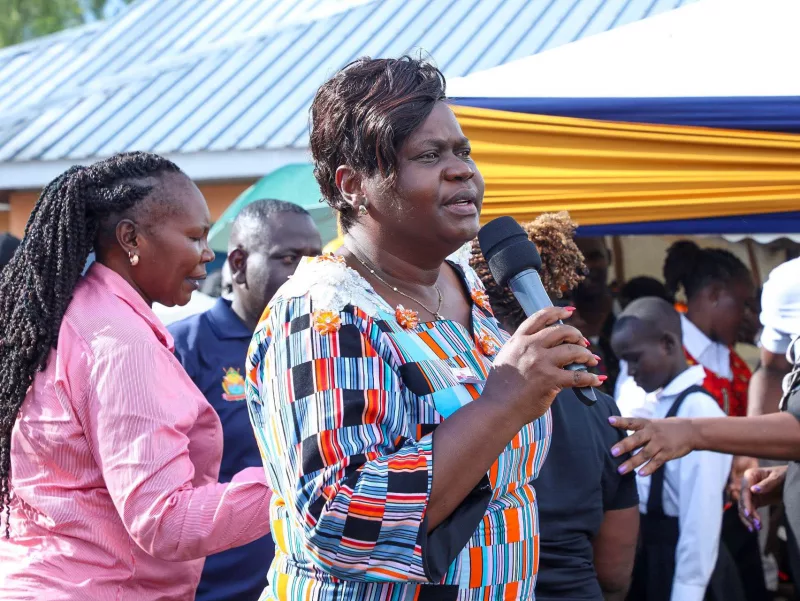
 Controller of Budget Margaret Nyakang'o/FILE
Governors are increasingly abandoning billions of shillings in pending bills inherited from previous administrations.
The development means contractors, suppliers and businesses have remained trapped in a financial nightmare years after delivering services to county governments.
A new report by Controller of Budget Margaret Nyakang’o reveals that more than half of the debt owed by county executives is aged three years and above.
This points to a troubling trend where successive administrations appear reluctant to settle obligations incurred by their predecessors.
For many contractors, the unpaid bills have become a matter of survival. Some have shut down businesses, others have auctioneers at their doors, while many continue to service bank loans for projects completed years ago.
The report shows that a significant number of counties carrying large volumes of old debt are under first-term governors who took office after the 2022 elections.
Among the counties with the highest proportions of pending bills aged more than three years are Mombasa, Wajir, Mandera, Murang’a, Kiambu, Laikipia, Embu, Machakos and Garissa.
Mombasa tops the list, with 98 per cent of its pending bills aged three years and above. Wajir follows at 80 per cent, Kiambu at 76 per cent, Mandera at 75 per cent and Murang’a at 74 per cent.
Embu and Laikipia each have 65 per cent of their pending bills classified as old debt, while Machakos stands at 54 per cent and Garissa at 52 per cent.
Most of these counties are led by first-term governors, including Abdulswamad Nassir of Mombasa, Irungu Kang’ata of Murang’a, Kimani Wamatangi of Kiambu, Cecily Mbarire of Embu, Wavinya Ndeti of Machakos and Joshua Irungu of Laikipia.
“This poses significant risks for county executives in ever settling their bills as their terms come to an end shortly,” the report warns.
The debt burden is heaviest in Kiambu, where pending bills aged more than three years have reached Sh3.56 billion.
Machakos follows with Sh2.85 billion, while Wajir and Mombasa owe Sh1.94 billion and Sh1.93 billion, respectively.
Kilifi and Kisii each have Sh1.28 billion in old pending bills, while Kisumu owes a similar amount. Other counties carrying large debts include Bungoma at Sh926.88 million, Laikipia at Sh852.11 million, Embu at Sh830.35 million and Kajiado at Sh812.16 million.
The revelations come amid concerns that counties are prioritising new spending while legitimate debts owed to businesses remain unpaid.
According to the report, county governments had accumulated pending bills amounting to Sh156.84 billion as of March 31, 2026.
Of this amount, Sh116.50 billion relates to recurrent expenditure while Sh40.34 billion is tied to development projects.
County executives account for Sh151.49 billion of the outstanding obligations, with county assemblies owing an additional Sh5.35 billion.
Although counties have managed to reduce pending bills from Sh183.03 billion recorded in June 2025, the Controller of Budget says the debt stock remains dangerously high.
The outstanding amount represents nearly a quarter of the cumulative county budget of Sh633.30 billion as of March 2026.
“The high stock of trade payables continues to constrain service delivery and disrupt business operations,” Nyakang’o says in the report.
The situation also raises questions about compliance with public finance laws. Regulation 41(2) of the Public Finance Management (County Governments) Regulations, 2015 requires county governments to prioritise debt-servicing obligations and avoid defaulting on payments.
Nyakang’o has urged counties to urgently verify and settle eligible pending bills, warning that continued delays threaten both public service delivery and the survival of businesses that depend on government contracts.
“County governments should prioritise the verification and settlement of eligible trade payables in line with legal requirements and implement the FY 2025/26 trade payables action plan,” the report states.
INSTANT ANALYSIS
The report exposes a growing governance crisis in counties, where changes in leadership appear to have disrupted the settlement of inherited debts. While pending bills have reduced overall, the fact that more than half are over three years old suggests many governors are prioritising new spending over old obligations. The unpaid debts continue to cripple contractors, undermine business confidence and slow economic activity. Unless counties clear legitimate pending bills, service delivery, development projects and public trust in devolution could suffer significantly.