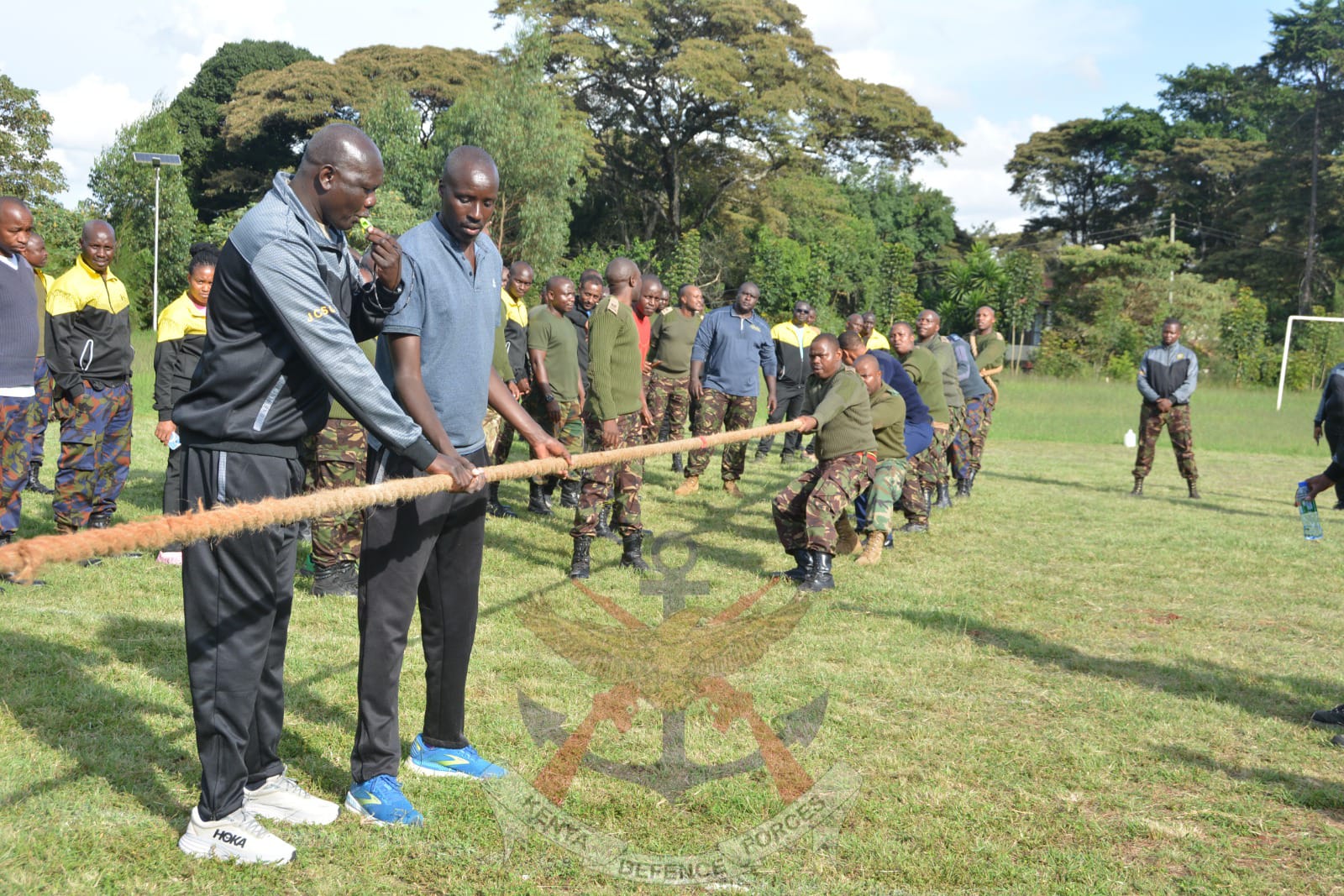
 KDF soldiers compete in a previous tug-of-war event/KDF
Humans have long been fascinated by sports that showcase raw power, grit and tactical intelligence.
Few disciplines embody those qualities better than tug-of-war, a contest that strips competition down to its most basic form, one team pulling against another in a battle of strength, endurance and teamwork.
Many people view tug-of-war as nothing more than a playground pastime or a fun activity at social gatherings. What many do not realise, however, is that it is a fully-fledged international sport that once occupied one of the grandest stages in world sport: the Olympic Games.
In today's edition of Know Your Sport, we break down the rules of tug of war, trace its journey to Olympic glory and explore why it eventually disappeared from the Games. At its core, tug-of-war is a competitive team sport that pits two teams against each other in a direct test of power and coordination.
While brute strength is important, success depends on teamwork, balance and technique. Athletes must anchor themselves firmly, lean in unison and use their collective body weight efficiently to gain an advantage over their opponents. A standard contest features two teams of eight athletes positioned at opposite ends of a thick rope. The objective is simple: pull the opposing team a set distance across a marked line.
The rope carries a centre marker, usually a coloured flag or tape, along with two additional markers placed four metres on either side of the centre mark. A centre line is marked on the ground directly beneath the rope's middle marker. Teams line up on opposite sides of the centre line, with the lead puller standing behind the four-metre marker on their side.
Before the contest begins, athletes grip the rope firmly with both hands in an underarm position. Wrapping the rope around the arms or body is strictly prohibited due to the serious injury risks involved. Once the referee signals the start, both teams pull in a coordinated rhythm, driving through their legs and leaning backwards to maximise force.
Victory is achieved when a team successfully pulls the opposing side's four-metre marker across the centre line. Most matches are contested in a best-of-three format. Like any organised sport, tug-of-war has a strict set of rules. Competitors are not allowed to intentionally sit or lie on the ground for prolonged periods or use their bodies to lock the rope in place.
For safety reasons, cleats and spiked footwear are generally prohibited, with athletes instead required to wear sturdy flat-soled sports shoes. Pullers must also maintain proper technique, including keeping their elbows above their knees during competition. The origins of tug-of-war stretch deep into antiquity, with evidence of the sport appearing across ancient Egypt, Greece, India and China.
Throughout history, the sport served different purposes in different cultures. In ancient China, military commanders used it as a training exercise to build strength and discipline among soldiers. The ancient Greeks practised it both as a competitive event and as physical preparation for other athletic disciplines around 500 BC.
Among Viking and Celtic societies, warriors in parts of Scandinavia and Germany embraced the activity as a measure of strength and a means of preparing for battle. Tug-of- war's greatest moment came when it became an official Olympic sport.
The event featured in every Olympic Games from Paris 1900 to Antwerp 1920, where it was contested as part of the athletics programme. During its five-edition Olympic run, Great Britain emerged as the dominant force, winning the most medals (five medals). Despite its popularity, the sport was eventually removed as the International Olympic Committee sought to streamline an increasingly crowded Olympic programme.
The absence of globally standardised rules, recurring judging disputes and the lack of a recognised international governing body also contribute to its downfall.
Today, the sport is governed worldwide by the Tug of War International Federation (TWIF), established in 1960, which oversees international competitions and regulations. In Kenya, the sport falls under the Kenya Tug of War Association, which is responsible for its development and administration.
The association draws many of its leading competitors from established institutional and county teams, including the General Service Unit (GSU), the Kenya Defence Forces and various county government teams.