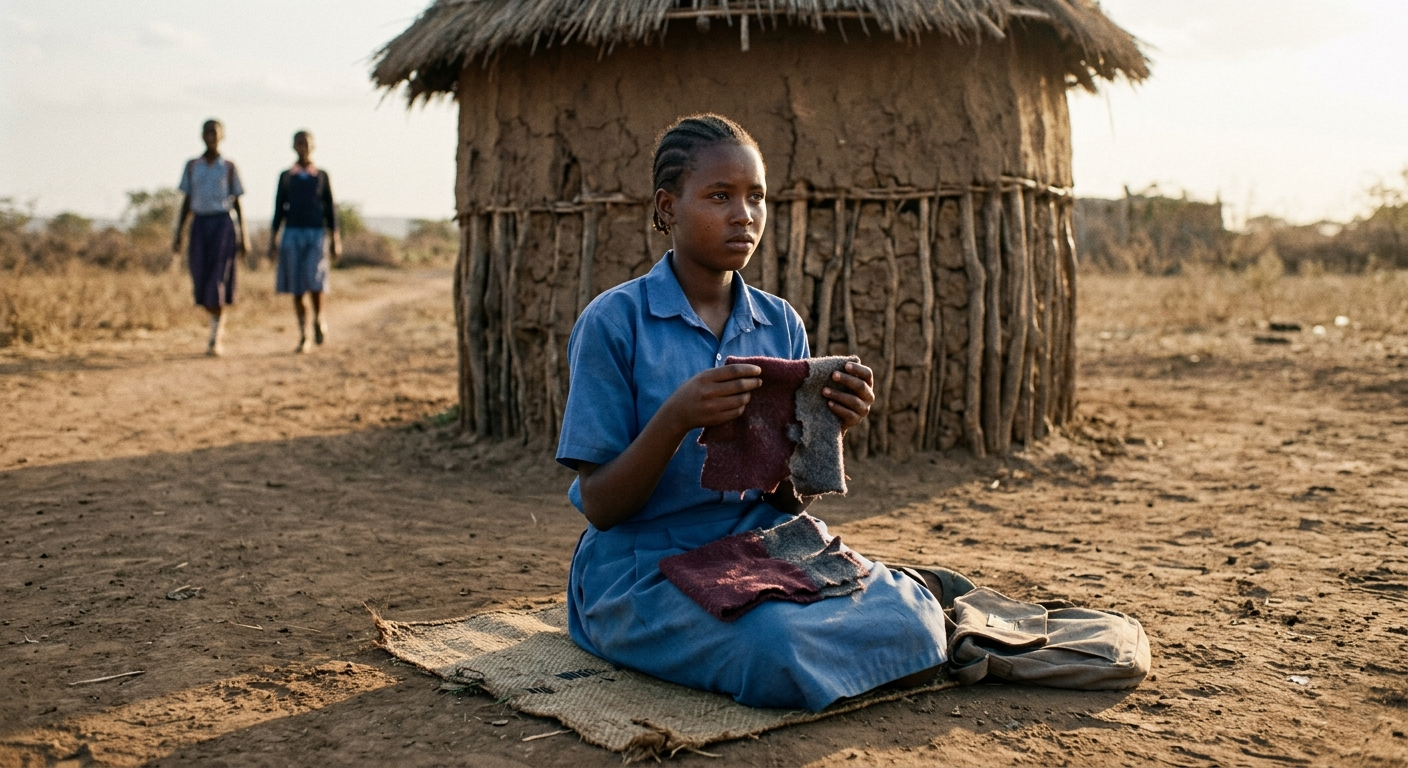
A new government report reveals that girls in the country’s arid and semi-arid counties face twice the menstrual-related absenteeism as those in better-served areas.
It has also emerged that one in five schools still report child marriage, and barely a quarter have disability-friendly toilets.
The National Gender and Equality Commission (NGEC) warns that without urgent action, Kenya will miss its Vision 2030 and SDG 4 targets for girls’ education.
The gender commission has singled out interventions on WASH programs, teacher deployment, and school leadership gender quotas.
The report, titled Evidence on School-Level Factors Affecting Girls’ Access to Quality Education in Marginalised Communities in Kenya, surveyed public primary schools across 19 counties.
Turkana, Mandera, Garissa, and Wajir counties, among others, and informal settlements in Nairobi were studied.
The report gives a vivid picture of barriers that continue to lock millions of girls out of equitable learning opportunities.
One of the most outstanding findings was on water, sanitation, and hygiene (WASH) facilities.
In counties with inadequate sanitation - defined as more than 40 girls per toilet, menstrual-related absenteeism averaged 15.8 per cent.
In the devolved units that were found to have met basic standards, that figure dropped to 7.3 per cent.
Overall, the average pupil-toilet ratio for girls was 32:1, well above the national standard of 20:1. But other regions were way below par.
Mandera recorded the worst ratios, reporting 97 boys per toilet and 45 girls per toilet.
Only 77 per cent of schools had functional handwashing points, and just 26 per cent offered toilets accessible to girls with disabilities.
In short, girls miss school every month simply because they have no private, safe place to manage menstruation.
It further emerged that despite constitutional guarantees of non-discrimination, school leadership is still largely male.
Across the sampled counties, 76 per cent of headteachers were male, and only 24 per cent female.
In Wajir and Mandera, every single headteacher was male at the time of the study.
By contrast, Nairobi’s informal settlements had more female headteachers – at 89 per cent.
It was also established that female representation in school governance bodies was similarly weak.
Women chair only 25 per cent of Parent-Teacher Associations (PTAs) and 20 per cent of Boards of Management (BOMs).
In Garissa, Wajir, and Mandera, there were no female PTA chairs, even as it also emerged that social and cultural barriers remain deeply entrenched.
At least 30 per cent of schools reported teenage pregnancies, and 16.9 per cent of girls were affected by child marriage – compared to less than 1 per cent of boys.
Female Genital Mutilation (FGM) cases were still reported in Baringo (27 per cent), Garissa (27 per cent), and Narok (21 per cent).
On teacher deployment, serious disparities were noted. In Mandera, for instance, the pupil-teacher ratio hit 66:1, which is far above the national standard of 40:1.
Female teachers were nearly absent in Wajir (14.9 per cent female) and Mandera (14.6 per cent female), depriving girls of classroom role models.
The rollout of the Competency-Based Education (CBC) was also found to be failing in marginalised areas.
At least 62 per cent of schools cited teacher shortages as the main barrier to implementing new learning areas, while 61 per cent lacked adequate learning resources.
Digital literacy training for teachers averaged just 33 per cent nationally, and stood at 0 per cent in Wajir.
Positive exceptions were noted in Tharaka-Nithi, Makueni, and Nairobi’s informal settlements.
Tharaka-Nithi recorded pupil-toilet ratios of just 10:1 for girls.