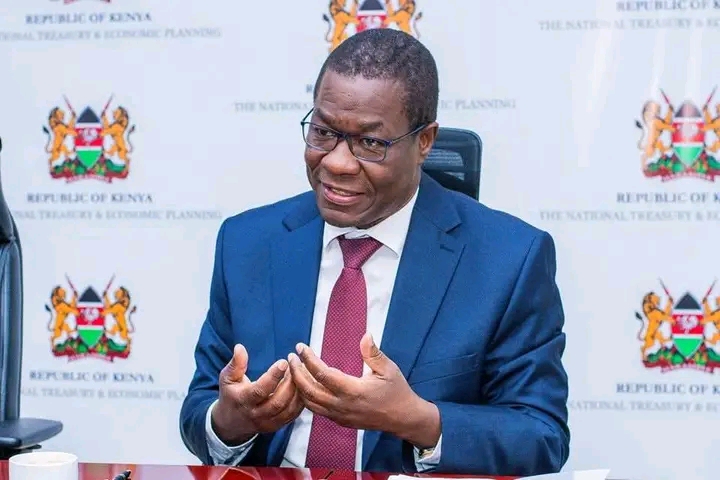
Energy and Petroleum Cabinet Secretary Opiyo Wandayi has defended the government's fuel pricing policies.
The CS insists that Kenya would be paying significantly more for petroleum products were it not for state interventions, including the government-to-government (G2G) fuel importation arrangement and fuel stabilisation subsidies.
Speaking on Radio Jambo on Friday, Wandayi said the government remains committed to lowering the cost of living through targeted interventions in the energy sector.
He confirmed that diesel prices will fall by Sh10 per litre in the next review cycle as directed by President William Ruto and expressed optimism that global market trends could ease pressure on fuel and electricity prices in the coming months.
Below are excerpts of the interview:
Why is fuel expensive in Kenya compared to its East African counterparts?
Before we speak of the price, let's reckon that Kenya has not lacked fuel since the war erupted. We should count ourselves lucky that we have not experienced shortages. As a country, our fuel is imported. As such, the price is determined by market forces. Prices have been going up globally since the war erupted.
Every country has its special needs and plans and ways they are following to fulfil their demand. The G2G fuel importation framework has worked a miracle for us. When fuel lands, its price is defined by the price at the source, freight, premium, insurance and other charges.
Under the framework, the freight and premium component is fixed. It doesn't change despite fluctuations in global prices. It is $78 per tonne for diesel, $84 for petrol and $97 for jet fuel. That has never changed. The same component has moved to nearly $300 per tonne in the global market. Were it not for G2G, we would be talking about something entirely different on fuel prices.
Is the plan to reduce diesel prices by Sh10, as announced by President Ruto, still on?
As an officer working under the government of President William Ruto, my work is to implement instructions issued by the government. The proposal will be fulfilled on June 14. Diesel will go down by Sh10 as instructed. We will do exactly as directed.
Matatu owners increased bus fares after the last review. Will the adjustment lead to a reduction in fares?
If the situation in the Middle East improves, prices will continue going down and that benefit should progressively reach our people. We beseech traders and matatu operators to adjust fares and charges in line with fuel prices. It is unfortunate that we have never seen fare charges fall at the same rate as fuel prices. That is not fair. We expect to see a corresponding reduction in fares whenever fuel prices decline.
In many parts of the world, prices are left entirely to market forces. In Kenya, however, we regulate fuel prices through various interventions, including support from the Petroleum Development Levy. If we left everything to market forces, Kenyans would suffer more.
We spent Sh6.2 billion during the April-May cycle and another Sh7.7 billion during the May-June cycle to stabilise prices. That is not a small amount of money. Besides the levy, the government previously reduced VAT on fuel by 50 per cent to cushion consumers.
Does this mean that without government intervention, Kenyans would be paying much higher prices?
If the government did not intervene, Kenyans would be buying fuel at around Sh272 per litre. Diesel consumption is usually high in the Northern Hemisphere during winter. Once consumption rises, prices also increase. Winter is now receding, and we expect prices to progressively come down.
We must also understand that several refineries were affected, and this had varying effects on different petroleum products. That contributed significantly to the supply challenges witnessed globally. We are not living in normal times, but we have faith that things will improve.
There were claims that substandard fuel was delivered into the country. What happened?
I would not want to say much because the matter is under active investigation. What is important is that once we detected a lapse, action was taken immediately and investigations are continuing. As a government, we have streamlined procurement under the G2G arrangement. The summary of the problem is that some fuel was imported outside the G2G framework. The investigations will establish the full circumstances, and appropriate action will be taken.
What happened to the Turkana oil project?
That is a very important question to me. Turkana oil was discovered more than 15 years ago in the South Lokichar Basin. However, because of administrative challenges and the high cost of extraction, commercial production has not started. It is a major investment. Tullow Oil was unable to proceed because of the huge capital requirements involved. We have now taken a new route, and we are pleased that Gulf Energy acquired Tullow Oil's interests.
I am the first Cabinet Secretary to approve the Field Development Plan for the Turkana oil project, as required by law, and Parliament has already ratified it. We are now at a different stage as we prepare for full commercial production. We are confident that oil will start flowing before the end of this year.
We have put adequate measures in place and, if all stakeholders work together, Kenya will soon begin exporting crude oil. At the moment, we do not have a refinery, but we hope to have one in the future so that we can process our own crude locally.
Electricity costs remain high. What is the problem, and can it be addressed?
We have put in place several mechanisms aimed at reducing electricity costs. On Wednesday, together with my colleagues, we announced the suspension of the proposed fuel cost charge review so that we do not add to the burden already facing Kenyans. Electricity prices would have gone up because Kenya Power had requested the Energy and Petroleum Regulatory Authority to review some charges upward. They argued that transmission costs had increased.
However, I advised them to explore alternative ways of addressing those challenges, including improving operational efficiencies, instead of passing the burden to consumers. That decision was taken specifically to cushion Kenyans. The biggest challenge remains transmission and distribution losses.
We have also expanded electricity generation capacity through new strategies and investments. If we successfully reduce transmission losses and improve efficiencies across the sector, we will keep electricity prices stable. I do not foresee an increase in electricity prices in the near future. Had we not intervened, prices would have risen. We want to maintain stability as we continue implementing reforms.
You have said fuel prices are likely to fall. How long will Kenyans have to wait?
As the government, our role is to create a conducive environment for players in the sector to import fuel and to ensure consumers are protected from overpricing. Our expectation is that when global prices decline, the benefits should trickle down directly to Kenyans. Price movements can be monitored every minute because they are influenced by global developments.
What we are doing is ensuring the necessary policy interventions are put in place at the right time. As international market conditions improve, we expect local consumers to benefit through lower fuel prices and reduced pressure on the cost of living.