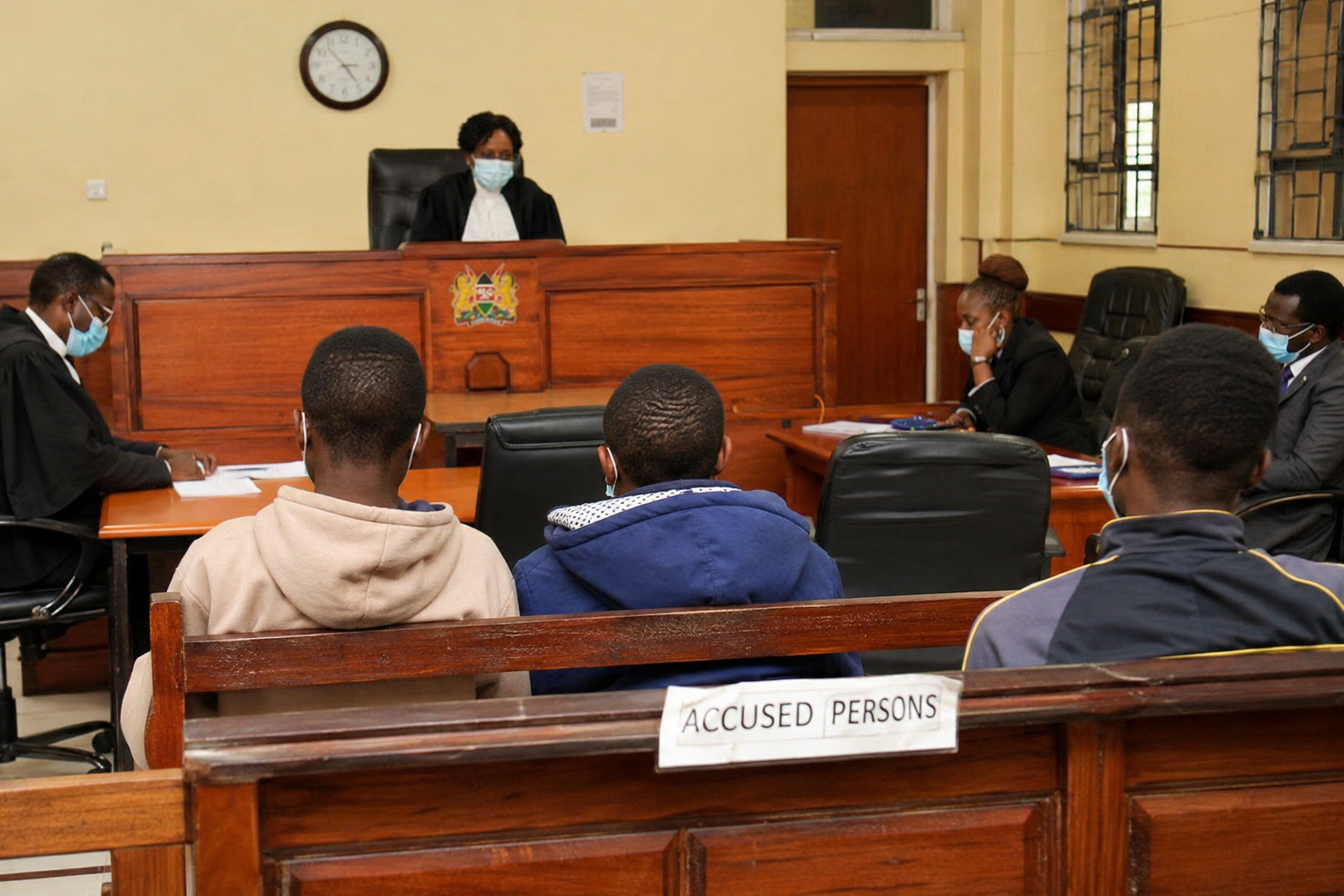
 A group of underage children facing charges in a court of law/AI ILLUSTRATION
When a child is arrested in Kenya, the law requires authorities to treat the case differently from that of an adult suspect.
From the moment of arrest to trial and sentencing, the justice system is expected to place the child's welfare, rehabilitation and future prospects at the centre of the process.
While children can be held accountable for criminal conduct, Kenyan law recognises that they are still developing and should be treated in a manner that promotes correction rather than punishment.
The issue has increasingly attracted public attention as more questions emerge about what happens when minors come into conflict with the law.
Can a child be arrested? Can they be charged in court? Can they be jailed? What rights do they have? And what happens after conviction?
The answers lie in the Constitution, the Children Act, 2022 and international conventions to which Kenya is a signatory.
One of the most important provisions under the Children Act concerns the age of criminal responsibility.
Under Section 221 of the Act, "a person under the age of 12 years shall not be criminally responsible for any act or omission."
The law further states that a child who commits an offence while under the age of 14 is presumed not to be capable of differentiating between right and wrong unless a court is satisfied otherwise through evidence.
“A child who commits an offence while under the age of fourteen years shall be presumed not to be capable of differentiating between right and wrong, unless the Court is satisfied on evidence to the contrary,” it states.
This means that before a child can be held criminally responsible, courts must consider both age and maturity.
The provision marked a major shift from the previous legal framework, which had set the age of criminal responsibility at eight years.
Child rights advocates welcomed the reform, arguing that it better reflects scientific evidence showing that young children often lack the mental and emotional capacity to fully understand the consequences of their actions.
But what happens when a child above the age of criminal responsibility is suspected of committing an offence?
Unlike adults, children are entitled to special protections from the moment they come into contact with law enforcement.
The Children Act guarantees a child offender the right to privacy during arrest, investigations and court proceedings.
The law prohibits the publication of information that may identify a child accused of an offence.
This explains why media houses generally do not publish names, photographs or other identifying details of minors facing criminal charges.
The rationale is simple: society has an obligation to protect children from lifelong stigma arising from mistakes committed during childhood.
After arrest, the child must be informed of their rights in a language they understand.
Section 233 of the Children Act requires the court to inform the child of several key rights at the commencement of proceedings.
These include the right to remain silent, the right to have a parent, guardian, close relative or probation officer present, the right to legal representation and the right to legal aid.
“The Children’s Court shall at the commencement of the proceedings in court, inform the child in a language that the child understands of the right to remain silent, the right to have a parent, guardian, close relative or probation officer present at the proceedings, the right to legal representation, the right to legal aid,” the section reads.
Legal experts say these safeguards recognise that children often lack the knowledge and confidence required to navigate the criminal justice system on their own.
“Responding to the Utumishi Girls’ tragedy, Kisumu Senator Tom Ojienda said it is important to establish whether these girls had the intention to commit some pf the alleged offences.
“They may not have fully considered the consequences of their actions,” Ojienda said recently during a TV interview.
If charges are eventually preferred against the child, the case is generally heard in a Children's Court.
Children's Courts are specialised courts established to deal with matters involving minors. Proceedings are designed to be less intimidating than ordinary criminal courts, and judicial officers handling such cases are expected to apply child-sensitive procedures.
Speaking in November, 2025, Chief Justice Martha Koome said the Judiciary would continue strengthening the children's justice system to ensure children's cases are heard and concluded within legally prescribed timelines.
“We will continue strengthening the Office of the Deputy Registrar of the Children’s Court and ?ensuring that children’s cases are heard and concluded within the legally mandated period of six ?months,” she stated.
The law also provides important guarantees once a child has been charged.
Under Section 235 of the Children Act, every child accused of violating the law must be informed promptly of the charges against them, be provided with legal assistance by the state, have the matter determined without delay, and not be compelled to testify or confess.
The child is also entitled to an interpreter where necessary and has the right to privacy throughout proceedings.
If the child has a disability, the court is required to provide reasonable accommodation to ensure meaningful participation in the proceedings.
One of the major differences between adult and juvenile justice systems is the emphasis on diversion.
Diversion refers to measures that steer children away from formal court processes where appropriate.
Rather than proceeding directly to trial, authorities may explore counselling, mediation, family interventions, community-based programmes and other rehabilitative approaches.
The objective is to ensure that youthful mistakes do not unnecessarily expose children to the damaging effects of prolonged criminal proceedings.
Where a matter proceeds to full hearing and a child is found responsible for an offence, the court's focus remains significantly different from that applied to adult offenders.
The juvenile justice system is anchored on the principle that children have a greater capacity for reform and should be given opportunities to reintegrate into society.
As a result, courts may consider a range of rehabilitative measures depending on the circumstances of the case.
These may include counselling programmes, probation supervision, educational interventions, vocational training, family-based rehabilitation initiatives and community service programmes.
The overarching objective is not merely to punish but to correct behaviour and address underlying social, educational or psychological factors that may have contributed to the offending conduct.
The law also seeks to minimise detention.
Where a child is not released on bond, Section 235 provides that they should be placed in a Children's Remand Home or Child Protection Unit rather than facilities meant for adults.
This separation is intended to protect children from abuse, exploitation and negative influences that may arise from mixing with adult offenders.
The Children Act also recognises that the justice process itself can be traumatic for minors.
That is why proceedings are designed to protect privacy, minimise exposure to public scrutiny and ensure that children understand what is happening at every stage.
The law's insistence on parental involvement, legal representation and child-sensitive procedures reflects a broader recognition that children require support, guidance and protection even when accused of wrongdoing.
Ultimately, Kenya's juvenile justice system seeks to balance two important objectives-accountability and rehabilitation.
Children who break the law are expected to take responsibility for their actions.
However, the law equally acknowledges that childhood is a period of growth, learning and change.