When Czech Prime Minister Petr Fiala made a historic visit to Nairobi in November 2023, the first ever by a Czech premier, the trip attracted little national, let alone global, attention.
Yet nearly three years later, the steady deepening of ties between Kenya and the Czech Republic is increasingly reflecting a broader shift in Nairobi’s foreign policy: the quiet building of a network of strategic middle-power alliances across Central Europe, the Gulf and Eurasia.
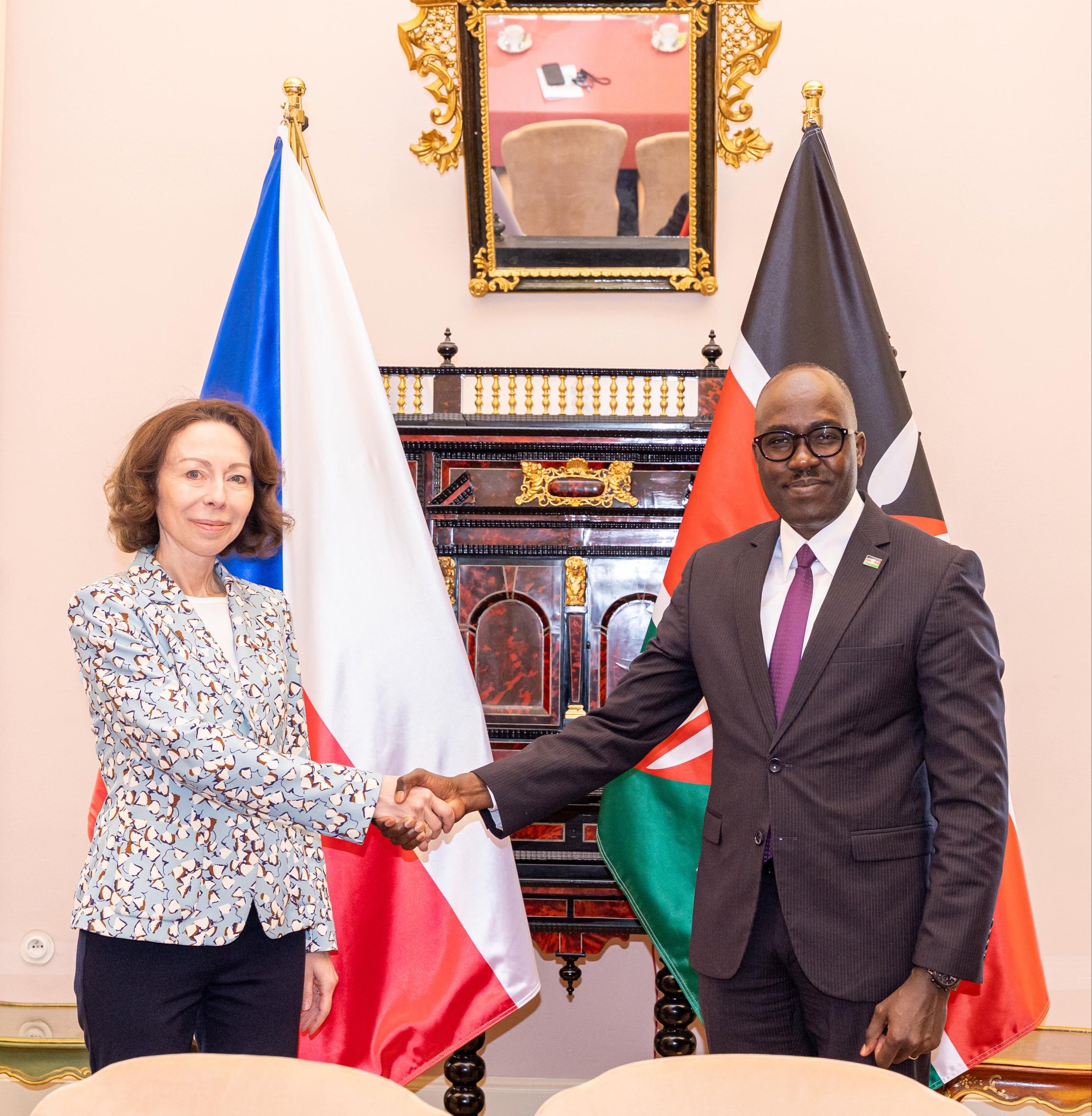
The latest sign came this week in Prague, where Foreign Affairs PS Korir Sing’oei held talks with Czech Deputy Foreign Affairs Minister Marie Chatardová.
The respective statements issued by both sides celebrated the rapidly growing trade ties, conservation partnerships and expanding diplomatic cooperation.
“We celebrated over three decades of deepening diplomatic ties and welcomed our surging economic cooperation, highlighted by a 24.3 per cent annual growth in Kenyan exports over the past five years,” Korir said.
He also took note of the “landmark” Double Taxation Avoidance Agreement signed in September 2025, while reaffirming the strong shared alignment across multilateral fora.
Additionally, the PS noted that beyond trade, the bilateral partnership is delivering meaningful impacts in conservation, human capital and culture.
“I expressed Kenya’s profound gratitude for the historic ‘Return of the Bongos’ mission last month, which brought four critically endangered mountain bongos to the Mount Kenya Wildlife Conservancy,” Korir said.
He also acknowledged “a decade of invaluable Czech medical scholarships for Kenyan students and the eco-conscious Shanga Trails artisan initiative”.
On the other hand, the Embassy of Czech in Nairobi said the discussions highlighted more than three decades of growing Czechia-Kenya relations and the strong momentum in bilateral economic cooperation. “The meeting also reaffirmed the close cooperation between Czech and Kenya across multilateral fora and showcased the tangible impact of our partnership in conservation, education and culture,” the embassy said.
It also echoed the conservation partnership through the ‘Return of the Bongos’.
“We are pleased that Dr Sing’oei also attended a meeting with the Czech-Kenya Interparliamentary Group," the statement added.
“The Embassy was pleased to see the continued strengthening of the enduring friendship between our two countries, delivering meaningful benefits for both our peoples.”
Kenya is increasingly broadening its international partnerships beyond the traditional Western powers and major global actors that historically dominated its foreign policy engagements.
Instead, Nairobi is cultivating a wider circle of pragmatic relationships with mid-sized states seen as economically useful, strategically flexible and politically less demanding. These include Belarus, Azerbaijan, Kazakhstan, Croatia and Lithuania.
Ties with the Czech seem to be intensifying around conservation, medical training, climate issues, parliamentary diplomacy and education exchanges.
The partnership is part of a trajectory that President William Ruto outlined during Fiala’s Nairobi visit in 2023.
The President pitched Kenya as a strategic gateway for Czech and European investment into Africa through the African Continental Free Trade Area, while urging Prague to establish a commercial hub in Nairobi.
Increasingly, Kenya is pursuing what analysts describe as ‘middle-power diplomacy’ by building flexible relationships with states outside the traditional great-power blocs dominating global politics.
In recent years, Nairobi has intensified engagement not only with Central European states but also with countries in Eurasia, the Gulf and Asia, including Azerbaijan, Kazakhstan, Serbia, Turkey and the UAE.
Kenya’s newer approach appears driven less by ideology and more by economic opportunity, strategic diversification and political flexibility, reflecting Ruto’s economic and commercial diplomacy.
Diplomacy experts argue that such partnerships offer several advantages, such as reducing overdependence on traditional partners, whose relationships with African states increasingly come with geopolitical competition.
The alliances often focus on highly practical cooperation areas, such as trade, technology transfer, climate financing, agriculture, logistics and education, sectors Kenya sees as directly tied to its economic transformation agenda.
The approach allows Kenya to position itself as a diplomatic and commercial connector state between Africa and emerging global centres of influence.
That ambition is becoming increasingly visible in Kenya’s diplomacy.
From hosting the Africa Climate Summit to mediating regional peace processes and pursuing new trade corridors, Nairobi is steadily projecting itself as a regional convening hub capable of linking different geopolitical spaces.
The Czech relationship fits neatly into that foreign policy approach that is also captured in the sessional paper on Kenya Foreign Policy 2025.
It also reflects a growing trend globally where medium-sized states are becoming more important in an increasingly fragmented international order. As major powers become consumed by strategic rivalry and conflict, countries such as Kenya are finding new room to manoeuvre diplomatically by cultivating multiple partnerships simultaneously.