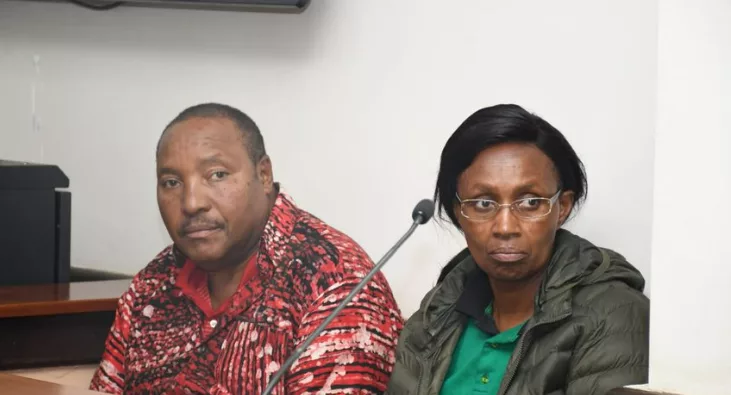
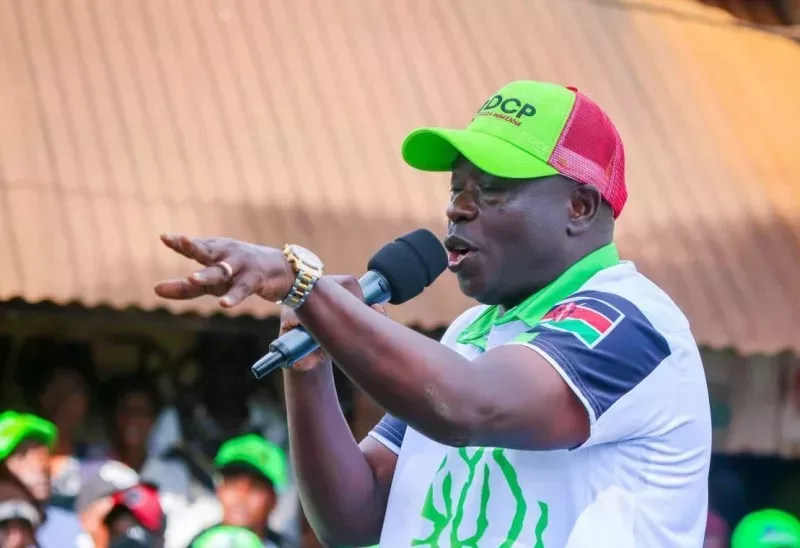
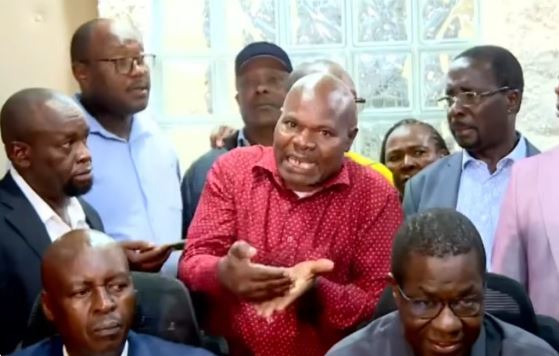
 Kennedy Kaunda, CEO of the East Africa Tour Guides and Drivers Association (EATGDA), speaks during the fuel price talks between transport sector stakeholders and government at Transcom House on May 18, 2026./SCREENGRAB
A high-level government meeting convened to end a nationwide transport crisis instead produced one of the most talked-about political moments in the country.
What was expected to be a carefully managed announcement by senior government officials quickly descended into confusion and open disagreement after a transport sector representative publicly contradicted cabinet secretaries in front of live cameras.
At the centre of the dramatic exchange was Kennedy Kaunda,, CEO of the East Africa Tour Guides and Drivers Association (EATGDA) whose blunt intervention during a televised press briefing instantly transformed him into an online sensation.
His repeated phrase — “with all due respect” — quickly became one of the defining lines of the fuel crisis debate as thousands of Kenyans across social media praised him for directly challenging government officials during negotiations over fuel prices and the nationwide matatu strike.
The confrontation happened during a high-level meeting chaired by Energy Cabinet Secretary Opiyo Wandayi and Transport Cabinet Secretary Davis Chirchir at Transcom House on Monday night.
The talks had been convened amid mounting pressure caused by a nationwide transport strike linked to rising fuel prices.
Matatu operators across the country had kept vehicles off the roads, paralysing transport services and leaving thousands of commuters stranded.
Businesses were affected.
Learning in several areas was disrupted.
Public frustration continued to grow.
The government hoped the late-night meeting would finally produce a breakthrough.
Instead, it produced a moment that would dominate national conversation.
THE MEETING THAT UNRAVELLED ON LIVE TELEVISION
During a joint press briefing after the closed-door discussions, Energy CS Opiyo Wandayi appeared optimistic that progress had been made.
He spoke about concerns surrounding fuel adulteration, particularly the widening price gap between diesel and kerosene.
“One of these issues was the matter of possible adulteration of diesel due to the huge disparity in the prices of diesel and kerosene,” Wandayi said.
“We have come to the understanding that for prudence purposes and to eliminate the risk of fuel adulteration on account of this huge disparity and to save the motor vehicles operating using diesel from possible malfunction, we are going to bridge the gap between the prices of diesel and petrol.”
“That would mean that the price of kerosene would have to go higher as that of diesel comes lower to bridge that gap,” he added.
The remarks appeared to suggest that an understanding had been reached between the government and transport stakeholders.
But moments later, the atmosphere changed dramatically.
Before the Cabinet Secretaries could leave, representatives from the Matatu Owners Association interrupted the briefing and openly rejected the impression that an agreement had been reached.
Then came the moment that would spread rapidly across social media platforms.
“We have not agreed to anything. They gave us 30, according to what they are going to discuss with EPRA, and we had stated 35 up to 30, that was the communication,” Kennedy Kaunda said.
“With all due respect, we respect everyone here; we did not come to set anybody up. We are law-abiding citizens. So there’s no deal. The strike is still on!”
The room immediately fell into visible tension.
The two Cabinet Secretaries stood silently as cameras rolled.
Observers noted that Wandayi appeared visibly uncomfortable as the disagreement unfolded publicly.
What had been intended as a united announcement instead exposed sharp divisions between the government and transport stakeholders.
Within minutes, clips of the exchange flooded social media.
The phrase “with all due respect” became instantly recognisable.
For many Kenyans online, the exchange symbolised something larger than a disagreement over fuel prices.
It became a moment of direct confrontation between ordinary sector representatives and senior government officials.
THE FUEL CRISIS BEHIND THE STANDOFF
The dramatic exchange did not happen in isolation.
It came amid growing national anger over fuel prices and the rising cost of living.
The nationwide strike by matatu operators had already caused widespread disruption.
Commuters in several towns struggled to access transport services.
Many workers were unable to report to work.
Parents faced difficulties taking children to school.
Business operations slowed in multiple urban centres.
Transport operators argued that fuel prices had become unsustainable.
Diesel prices, in particular, had become a major point of contention because matatus and commercial transport vehicles depend heavily on diesel.
The Energy and Petroleum Regulatory Authority later announced fuel price adjustments that reduced diesel prices by Sh10 to Sh232.86 per litre.
At the same time, kerosene prices increased by Sh38.60 to Sh191.38 per litre.
But the reduction failed to calm tensions.
Transport stakeholders maintained that the changes were insufficient.
The disagreement over the scale of the reduction became one of the central issues during the Transcom House negotiations.
According to Kaunda, transport stakeholders had communicated their position clearly.
He said operators wanted a much larger reduction before any agreement could be reached.
The gap between what the government proposed and what the sector demanded ultimately collapsed the negotiations.
THE MAN BEHIND THE VIRAL MOMENT
As clips of the confrontation spread online, many Kenyans began asking the same question:
Who exactly is Kennedy Kaunda?
The transport sector official quickly became one of the most discussed personalities in the country.
His calm but firm delivery during the confrontation attracted widespread attention.
For many Kenyans frustrated by the fuel crisis, he represented a rare public figure willing to openly challenge the government during live negotiations.
Reports identified him as the Group CEO of the Tourist Guide Association.
Although he was not previously a nationally recognised public figure, his intervention instantly elevated him into the centre of national political discussion.
His repeated use of the phrase “with all due respect” became a defining slogan online.
Memes, posts, commentary clips, and reactions flooded social media platforms.
Many users praised him for refusing to endorse what he believed was an inaccurate representation of the talks.
Others described him as fearless.
Some referred to him as the voice of ordinary Kenyans struggling with rising fuel costs.
What made the moment especially powerful for many viewers was the setting.
The disagreement unfolded directly in front of senior Cabinet officials and national television cameras.
There was no attempt to soften the disagreement.
There was no diplomatic language designed to hide the tension.
Instead, Kaunda directly contradicted the government’s public position.
That bluntness became the reason the clip spread so rapidly.
Kaunda's East Africa Tour Guides and Drivers Association (EATGDA) is a professional and non-political association that unites practicing tour guides, naturalists, and driver-guides across Kenya and the broader East African region.
The organisation advocates for professional standards, certification, and welfare improvements for drivers and guides operating within the tourism sector. It also works closely with institutions such as the Kenya Wildlife Service and the Tourism Regulatory Authority to improve recognition and working conditions within the industry.
While not directly affiliated with matatu leadership groups such as the Matatu Owners Association, Kaunda attended the negotiations because tour operators and tourism transport providers have also been heavily affected by fuel price increases.
“I DIDN’T SEE THIS COMING”
As public attention intensified, Kaunda later spoke in a follow-up interview where he reflected on the viral moment.
“With all due respect, I didn’t see this coming,” he said.
The phrase immediately reinforced the slogan that had already become associated with him.
During the interview, he defended his intervention and insisted that his actions were motivated by accountability and honesty.
According to Kaunda, the nearly five-hour meeting had involved detailed discussions between government officials and transport stakeholders.
However, he maintained that there had been no final agreement.
“The clarion call was that we postpone and go back to consult,” he explained.
“Thereafter, they said they needed to go back because we had not agreed with the offer they had given us. So we agreed to call the media to issue a press statement, which we all agreed.”
Kaunda said he became concerned when government officials later appeared to present the discussions as if a deal had already been reached.
“When the CSs came into the boardroom, I was taken by surprise,” he said.
“Being as I am, I am a trained guy to give correct, authentic information. I was taken by surprise that we had reached an agreement.”
“That is what led me, and my conscience, to talk to the nation that has been affected by the fuel increment to state it the way it is.”
The explanation only strengthened support among many Kenyans online.
To supporters, his remarks suggested that he had acted out of principle rather than politics.
Many praised him for insisting on clarity during a moment of national tension.
SOCIAL MEDIA TURNS KAUNDA INTO A SYMBOL
As the video spread online, thousands of Kenyans weighed in on the confrontation.
The reactions transformed Kaunda from an unknown transport stakeholder into a national talking point.
Some users compared his actions to the type of leadership they believed was missing among elected officials.
X user Protus Onyango wrote:
“If MPs had the courage of this man — who has used a minute to stand with millions of Kenyans — they could have not allowed this govt to run roughshod on the electorate. But they are selfish & only think about themselves, families & cronies.”
Another user criticised government leadership during the crisis.
“The circus by the so-called experts continues. How can people with no moral decency lead Kenya out of this fuel crisis when their own incompetence is what pushed the country here in the first place? A major disappointment, though not unexpected, from the CS for Energy and the Treasury.”
Nelly Githambo also weighed in.
“The Cabinet Secretaries are surprised they are being read for filth on live TV. The government is so used to having its own way they thought the matatu guys would just play along. The narrative here would have been the matatu welfare agreed but then want to hold the government hostage tomorrow. Protect this man at all costs. He’s the true embodiment of Kenyan heroism.”
Another user focused specifically on the now-famous phrase.
'This is the best use of ‘With all due respect".' Opiyo and Chirchir are clearly not used to being told the truth to their faces. They look utterly shocked.”
The reactions highlighted growing public frustration over fuel prices and the broader cost of living.
For many Kenyans, the exchange reflected a wider feeling that ordinary citizens were no longer willing to quietly accept official explanations during periods of economic hardship.
KAUNDA DENIES ‘BROWN ENVELOPE’ CLAIMS
Kaunda has denied claims that he or other transport sector representatives received a “brown envelope” to call off a planned strike over fuel prices.
He said no agreement had been reached yet and insisted that commuters and operators were still struggling with the high cost of fuel.
Kaunda noted that commuters were suffering as many vehicles were operating with few passengers because people could no longer afford transport costs.
“We had goodwill, and that was the goodwill we gave out after seven days. Whether the brown envelope was given to me or anybody else, I have not seen the envelope. The commuters are crying. Even when you look at the vehicles, they are empty. They are going to town and coming out of town empty,” he said.
This comes amid allegations that some members of the transport sector were bribed to suspend protests over rising fuel prices.