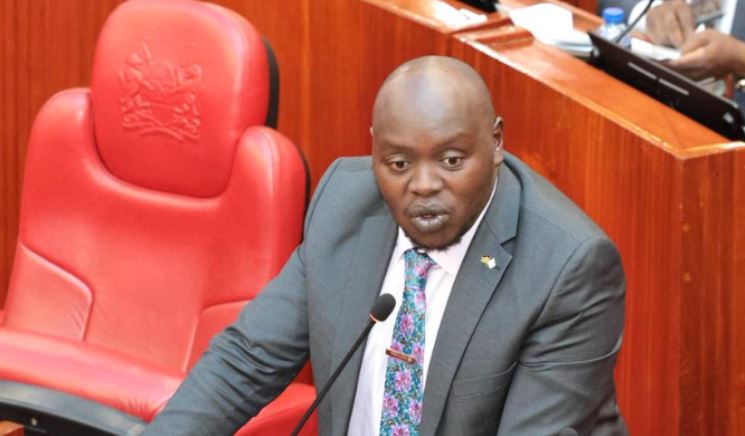
 Nandi Senator Samson Cherargei. /SCREENGRAB
Calls for value addition in miraa to maximise revenue have now reached Parliament, with Nandi Senator Samson Cherargei proposing the production and consumption of miraa juice within the Parliamentary menu.
Speaking on Tuesday during debate on the Narcotic Drugs and Psychotropic Substances Control (Amendment) Bill by Meru Senator Kathuri Murungi, Cherargei said the leaves and succulent stems of the plant could be harnessed for juice and even incorporated into refreshments served at the Parliament café.
"If we pass this Bill and I know we will pass it, in our availability of drinks in Parliament, I'm proposing that we should include miraa juice so that we can start taking and Kenyans can take the lead because it's not psychotropic substance," he said.
Miraa consists of long, succulent stems with small leaves, which are typically peeled and chewed.
Although it differs from muguka, which is considered more potent, both are varieties of the same plant species, Catha edulis, and act as stimulants.
The two substances are classified as psychoactive drugs by the National Authority for the Campaign Against Alcohol and Drug Abuse (Nacada) and the Ministry of Health, with reported side effects including insomnia, high blood pressure and anxiety.
Predominantly grown in Meru county, miraa is more expensive and is often regarded as a premium product, frequently transported by air to distant markets.
Together, miraa and muguka are estimated to inject about Sh13 billion into the economy, though stakeholders have repeatedly argued that their current presentation limits broader market appeal, strengthening calls for value addition.
"The first person who will assist us in testing that juice will be deputy speaker (Murungi), Senator Mundiki and yours truly. I will be the third person. We will only consume water, soda, miraa juice and milk, of course, but other things will be exceptional," Cherargei said.
"We need to expand our menu because I'm told it's good for the body and the soul, and it can assist you in other engagements, especially after 6 pm and 6 am."
Nacada classifies miraa (khat) as a harmful drug and a leading substance of abuse in Kenya, citing its health impacts and association with substance use disorders.
While acknowledging its economic importance, the agency has historically pushed for tighter regulation, opposed its processing into new products and sought to restrict its usage.
However, advocacy for legalisation and value addition of miraa and its byproducts has gained traction in recent years.
In 2024, a team of researchers from Meru University of Science and Technology developed an energy drink from muguka and wine from miraa, in an effort to demonstrate potential commercial applications of the crops.
The research team also produced chewing gum from both products. Prof Joshua Arimi said the innovations led to the development of products including a wine christened Miraa Bamboocha and a Muguka Energy Drink.
Their work focused on nutritional and chemical composition analysis, with findings indicating that both plants contain significant levels of polyphenols and other bioactive compounds.
Polyphenols are naturally occurring micronutrients associated with fibre content and nutraceutical properties, substances derived from food sources believed to have nutritional or therapeutic effects.
Prof Arimi said the initiative was intended to demonstrate value addition potential, noting that the raw plant materials are not visually or commercially appealing to some consumers.
He urged the government to increase funding for miraa research to further explore its benefits.
“We are expounding to see what benefits the other compounds have but we think there are other benefits we can derive from the plant,” the professor said.
Beyond polyphenols, miraa is believed to contain more than 50 other macronutrients.
A pharmacological and herbal researcher who was part of the team of scientists at the university dismissed claims linking the stimulant to mental illness, questioning regional disparities in reported effects.
"How does it make people zombies in Mombasa and not in Embu and Meru? There must be another thing that is contributing to that behaviour and mannerism in Coast and not miraa and muguka,” Arimi concurred.