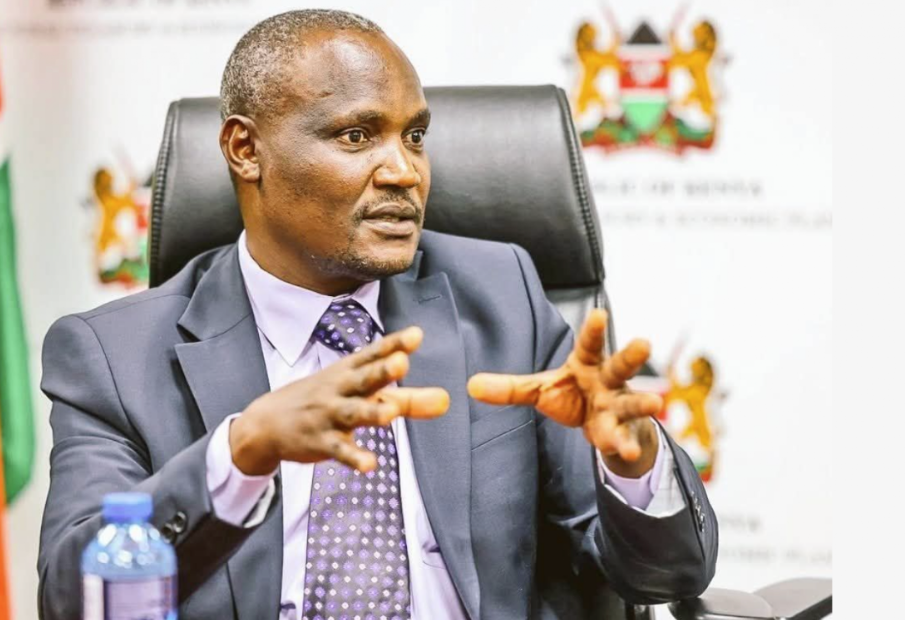
PRESIDENT William Ruto has steered the country through
turbulent times compared to his predecessors, Treasury CS John Mbadi now says,
dismissing critics of the slowdown in growth last year.
The Economic Survey 2026 by the Kenya National Bureau of Statistics (KNBS), released last week, indicates the country’s economic growth was recorded at 4.6 per cent.
This was a slight drop from 4.7 per cent in 2024, as key sectors of the economy grew, but at a slower pace compared to the previous year.
Mbadi has also dismissed claims of inconsistencies between official
government data and figures cited by President William Ruto.
In a detailed explanation of recent statistics, Mbadi said
apparent discrepancies stem largely from differences in measurement standards
and selective interpretation of data, rather than any contradiction within
government.
On maize production, one of the key areas cited in the debate, Mbadi said confusion arose from the use of different bag sizes as units of measurement.
While some government communications referenced 50-kilogramme bags, the Kenya National Bureau of Statistics (KNBS) reports production using 90-kilogramme bags to ensure consistency. Standardised to the 90kg unit, Mbadi said maize output has shown a clear upward trend.
He said production rose from 34.2 million bags in 2022 to 47 million in 2023, before easing slightly to 44.8 million in 2024 and improving to 45.8 million in 2025.
He attributed the gains to government interventions, noting that production remained resilient even in the face of drought due to favourable conditions in key growing regions during the main planting season.
“The government has increased maize production significantly. These are facts captured in official data,” Mbadi said.
He acknowledged that not all agricultural sub-sectors performed equally, with sugarcane and tea production affected by adverse weather and structural disruptions, including the leasing of state-owned sugar factories.
Mbadi also pushed back against claims that job creation figures in the housing sector had been overstated. He said the discrepancy arose from comparing formal sector employment data with broader figures that include informal jobs.
According to Mbadi, the 238,000 jobs often cited refer only to formal employment within the construction sector.
When informal sector jobs are included, total employment creation rises, with the Economic Survey 2026 indicating the economy created 822,100 jobs last year, with housing accounting for a significant share.
“The figures being compared are not equivalent. Once you aggregate both formal and informal employment, the numbers align,” he said.
Similarly, he clarified that housing delivery figures differ depending on whether they refer to units under construction or completed units, urging analysts to consider the full dataset before concluding.
On broader economic indicators, Mbadi pointed to steady improvements in per capita income, which rose from Sh194,000 in 2022 to Sh214,000 in 2025. He also highlighted declining inflation, which eased from an average of 7.7 percent in 2022 to 4.1 percent in 2025.
The combined effect, he said, has been a turnaround in real earnings—which account for inflation—from negative 3.1 per cent in 2022 to positive two per cent in 2025.
“This is a key indicator of improved living standards, yet it is not receiving the attention it deserves,” Mbadi said.
He acknowledged that overall economic growth slowed slightly to 4.6 per cent in 2025 from 4.7 per cent the previous year, but maintained that the performance remains solid given prevailing conditions.
The slowdown in the fourth quarter, he explained, was largely driven by weaker growth in agriculture, manufacturing, and transport.
Agriculture, which accounts for about 26 per cent of GDP, was affected by drought, while food manufacturing slowed in line with reduced agricultural output and transitional disruptions in the sugar sector.
Agriculture is key to Kenya's economy, indirectly through linkages with other sectors, including manufacturing sub-sectors such as agro-processing and food products.
The sector employs more than 40 per cent of the total population and more than 70 per cent of Kenya's rural people. Transport performance was also hit by challenges at Kenya Airways, where aircraft servicing delays led to a sharp contraction in air transport activity.
Construction activities rebounded from a 0.7 per cent contraction in 2024 to a 6.8 per cent growth in 2025.
The mining and quarrying sector also recovered from a 7.8 per cent contraction in 2024, growing by 14.9 per cent in the period under review, partly due to a significant increase in production of minerals used in cement production, with other key sectors also remaining resilient amid growth.
Despite these pressures, Mbadi said all sectors of the economy recorded growth in 2025, albeit at varying rates.
“So if you look at all this, then the economic performance of 2025 was much better than 2024, even though there is that 0.1 drop,” Mbadi told Journalists in Nairobi.
Mbadi further cautioned against direct comparisons of the current administration’s performance with previous governments, arguing that economic conditions have been markedly different.
He cited the lingering effects of the Covid-19 pandemic, the Russia-Ukraine war, the worst drought in four decades, domestic unrest in 2024 (Anti-Finance Bill protests by the GenZ), and the current Middle East conflict as major shocks that have weighed on the economy.
“You cannot compare periods of stability with periods of multiple global and domestic shocks. It is comparing apples and oranges,” he said.
Mbadi maintained that, despite these headwinds, the economy has remained resilient.
“For an economy the size of Kenya, a growth rate of 4.6 per cent is not insignificant,” he said, adding that the government’s focus remains on sustaining growth while managing external risks.




Comments 0
Sign in to join the conversation
Sign In Create AccountNo comments yet. Be the first to share your thoughts!