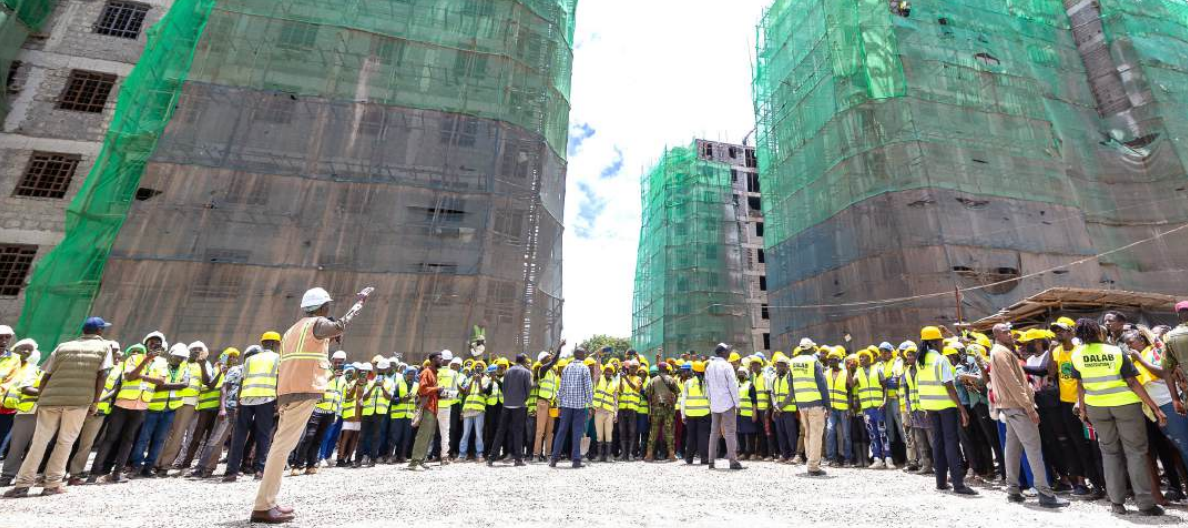
 President
William Ruto, during the
inspection of
the Bustani
Affordable
Housing project
in Thika Town
on March 27
/HIRAM OMONDI
/PCS
President
William Ruto, during the
inspection of
the Bustani
Affordable
Housing project
in Thika Town
on March 27
/HIRAM OMONDI
/PCS
KENYA recorded 822,100 new jobs in 2025, even as economic growth eased to 4.6 per cent, pushing total employment to 21.6 million, according to latest government data.
The new jobs as per the Economic Survey 2026 pushed total employment excluding small-scale agriculture up from 20.8 million in 2024.
However, the vast majority of these jobs — over 87 per cent — were in the informal sector, pointing to the persistent challenge of formal job creation in the country.
Compared to 2024, the Economic Survey 2026 shows that formal employment recovered last year even though it was at a slower growth rate, only rising by four per cent to 3.5 million.
Treasury Cabinet Secretary John Mbadi said that despite the rise in job openings, the economy expanded by 4.6 per cent in 2025, slightly down from 4.7 percent in 2024, with Gross Domestic Product (GDP) rising to Sh16.2 trillion.
“The Kenyan economy is now valued at Sh17.6 trillion, while GDP per capita stands at $2,549, or (Sh329,330). Growth remained relatively stable through the first three quarters of the year, averaging about 4.8 to 4.9 per cent, before slowing sharply to 4.0 percent in the fourth quarter,” Mbadi said.
At 4.6 per cent growth, this was the second consecutive year of deceleration from 4.7 per cent in 2024 and 5.7 per cent in 2023.
The figures, published by the Kenya National Bureau of Statistics, paint a picture of an economy that is both struggling to maintain growth and to translate it into high-quality, formal employment opportunities.
According to Mbadi, investments in affordable housing and easing interest rates has spurred the growth in the construction sector which emerged among the countries top employment creators.
Among the key drivers of job creation in 2025 was the construction sector, which rebounded strongly, growing by 6.8 per cent from a contraction of 0.7 per cent in 2024.
The sector employed approximately 283,300 people, supported largely by government-backed infrastructure projects and the affordable housing programme.
“Loans and advances from commercial banks to the construction sector rose from Sh576.3 billion in 2024 to Sh646.5 billion in 2025. Over the same period, cement consumption grew by 20.3 per cent to 10.3 thousand metric tonnes,” said KNBS director general Macdonald Obudho.
Employment also increased, with private sector jobs rising by 2.1 per cent to 228.2 thousand persons in 2025, while public sector employment grew from 9.9 thousand in 2024 to 10.1 thousand in 2025.
Mbadi attributed some of these this recovery to targeted policy interventions, including financing for stalled road projects and renewed investment in housing.
“The affordable housing scheme is contributing significantly to economic growth and also to employment and job creation,” he said.
“The revival of construction activity has had spillover effects across the economy, stimulating demand in related industries such as cement production, transport, and financial services.”
Despite modest growth of 2.1 per cent, the manufacturing sector remains a critical pillar for job creation, employing about 388,600 people.
Data from KNBS suggests that manufacturing holds the greatest potential for expanding formal employment, particularly if the country strengthens value addition and reduces reliance on imports.
Obudho noted that manufacturing accounts for the largest share of private sector employment by industry, making it a strategic sector for job expansion.
“If we are looking for areas that can employ more people quickly, manufacturing is key,” he said.
However, the sector continues to face headwinds, including high production costs, energy prices, and competition from imported goods. Agro-based industries, in particular, contracted by 1.2 per cent, largely due to declining agricultural output.
Agriculture, which contributes over 23 per cent of GDP, remains a major employer but experienced slower growth of 2.8 per cent in 2025.
A severe drought in the final quarter of the year significantly affected production, reducing overall sector performance.
The slowdown had ripple effects across the economy, impacting manufacturing, transport, and trade sectors that are closely linked to agricultural output.
Mbadi noted that the drought led to a decline in agricultural growth from 4.4 per cent to 3.1 per cent, contributing to the overall easing of GDP growth to 4.6 per cent in 2025 from 4.7 per cent in 2024.
“Because agriculture is a key source of livelihoods, particularly in rural areas, weather-related shocks continue to pose a major risk to employment stability,” the CS said.
Despite the slowdown in economic activity, data by KNBS shows that economic output continued to expand.
GDP rose by 8.6 per cent from Sh16.2 trillion in 2024 to Sh17.6 trillion in the review year, representing an increase of Sh1.4 trillion in nominal terms.
The financial and insurance sector emerged as the strongest driver of growth, expanding by 6.5 per cent, supported by stronger lending activity and sustained demand for financial services.
Real estate followed at 3.9 per cent, while transport and storage grew by 3.7 per cent.
Wholesale and retail trade recorded a growth of 3.6 per cent, while agriculture, forestry and fishing posted a 3.1 per cent expansion, rounding out the top five sectors contributing to overall economic performance during the review period.
The agriculture sector, which remains at the core of Kenya’s economy, grew at a slower pace of 2.8 per cent, a drop from 4.3 per cent in the year before, on falling production of wheat and tea.
The manufacturing sector also slowed, expanding by 2.1 per cent compared to 3.2 percent in 2024.
Kenya’s services sector remains the backbone of the economy and a major contributor to employment. Key sub-sectors such as financial services, ICT, wholesale and retail trade, and transport continued to expand, supporting job creation.
While ICT contributed Sh404.7 billion in value add, internet subscriptions rose by 11.5 per cent to 64.4 million, while mobile subscriptions increased to 78.4 million, reflecting rapid digital adoption.
“This digital expansion is reshaping the labour market, enabling new forms of work in e-commerce, digital services, and gig economy platforms, many of which fall within the informal sector,” Obudho said.
Despite the creation of over 800,000 jobs, Kenya’s rapidly growing population means that the labour market remains under pressure.
Each year, hundreds of thousands of young people enter the job market, intensifying the need for sustained creation of opportunities.
The current pace of job growth, while significant, may not be sufficient to absorb all new entrants into the labour market, particularly into formal employment.
This underscores the importance of policies aimed at accelerating industrialisation, supporting MSMEs, and improving the business environment to stimulate private sector hiring.
“The government’s economic strategy, aligned with Kenya Vision 2030 and the Bottom-Up Economic Transformation Agenda, places job creation at the centre of economic policy,” Mbadi said.
He noted that sectors like agriculture and food security, MSME development, affordable housing, healthcare and digital economy are expected to drive inclusive growth and expand employment opportunities in the coming years.
“Growth will be driven by the government’s development agenda, with the aim of accelerating economic transformation and promoting inclusive growth,” he said.
Even as the state celebrates creating jobs during a tough operating environment, the quality of employment remains a critical concern. The dominance of informal jobs raises questions about income security, productivity, and long-term economic sustainability.
Several tax lobby groups have questioned the viability of growing employment in informal sector which makes them hard to tax.