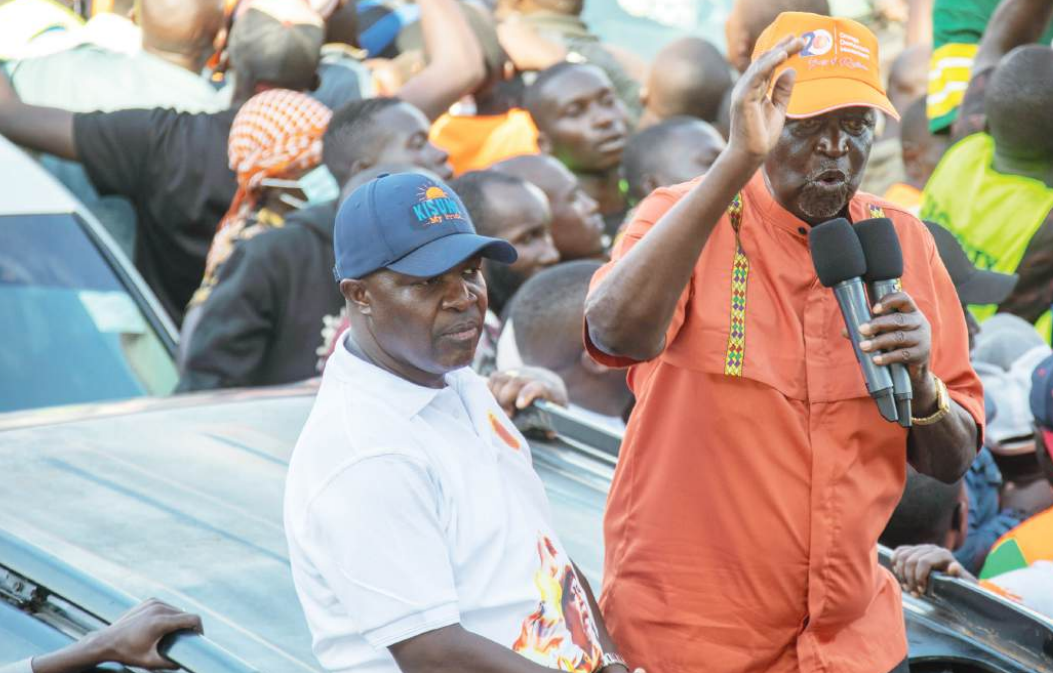
A fresh power struggle is playing out within ODM as the two rival factions train their sights on traditional strongholds associated with former party leader Raila Odinga.
The rival teams are engaged in a silent but vicious coordinated push to win over the party’s grassroots structures that were loyal to Raila.
Oburu will on Sunday lead a strong team of the mainstream party leaders to Malindi in Kilifi county for the second leg of the youth convention.
Sifuna, on the other hand, will be leading the ODM splinter group consisting of Siaya Governor James Orengo and Embakasi East MP Babu Owino to a rally in Vihiga on Saturday.
The team will then cross to the lakeside city of Kisumu for a major political rally to popularise their breakaway faction and explain to supporters why they are opposed to the dalliance between President William Ruto and the team led by Oburu.
The twin tours underscore an intensifying battle for influence within the party, with both camps keen to position themselves as the legitimate heirs to ODM’s political base.
Coast and Western are long considered a crucial voting bloc for the party and delivered for Raila to almost a man.
In the last presidential elections, Ruto got 77,331 votes, trailing Raila, who garnered 204,536 votes. In Vihiga, Raila won with 114,714 votes against Ruto’s 67,633.
In recent weeks, the factions have ramped up public engagements, holding rallies and consultative meetings aimed at energising supporters and outflanking each other.
Last week, the Linda Mwanchi team were in Nakuru, where they pulled a mammoth crowd. Before the Nakuru blitz, they were in Mombasa – another Raila stronghold.
On the other hand, the Oburu team were in Nairobi’s Jamhuri grounds for the first leg of the youth convention meant to consolidate support and listen to the views of the youths on the leadership of the party.
Observers say the outreach is part of a broader strategy to entrench dominance ahead of upcoming party processes, even as internal wrangles continue to simmer.
Political analyst Prof Gitile Naituli has weighed in on the ongoing succession contest within ODM, arguing that the faction likely to inherit Raila’s political base will strike a delicate balance between negotiation and confrontation.
Speaking amid intensifying rivalry between competing camps in the party, Naituli said Raila’s enduring influence has been built on a unique blend of hardline resistance and strategic engagement with opponents — a formula that any successor must replicate.
“ODM stands at that threshold. If the broad-based experiment ultimately collapses, as many such arrangements in Kenyan history have, the party will be forced into a moment of clarity,” Naituli said.
“It will have to decide not just how it positions itself against the government, but how it understands itself. And in that moment, one question will matter more than any other: Which version of Raila survives Raila?
“The negotiator who sought access, or the agitator who demanded change? The answer will not just shape the future of ODM. It will shape the character of opposition politics in Kenya itself.”
He said that while the Oburu faction appears to lean heavily on diplomacy and backroom deals, the Sifuna side is banking on aggressive grassroots mobilisation, warning that neither approach on its own is sufficient to command nationwide appeal.
“Within ODM, two distinct but interconnected currents have long coexisted. On one side are the pragmatists, leaders willing to engage, negotiate, and extract incremental gains from within the system. Figures such as Hassan Joho, Wycliffe Oparanya, Junet Mohamed, and Gladys Wanga have come to embody this approach,” he told the Star.
“They understand the language of access, the value of proximity and the possibilities that come with being at the table.”
“On the other side are the purists. Those who view power through a more ideological lens, who see compromise as a potential erosion of principle. Here, voices like Sifuna, Babu Owino and James Orengo have remained unyielding. They speak not to the corridors of power, but to the streets, to a base that demands clarity, not calibration.”
But according to political commentator Martin Andati, the Sifuna wing appears to be winning over Raila supporters, describing the Oburu side as holding on to the shell of a political party.
“The Oburu team are only having the party, the Linda Mwananchi team have gone with the supporters,” Andati told the Star.
The remarks come as rival ODM factions ramp up parallel campaigns, each seeking to position itself as the natural heir to Raila’s political machinery.
The Sifuna team has, however, expressed security concerns after the disruption of some of their rallies by people they claim are law enforcement officers.
The issue became a topic of discussion on Thursday before a Senate committee, with senators demanding assurance that the planned Kisumu meeting will not be chaotic.
The senators were meeting Inspector General of Police Douglas Kanja. This followed the recent attack on Vihiga Senator Godffrey Osotsi at the lakeside city.
The police boss assured the lawmakers that the National Police Service has already put in place adequate security measures to ensure the safety of all participants during the political gathering.
“On the planned meeting in Kisumu, I want to assure the committee that it will be fully secured. However, I also urge the organisers to comply with the law, including Article 37 of the Constitution, which guarantees the right to assemble but also places responsibility on organisers to ensure peace,” Kanja said.
Alego Usonga MP Sam Atandi, however, urged the residents to keep off the rallies.
The rallies are coming against the backdrop of the Oburu team reaching a consensus with their UDA partner for joint engagements ahead of the 2027 election.
The team was threatened by a looming fallout over zoning and what ODM described as a lack of respect from the UDA side.
President Ruto assured the members of his unwavering support for the broad-based arrangement, and picked ODM chairpersonWanga (Homa Bay governor) and her UDA counterpart Cecily Mbarire to lead the consolidation efforts.