
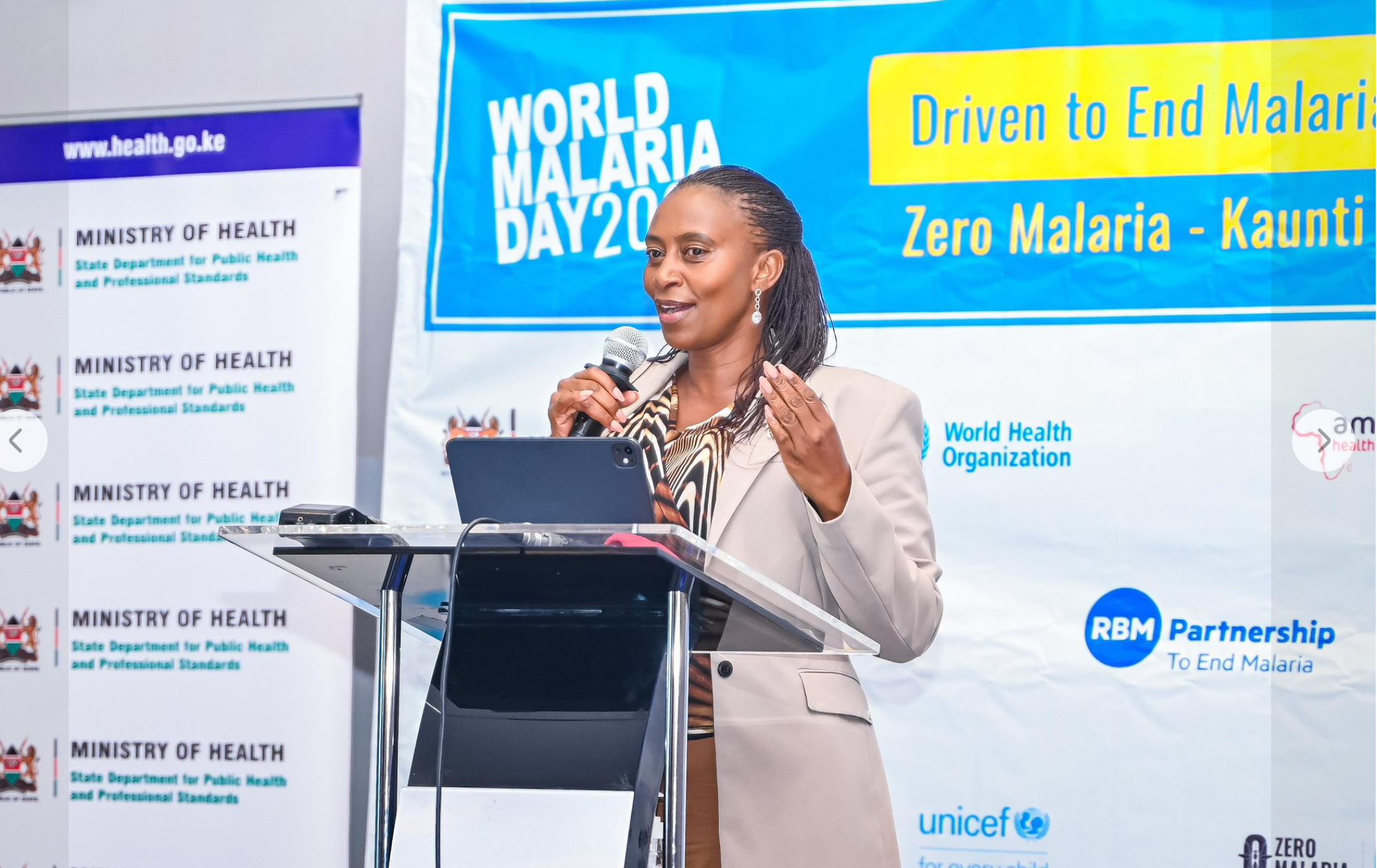
 Public Health PS Mary Muthoni in Nairobi /MoH.
Kenya’s fight against malaria is crawling, with new data showing infections dropped by just five per cent since 2023.
Public Health PS Mary Muthoni blamed counties, saying they failed to properly implement control measures on the ground.
She said Kenya has more knowledge and tools to defeat malaria, but is failing to apply them effectively on the ground.
Muthoni spoke in Nairobi ahead of World Malaria Day.
“Malaria today is not a mystery. We understand how it spreads, who it affects most, and what interventions work. Yet it continues to persist, not because solutions are absent, but because delivery is uneven,” she said.
“The gap we must now close is not one of knowledge, but of implementation.”
Muthoni said the biggest weaknesses were at the county level, where policies are translated into services.
She said malaria patterns differ widely across the country, requiring localised responses rather than uniform national approaches.
While some counties continue to record high infection rates, others are approaching elimination.
“Counties are where policies become services, where strategies become action, and where outcomes are ultimately determined. If we are truly ‘driven to end malaria,’ then that drive must be visible in county plans, in county budgets, and in county systems,” the PS said.
She said about 4.2 million malaria cases were recorded in 2024 alone. The disease accounts for 18 per cent of outpatient visits, while about three out of every four Kenyans live in areas where they can get malaria.
Despite the high burden, the PS said recent gains have been modest.
“Malaria incidence has declined by five per cent between 2023 and 2025. Over the past decade, prevalence has dropped from eight per cent to six per cent. Mortality has fallen by 32 per cent over the previous strategy cycle,” the PS said.
The slow progress contrasts sharply with Kenya’s ambitions under the Kenya Malaria Strategy 2023–27, which aimed to reduce malaria incidence by 80 per cent and deaths by 90 per cent by 2027.
The strategy also targets the elimination of local transmission in Nyandarua, Laikipia, Kirinyaga and Nyeri counties by 2027.
However, the strategy document also shows that past efforts have struggled to meet targets, especially in the four counties.
“Though training was conducted in the four targeted counties, there has been limited financial investment at the national and county levels to fulfil the elimination mandate, including on the establishment of a case-based surveillance system,” the strategy document says.
However, Muthoni praised the four target counties, saying they are now nearing zero local transmission.
Kirinyaga will host this year’s national World Malaria Day celebrations, marking the first time the event is being held in a county close to eliminating the disease.
“Kirinyaga has recorded near-zero indigenous cases in recent years and is part of the Mt Kenya region counties targeted for elimination,” she said.
Experts say the burden remains highest in western Kenya, particularly in counties around Lake Victoria, where malaria transmission is intense due to favourable climate conditions.
Muthoni warned that financing gaps and emerging challenges such as climate change and insecticide resistance could further slow progress.
She called for increased domestic investment, particularly at the county level, to sustain malaria control efforts.
She also emphasised the need to strengthen health systems, including diagnosis, treatment, community health services, and disease surveillance.
Still, she cautioned that success will depend on stronger coordination across all levels of government and sustained public awareness.