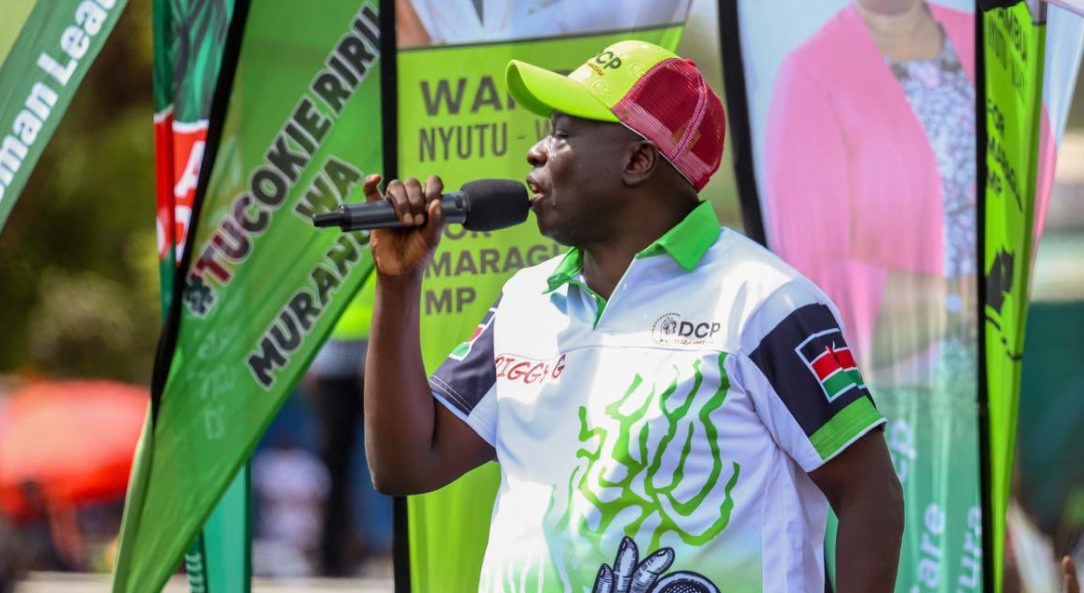
 Former Deputy President and Democracy for Citizens Party leader Rigathi Gachagua addressing a rally in Maragua, Murang’a county on Sunday, April 19, 2026. /RIGATHI GACHAGUA/X
DCP leader Rigathi Gachagua is locked in a political contest with Mt Kenya governors as he seeks to assert dominance in the vote-rich region ahead of next year's general election.
The former Deputy President, who has been positioning himself as the de facto kingpin of the region, is encountering headwinds with county chiefs and a majority of elected leaders continuing to align themselves with President William Ruto.
At the centre of the standoff is Gachagua’s strategy to reshape the region’s political landscape by backing alternative candidates to challenge incumbents, including governors and MPs perceived to be loyal to the President.
While the move is aimed at consolidating his influence, it has instead deepened divisions and alienated key power brokers.
An analysis of the region reveals that none of the sitting governors has publicly endorsed Gachagua’s camp, dealing a significant blow to his efforts to build a formidable political base.
Despite the threat of a DCP wave, key governors have openly declared their support for President Ruto, reinforcing his influence across the region.
Among them are Embu Governor Cecily Mbarire, Tharaka Nithi's Muthomi Njuki and Meru's Isaac Mutuma, all of whom have committed to backing the President’s re-election bid.
Following their stances, the DCP party has promised them a run for their money when elections are called, unless they defect from UDA.
The former DP has been unveiling candidates while also working in the background to groom replacements of the lot he says ‘betrayed the community’.
In Embu, Gachagua is reportedly considering fronting former Cabinet Secretary Sicily Kariuki to challenge Mbarire. Even so, Manyatta MP Gitonga Mukunji is also a leading light on Gachagua’s side.
In Meru, the former DP is backing former Agriculture CS Mithika Linturi to unseat Mutuma, moves that have further strained relations with sitting governors.
The situation is similar in Mt Kenya West, where Gachagua has struggled to win over county bosses.
In Kiambu, Governor Kimani Wamatangi has consistently appeared alongside President Ruto at public events and remains firmly within the UDA fold.
Gachagua’s decision to unveil John Mwaura as the DCP gubernatorial aspirant for Kiambu in 2027 has been interpreted as a direct challenge to Wamatangi, whose entrenched grassroots networks and development record pose a formidable obstacle.
In Murang’a, Governor Irungu Kang’ata has maintained a cautious distance from Gachagua’s political activities.
The DCP leader is reportedly considering backing former minister Jamleck Kamau to contest the seat, further signalling his strategy of unseating incumbents.
Kirinyaga Governor Anne Waiguru, a close ally of President Ruto and a potential running mate in 2027, remains a key figure complicating Gachagua’s plans.
She recently joined Gachagua’s successor, DP Kithure Kindiki, for an event where the rallying call was to support Ruto’s reelection.
With Waiguru serving her final term, Gachagua is backing Senator Murango to succeed her, setting the stage for a high-stakes contest.
In Nyeri, Governor Mutahi Kahiga, once a vocal supporter of Gachagua, has adopted a more cautious approach.
His participation in a UDA meeting convened by Ruto at Sagana State Lodge, signalled a possible shift in allegiance.
“I am still a member of UDA and that is a fact,” Kahiga said earlier this year.
“I voted for Ruto; he is my president, and I am a governor.”
Elsewhere, Laikipia Governor Joshua Irungu and Nyandarua Governor Moses Badilisha have refrained from endorsing Gachagua, opting to remain either neutral or aligned with the ruling party.
In Nakuru, Governor Susan Kihika has been unequivocal in her support for President Ruto, strengthening the President’s foothold in one of the region’s most influential counties.
Gachagua is reportedly backing Senator Tabitha Karanja to challenge her, although she has not publicly declared allegiance to his camp.
Governors wield immense influence through control of county resources, grassroots mobilisation networks and their ability to shape local political narratives—making them critical players in any regional power equation.
Political analyst Martin Andati notes that while Gachagua remains a dominant figure in Mt Kenya politics, governors are unlikely to risk falling out with the national government.
“It is clear that Gachagua is the man to beat in Mt Kenya and whoever aligns with him, has high chances,” Andati said.
“But governors occupy a unique position that requires them to work with the government in power. At the right time, they may shift for their political survival.”
However, Gachagua’s allies maintain that his grip on the region is firm.
Kirinyaga Senator James Murango has publicly declared that the political direction of Mt Kenya is already settled.
“By now, we know who is in charge of Mt Kenya politics. It is not a secret anymore. It is up to them to decide,” Murango said.
Despite resistance from governors, Gachagua retains support from a section of senators, including John Methu (Nyandarua), John Kinyua (Laikipia), Joe Nyutu (Murang’a) and Karungo Thang’wa (Kiambu).
However, most MPs across the region have remained loyal to the President.
National Assembly Majority leader Kimani Ichung’wah and other pro-government legislators have downplayed Gachagua’s influence, accusing him of attempting to destabilise the region’s political unity.
Gachagua, however, has accused MPs of blind loyalty to the President, warning they risk facing voter backlash in 2027.
“They say yes to everything William Ruto says,” he said. “Na nyinyi muendelee tu, mtakutana na hawa wananchi.”
His confrontational approach has been evident in what he calls “Operation Fagia”, a political campaign aimed at removing leaders he accuses of betrayal.
The strategy includes backing alternative candidates across multiple constituencies, further heightening tensions within the region.
Ruto still commands the following of 60 MPs from the vote-rich region, while Gachagua has been haemorrhaging the few who once backed him.
Gachagua got 44 votes that were against his impeachment, which included 20 lawmakers from Mt Kenya region. The vote was won with 282 MPs in support.
Githunguri MP Gathoni Wamuchomba is among the lawmakers who have broken ranks with the former DP, with many others who once were in his camp remaining non-committal.
Even before his impeachment in October 2024, Gachagua had issued ultimatums to MPs, urging them to align with his political agenda or risk being voted out.
Since his removal from office, he has intensified efforts to reorganise his political base.
However, analysts warn that without the backing of governors and a critical mass of MPs, his path to becoming Mt Kenya’s undisputed political kingpin remains uncertain.
While he commands pockets of support among senators and a few MPs, the overwhelming alignment of governors and key leaders with Ruto presents a formidable challenge.
The influence of county chiefs—often described as “small presidents”—cannot be understated, given their ability to mobilise resources and shape voter sentiment at the grassroots level.
INSTANT ANALYSIS
Rigathi Gachagua’s attempt to consolidate Mt Kenya support is faltering as most governors, MPs, and key leaders remain loyal to President William Ruto. Despite backing from a few senators and isolated MPs, Gachagua lacks the crucial influence of county chiefs who control grassroots networks and resources. His strategy of fronting rival candidates has further alienated incumbents. With limited high-level defections and strong pro-Ruto alignment across the region, Gachagua’s bid to emerge as Mt Kenya’s political kingpin ahead of 2027 faces significant uncertainty.