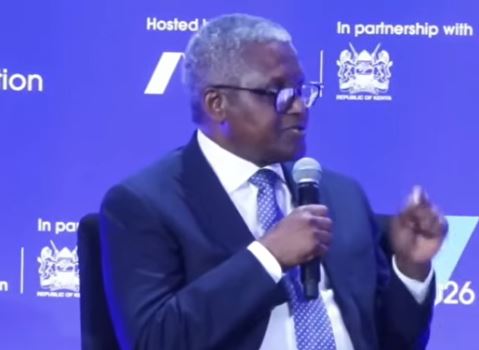
 Aliko Dangote speaking at the Africa We Build Summit in Nairobi on April 23, 2026./FILE
President William Ruto summed it up with a striking observation: Africa’s largest oil producer still had citizens queuing for fuel.
That paradox—of abundance without access—has defined Nigeria’s energy sector for decades. But a major shift is now underway, driven by the refinery project of billionaire industrialist Aliko Dangote.
For years, Nigerians endured long fuel queues despite the country’s vast crude oil reserves. That reality is now changing, with the Dangote refinery marking a turning point from chronic shortages to stable—and even surplus—supply.
“Historically, Nigeria has battled fuel queues since 1972. For the first time, we are eliminating those queues, not through imports but by producing locally,” Dangote said.
The refinery, which began full operations in 2025, is producing about 50 million litres of petrol daily—more than Nigeria’s total consumption. Even during maintenance periods, supply has remained steady.
“We are delivering 50 million litres of PMS every day. Nigerians can now be assured that fuel queues are history,” Dangote added.
By early 2026, the country was recording a surplus of between 15 and 20 million litres daily, opening up export opportunities to West Africa, Europe and the United States.
“We are not only meeting Nigeria’s needs but also supplying neighbouring countries and international markets,” he said.
The economic ripple effects are already being felt. Local industries, especially plastics and manufacturing, are benefiting from a steady supply of feedstock, cutting down on imports that previously cost between $350 million and $400 million annually.
Fuel prices have also dropped, driven by increased competition and reduced smuggling, although Dangote acknowledged the challenge remains.
“Smuggling persists because of price differences. Locally, petrol sells at about 800 naira per litre, while across borders it can fetch between 1,500 and 1,600 naira,” he said.
Looking ahead, Dangote plans to expand the refinery’s capacity to 1.4 million barrels per day by 2028, potentially surpassing India’s Reliance refinery.
He also revealed plans to scale up fertiliser production to 12 million tonnes annually, positioning Nigeria as a global leader.
“Our vision is to make Nigeria not just self-sufficient but a global leader in energy and agriculture,” he said.
The turnaround underscores a broader lesson for resource-rich nations: investing in local refining capacity can unlock value, stabilise supply and reshape entire economies.





Comments 0
Sign in to join the conversation
Sign In Create AccountNo comments yet. Be the first to share your thoughts!