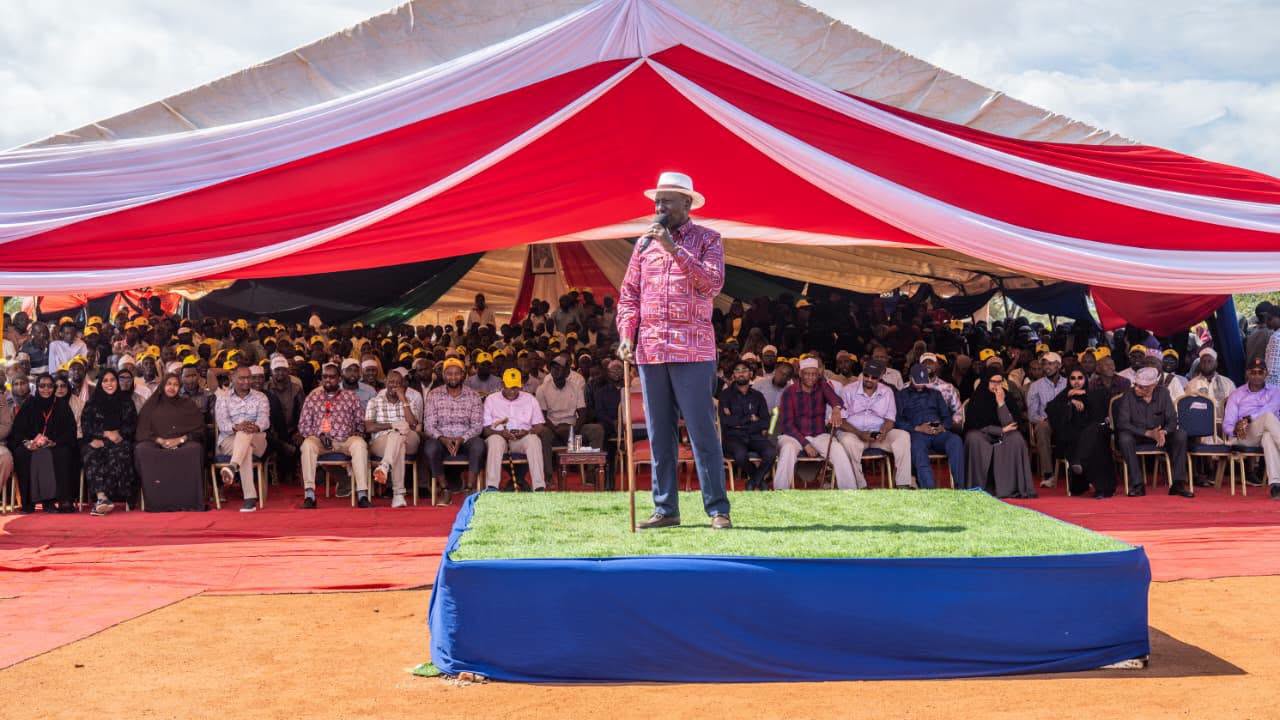
President William Ruto has defended Kenya’s relatively higher fuel prices compared to neighbouring countries in the East African Community.
The development comes even as he assured the public that the government is closely monitoring global and local factors that continue to influence pump prices.
Speaking during a service at Africa Gospel Church in Karen, Nairobi, the President said geopolitical tensions in the Middle East have had a direct impact on global transport and logistics routes.
The situation has, in turn, affected fuel costs worldwide.
“As we continue to go into the future, we will continue to manage situations. There are situations like what is happening in the Middle East that affect transport routes, logistics routes and escalating prices,” Ruto said.
The head of state spoke in the wake of public uproar over the soaring prices of fuel in the country.
Last week, the prices of petrol and diesel crossed the Sh200 mark per litre after the Energy and Petroleum Regulatory Authority increased prices by as high as Sh40 per litre in its monthly review.
However, the state moved swiftly and cut value added tax by 50 per cent, a situation that reduced the prices to under Sh200 per litre.
But the opposition has been piling pressure on the government to further slash the taxes on fuel to ease the burden on Kenyans.
Fuel prices remain a key driver of inflation, affecting transport, food prices and overall household expenditure across the country.
Ruto said that Kenya’s fuel pricing structure is also shaped by domestic fiscal reforms, noting that recent interventions by Parliament played a crucial role in stabilising the situation.
“I want to thank Parliament for stepping in when I proposed changes to our tax structure. They did it expeditiously,” he said.
He added, “In fact, the passage of the law was done in an hour and 20 minutes and we had a whole brand-new law for me to sign. That has significantly adjusted the prices downwards. We are going to monitor the situation to see how it goes forward.”
The head of state also addressed public concern over why fuel prices in Kenya often appear higher than in neighbouring countries.
Ruto said the comparisons must be made fairly based on economic classifications rather than geographic proximity.
“Many people in Kenya keep asking why sometimes the prices of fuel are different in Kenya from our neighbours. Kenya is a middle-income country.”
“Our neighbours are least developed countries. There is a big difference. If you want to compare Kenya fairly with others, compare Kenya with other middle-income countries. That is how you will get the figures right,” he said.
Ruto argued that when assessed against similar economies, Kenya’s fuel prices are not unusually high, and in some cases are comparable or even lower than those of other middle-income nations.
He further linked fuel pricing to national development priorities, particularly infrastructure development and maintenance, saying the country’s extensive road network significantly influences expenditure needs.
“Our fuel supports transport infrastructure. We have 20,000km of tarmac to maintain. We have 6,000km of tarmac under construction.”
“The 20,000km of road to maintain here in Kenya is actually the same as for the other six or seven EAC (East African Community) countries combined,” he said.
According to the President, Kenya’s road network alone surpasses the combined tarmacked roads of Uganda, Tanzania, the Democratic Republic of Congo, Rwanda, Burundi and South Sudan.
“The 6,000km of tarmac we are constructing at the moment in Kenya is equivalent to all the tarmac in our neighbouring country that has been built for 60 years,” he added.
Ruto said the government is also pursuing even more ambitious infrastructure goals, including expanding the road network further in the coming years.
“We are setting our standards even higher. We want to tarmac another 28,000km in the next seven years,” he said.