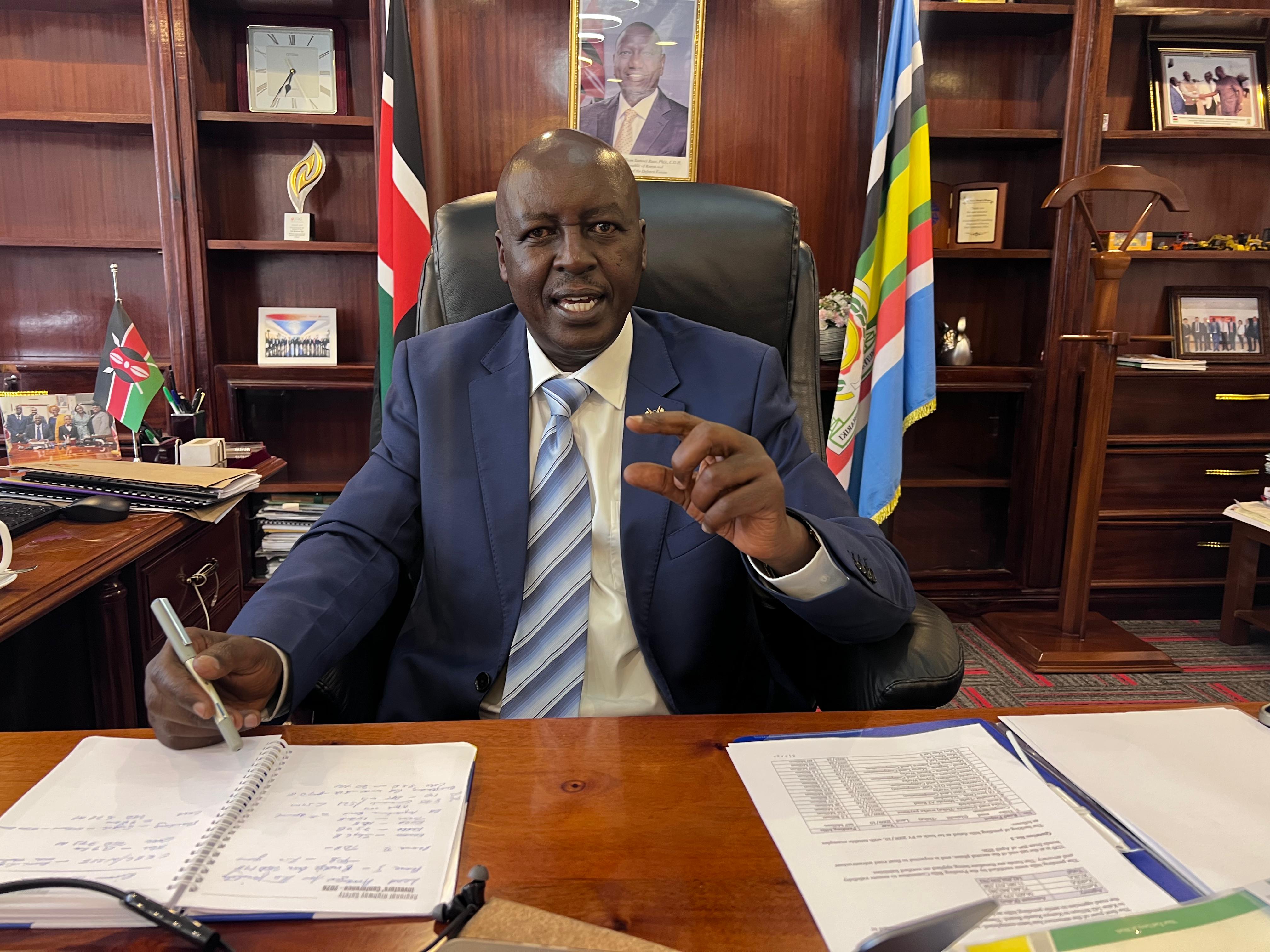
WHEN Engineer Joseph Mbugua speaks about roads, it is not just policy—it is personal. The Principal Secretary in the State Department for Roads traces his passion back to the muddy, impassable tracks of rural Nyandarua, where getting milk to market was a daily struggle.
From the muddy footpaths to the boardrooms shaping Kenya’s infrastructure policy, Mbugua has spent more than three decades in public service quietly building the arteries that keep the country moving.
Today, as PS Roads, he sits at the centre of one of Kenya’s most critical and politically sensitive sectors: fixing a vast but strained road network, unlocking stalled projects and restoring contractor confidence after years of funding constraints.
Speaking to the Star, PS Mbugua reflects on his journey from a rural upbringing defined by impassable roads to leading reforms aimed at modernising Kenya’s transport infrastructure. He opens up on the tough realities of a Sh1.78 trillion funding gap, the pain of pending bills that nearly crippled contractors, and the bold securitisation plan that has revived projects across the country. He also weighs in on emerging challenges and why, despite the setbacks, he believes Kenya’s road sector is firmly on a path to recovery.
At its core, his story is one of persistence, public service and a belief that roads are more than tarmac—they are lifelines for economic growth, social mobility and national cohesion.
Tell us about your background—where you grew up, your education and how your journey began?
I was born in Nyandarua, Kipipiri Constituency, in the early 1960s. My parents worked under the colonial government, and I grew up in a rural setting where infrastructure challenges were part of daily life. I began my education at Nyakiambi Nursery School, then proceeded to Mwiteithia Primary School. After that, I joined Njabini Secondary School for my O-Levels and later Kanunga High School for A-Levels.
After completing pre-university training at NYS Gilgil, I joined the University of Nairobi, where I pursued a Bachelor of Science degree in Civil Engineering, graduating in 1989. That same year, I was recruited into public service through the Public Service Commission and posted to the Ministry of Public Works.
That is where I started off working, specifically in the structural department, which I did for about eight years. Later, I applied for departmental transfer to have more exposure and joined the State Department for Roads in 1997. So I have been in the road sector for that period of time. I worked both within Nairobi and outside, especially the eastern and central regions.
What inspired you to pursue engineering, particularly roads?
Growing up in Nyandarua, roads were a major challenge. Transporting milk to markets was difficult. You could fall off your bicycle and lose everything. I remember asking myself: Who solves these problems? That curiosity led me to engineering. Initially, I wanted to be a bridge engineer because bridges symbolised connection, linking communities that were otherwise cut off. As I advanced in school, I focused heavily on mathematics, physics and chemistry, knowing these were essential for engineering. That foundation shaped my career.
You have spent your entire career in public service. Do you ever feel you missed the private sector?
Not at all. I see it as a matter of calling. Some of my classmates went into banking and rose to senior positions. That is their path. Mine was public service. When I started, my salary was about Sh4,700, including house allowance. It was modest, but public service is about impact, not just income. If your motivation is purely financial, you may move jobs frequently. But if you are driven by service, you find fulfillment in solving real problems for people.
Walk us through your career progression leading to your current role.
I began in structural engineering within the Ministry of Public Works. In 1997, I transferred to the roads department to gain broader exposure. Over the years, I served in Embu, later becoming District Roads Engineer in Mbeere. I also worked in Thika region and later joined the Kenya Rural Roads Authority in 2009 when road agencies were created. I served as Regional Engineer in Murang’a, then Regional Director in Kiambu. In 2022, I was appointed Principal Secretary in the State Department for Roads. It has been a long journey of service, learning, and leadership.
What is the current state of Kenya’s road network?
Kenya has approximately 239,122 kilometres of roads. Out of these, about 57,263 kilometres are national roads, while counties manage roughly 181,858 kilometres. In terms of condition, about 20 per cent or 48, 052 kilometres are in good condition, 46, which is 109,463 kilometres, are in fair condition, while 77,720 kilometres, which is 33 per cent, are in poor condition. Around 3,887 kilometres are currently under construction.
That suggests a significant maintenance backlog. How big is the funding gap?
To bring all roads to a serviceable condition, we need about Sh600 billion for maintenance alone. If we include full development, which is upgrading and expanding the network, the requirement rises to approximately Sh1.78 trillion. However, our annual exchequer allocation is about Sh60 billion, and even then, disbursements are often lower. This mismatch has, over the years, created delays, pending bills and stalled projects.
Pending bills have been a major issue. How has the government addressed this?
When we came into office in 2022, pending bills stood at around Sh174 billion. Contractors had stopped work, some faced auctions and confidence in the sector was low. We introduced a securitisation programme backed by the Roads Maintenance Levy Fund. In 2025, we implemented a structured settlement. Contractors received 40 per cent upfront, a second 40 per cent followed then the remaining 20 per cent was cleared by December. We also negotiated a partial waiver on interest, saving the government about Sh7.5 billion. Today, all verified pending bills up to December 2024 have been cleared, and we are now paying current certificates in near real-time. We don’t have pending bills.
What impact has this had on road projects?
The impact has been transformative. Over 80 per cent of contractors resumed work after payments began. Projects that had stalled for years are now progressing.In Nairobi, for example, the Kangemi interchange is back on track, works along Waiyaki Way and Gitaru are ongoing, Upper Hill and Uhuru Highway improvements are visible. Across the country, even previously stalled programmes like the Mau Mau roads have resumed, so a lot is going on and Kenyans can see for themselves.
Beyond infrastructure, what has been the economic impact of these developments?
The effects are widespread. Construction activity has increased demand for materials like cement, steel, bitumen and aggregates, boosting these sub-sectors. Jobs have been restored from engineers, drivers, machine operators, you name it. Local economies are also benefiting from improved connectivity. Roads are economic enablers. They allow farmers to access markets, businesses to grow and communities to access schools and hospitals. The impact is huge.
Land compensation has often delayed projects. How are you addressing this?
Compensation remains a challenge, mainly due to land ownership issues. Many parcels are still under deceased owners, requiring succession processes before payment.We also face difficulties tracing displaced businesses, especially in urban areas. However, we are working closely with stakeholders to resolve these issues and ensure timely compensation.
How is the government planning to finance roads sustainably going forward?
We are diversifying funding sources. In addition to securitisation, we are exploring an infrastructure fund projected to mobilise up to Sh3 trillion for roads, water and energy projects. We are also developing a tolling policy. This will ensure all road users, including electric vehicles, contribute to infrastructure maintenance.
Speaking of electric vehicles (EVs), how will they contribute, given that they don’t pay the fuel levy?
That is a key consideration. For now, we are encouraging EV adoption. Over time, contributions may be integrated through tolling, insurance or charging infrastructure levies. The idea is to balance sustainability with fairness, which is ensuring all users contribute without discouraging innovation.
There has been criticism about road quality and durability. What is your response?
Much of this stems from past design decisions. Under the low-volume seal programme, roads were built with thinner pavement layers to maximise coverage. However, traffic patterns changed. Roads designed for light use began carrying heavy commercial traffic, leading to faster deterioration. We are now strengthening pavements, redesigning based on actual traffic loads, and enforcing axle load controls to improve durability.
What keeps you motivated after decades in public service?
Service to people. When you see a community finally connected by a road, when children can reach school safely, when businesses thrive, that is fulfillment. Even on holidays, I find myself inspecting roads. It is not just a job; it is a calling. Roads, water and power are fundamental to life and being part of that transformation is deeply rewarding.
What is your message to Kenyans regarding infrastructure development?
We have come from a difficult period, which I would describe as being in the ICU. Today, we are recovering. There is still work to be done, but the progress is real. With sustained investment, transparency, and public support, Kenya’s road network will continue to improve, unlocking growth and opportunity for all.