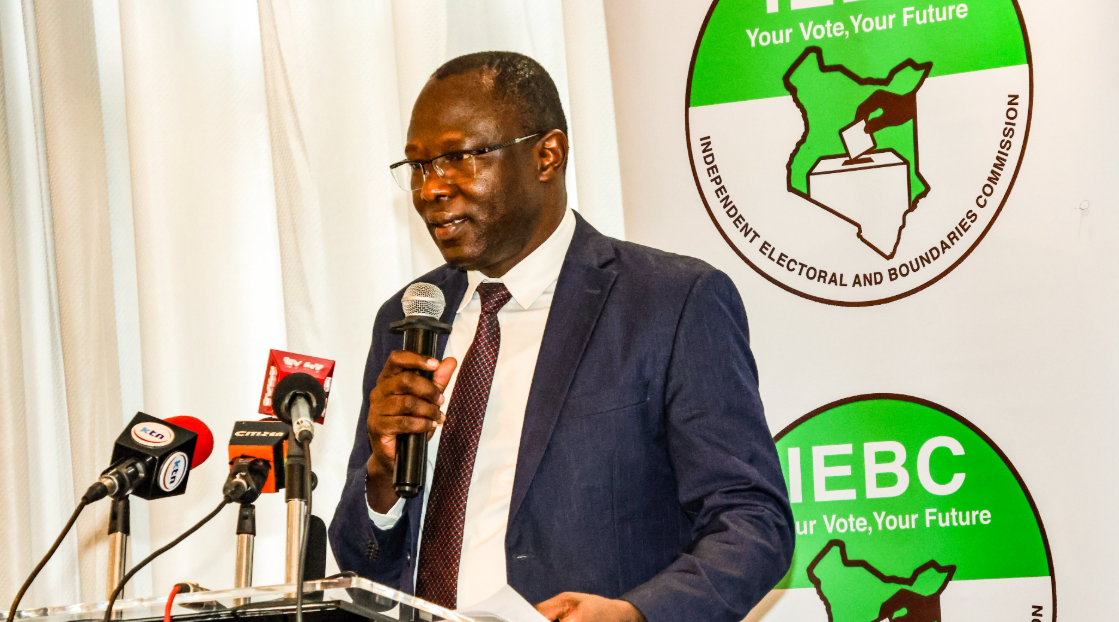
The Independent Electoral and Boundaries Commission (IEBC) has raised concerns over reported cases of political violence and alleged goonism, while stating it has no powers to address them.
IEBC Chairperson Erastus Ethekon, while acknowledging recent concerns, said the commission’s mandate on issues such as political violence is limited in line with the law.
According to Ethekon, the Commission’s mandate takes effect once elections are declared through enforcement of the electoral code of conduct framework applies.
“We have the electoral code of conduct, but it only becomes enforceable once the election period is gazetted and candidates are registered. That is when political actors formally fall under our jurisdiction,” he said.
Speaking Wednesday morning during an IEBC–Kenya Private Sector Alliance (KEPSA) breakfast meeting in Nairobi, the commission raised concerns over the prevailing political environment, noting that issues such as alleged goonism and mistrust could undermine the conduct of the upcoming elections.
Ethekon used the opportunity to assure the business community of the commission’s preparations ahead of next year’s general election, with ongoing voter registration activities, while raising concerns about the security situation.
“Operationally, we are fine. What we are worried about is the environment in which we will hold the election. Will it be peaceful?” he posed even as he noted that some commission offices were reportedly attacked during the Continuous Voter Registration (CVR) exercise.
“We are offering a service to facilitate Kenyans in exercising their democratic right. It should not be made difficult,” he said.
The private sector warned that a culture of “goonism,” where politicians allegedly deploy hired groups to advance political agendas, alongside concerns about vote manipulation through financial inducements, may undermine the electoral integrity process.
KEPSA, through its representative Vimal Shah, noted that the country is currently grappling with a significant trust deficit, warning that uncertainty around electoral processes is fuelling anxiety among citizens and businesses.
“We are seeing a fear psychosis that is causing widespread concern about the future. There is a need for clarity of rules and a coordinated approach to conflict resolution,” Shah said.
According to Shah, KEPSA has proposed the formation of a multi-agency task force to address electoral tensions, citing fragmentation across institutions as a key challenge.
“The mistrust is too high, and the cost of elections in Kenya remains significantly elevated,” he added.