On August 1, 2023, this writer sat in a lecture hall in the Jianguomenwai Diplomatic Residence Compound for a lesson. The class setting, however, was not an ordinary one.
On the table lay brushes, ink, and sugar paper. The instructor and her apprentices, sharp and ready, quickly ushered us into the drill.
It was the day to learn calligraphy, far from the teachings on national conditions that uniquely define China. My colleagues from more than 81 nations also looked elated.
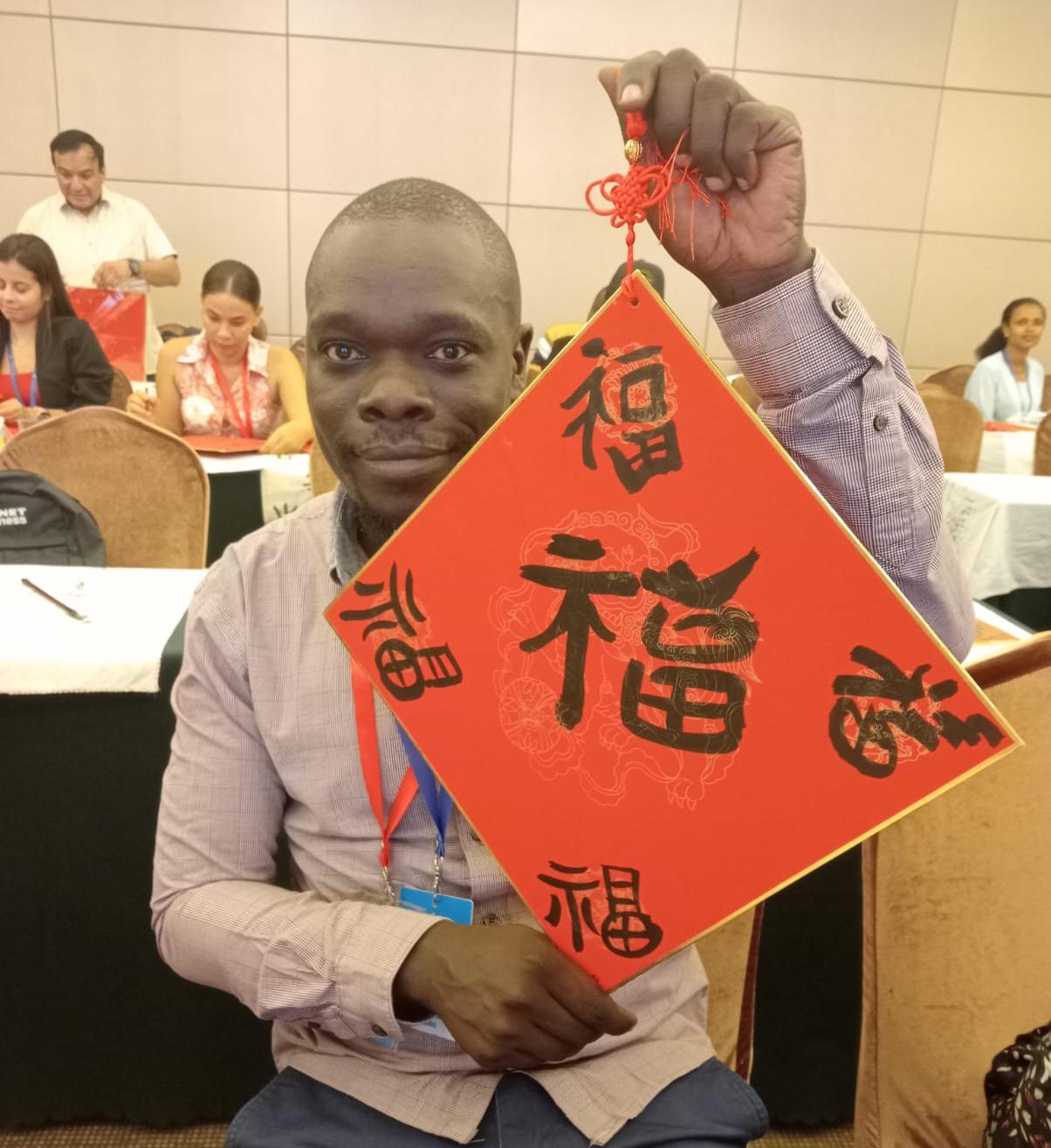
Yours truly, with a brush steady in his hands, took the first dip into the black ink jar, and from the instructor’s words scribbled what would turn out to be a beautiful image of the character fú.
In Chinese culture, the character is a symbol of good fortune, luck, blessings, happiness, and prosperity.
After a few attempts at practice, we were handed a red cardboard to put our art into practice. The product remains etched at one corner of my humble abode.
China, on April 13, marked Chinese Language Day, one of the key events in the United Nations calendar. Chinese is one of the six official languages of the UN.
But it is the speech by Beijing’s envoy to Kenya, Ambassador Guo Haiyan, which brought back memories of the hot afternoon at the Jianguomen DRC.
In her sentiments, she placed calligraphy at the centre of prevailing global politics, presenting the Chinese language as a tool to ease tensions.
Amb Guo’s view that “calligraphy reflects a civilizational outlook of equality and mutual learning” resonates with the call for multilateralism.
In essence, diversity is here with us and, as advocated by President Xi Jinping in his Global Civilization Initiative, language has a leading role.
Kenya and China have a long history of diplomatic ties, with more Kenyans taking lessons in Mandarin.
What stands out is that, beyond ceremonial speeches and diplomatic niceties, calligraphy offers something far deeper to foreign learners.
Many scholarly and opinion articles describe it as a doorway into the Chinese worldview, not merely about writing characters.
It is more about discipline, patience, and harmony, which are core values that Chinese society holds in the highest regard.
From the master’s words on the referenced day, “each stroke in Chinese calligraphy carries weight.”
A slight tilt, a pause, or a heavier press of the brush can alter meaning and beauty. For a beginner, the process demands concentration and humility.
One quickly realises that mastery cannot be rushed; hence, it is a lesson that stands in stark contrast to the current fast-paced, results-driven global culture.
For many foreign students and visitors on learning exchanges, including those from Kenya, the encounter with calligraphy becomes their first intimate interaction with Chinese philosophy.
The practice is deeply influenced by ideals that Chinese philosopher Confucius, from Qufu, imparted in his many literary works.
Ambassador Guo framed calligraphy as a bridge in global politics, a statement that may seem poetic but carries practical significance.
In a world increasingly defined by geopolitical tensions, cultural literacy is becoming a critical tool for diplomacy.
Understanding how another society thinks, expresses itself, and preserves its traditions can ease misunderstandings that often arise from cultural gaps.
Language, in this regard, is more than a communication tool but a vessel of identity.
In the use of Chinese characters, each symbol carries meaning as well as sound, making calligraphy a visual representation of language.
Kenya’s growing engagement with China provides fertile ground for such cultural exchanges.
Ties between Nairobi and Beijing have expanded significantly over the years, from infrastructure to people-to-people exchanges.
As economic cooperation deepens, it has brought a new area of focus: cultural understanding.
Institutions such as Confucius Institutes at the University of Nairobi, Kenyatta University, Moi University, and Egerton University have seen rising enrolment, with young Kenyans eager to learn Mandarin.
For many, the motivation is better job prospects, business opportunities, or academic advancement.
From my lessons in Jianguomen, those who venture deeply into calligraphy often discover a connection to the cultural soul behind the language.
Moreover, calligraphy fosters people-to-people connections.
In our classroom, the shared struggle to perfect our skills in the art created camaraderie, bonds that have remained alive to date. The cultural blend was equally reassuring.
Looking back at that afternoon in Jianguomen, the memory is no longer just about ink on paper. It is about a moment of connection between individuals, cultures, and ideas.
The character fú that now sits in my home serves as a daily reminder of that lesson: that in the end, one does not just acquire a skill but embraces a philosophy.