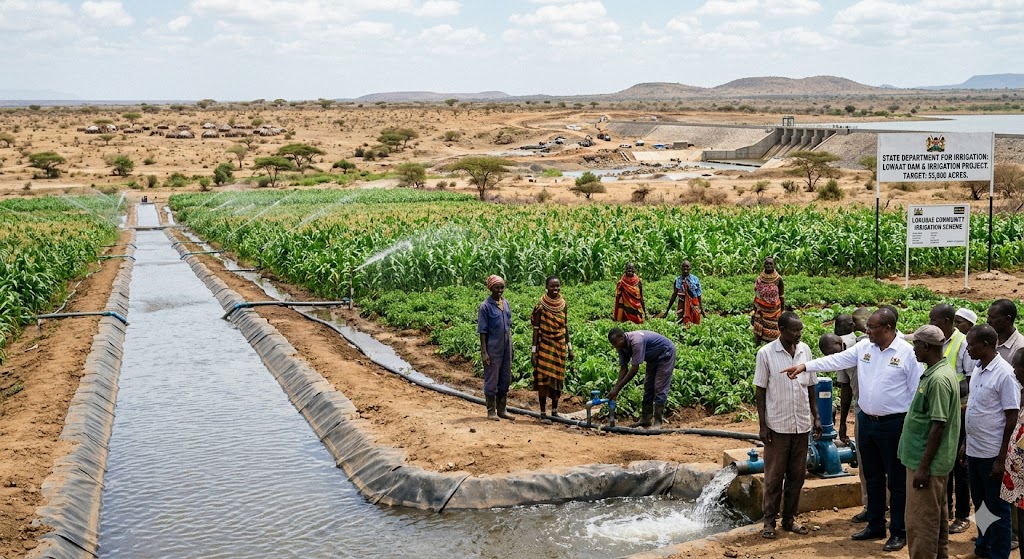
 Government targets 55,000 irrigated acres in Turkana East to cut food insecurity/AI ILLUSTRATION
The government is ramping up irrigation development in Turkana East, targeting at least 55,000 acres under irrigation in a move aimed at boosting food production and reducing reliance on relief supplies in the arid region.
The plan, driven by the State Department for Irrigation, combines expansion of community-based schemes with large-scale investments anchored on the proposed Lowaat Dam project.
Principal Secretary in the State Department for Irrigation, Ephantus Kimotho, said the initiative is part of a broader national strategy to increase land under irrigation to two million acres, describing irrigation as key to transforming livelihoods in marginal areas.
“Irrigation development remains the most viable pathway to unlocking the region’s agricultural potential and reducing dependency on relief food,” Kimotho said during farmer engagements in Turkana East.
Currently, only about 6,000 acres in the area are under irrigation despite its vast potential.
The government now plans to expand community irrigation to 10,000 acres while setting aside an additional 45,000 acres for commercial farming under the Lowaat Dam.
The expansion builds on existing schemes in Lokubae, Morulem and Elelea, which together support more than 1,000 farmers cultivating crops such as maize, sorghum, green grams and vegetables.
However, most of the production remains at subsistence level.
Officials say scaling up irrigation will shift farmers from subsistence to surplus production, enabling households to earn income and supply markets beyond their local communities.
PS Kimotho said land earmarked for community irrigation has already been mapped, paving the way for implementation, with the dam project set to be financed under the National Infrastructure Fund.
“The development of the dam will not only support irrigation but also spur complementary investments such as road infrastructure, opening up the region to trade and investment,” he said.
In the short term, the government is prioritising rehabilitation of existing schemes to deliver quick results.
Plans are underway to desilt canals in the three major schemes to allow farmers to resume production without delay.
The rehabilitation of irrigation clusters in Lokubae is expected to have wide-ranging benefits, including increased household incomes, job creation and improved access to animal feed.
It is also projected to enhance nutrition through diversified food production while improving overall living standards for pastoral and agro-pastoral communities.
Turkana East MP Nicholas Ngikor Nixon welcomed the intervention, saying it will revive stalled projects and restore livelihoods in the area.
“The initiative will restore livelihoods and unlock long-term economic growth for our people,” he said.
Leaders also highlighted the role of Irrigation Water Users Associations and cooperatives in ensuring sustainability of the schemes and strengthening market access for farmers.
Stakeholders note that irrigation expansion could help cushion the region against climate shocks, which have frequently disrupted rain-fed agriculture.
With improved water access and infrastructure, the government expects Turkana East to gradually transition into a productive agricultural zone, reducing food insecurity and building resilience among communities that have long depended on aid.