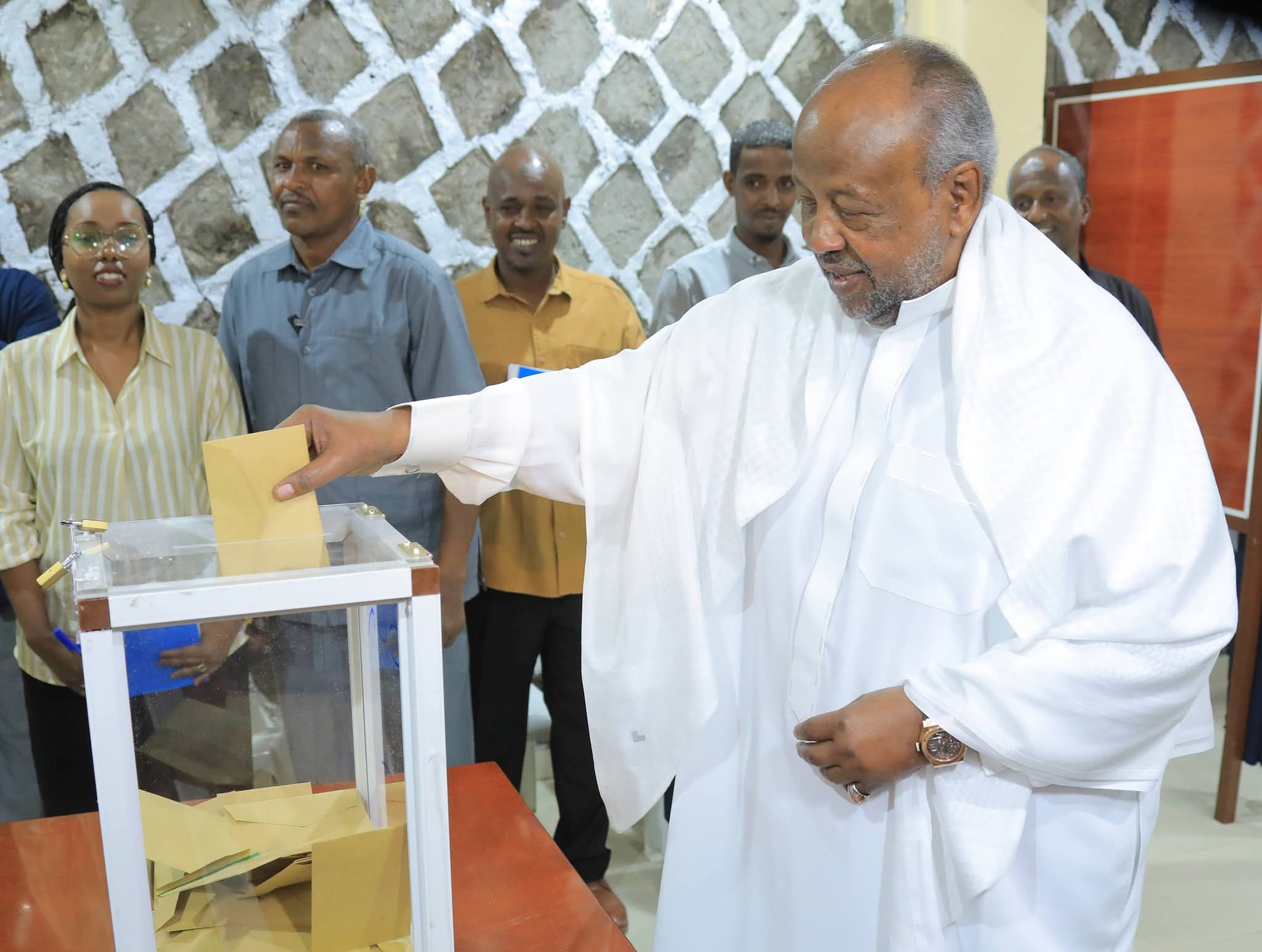
Voting is underway in Djibouti as President Ismail Omar Guelleh cast his ballot early Friday morning, setting the tone for what authorities and observers have described as a calm and orderly election day.
Guelleh voted in the capital, Djibouti City, shortly after polling stations opened, joining thousands of citizens across the country participating in what is being viewed as a significant democratic exercise.
Other candidates, including opposition figures, also cast their votes in various regions, underscoring broad participation in the electoral process.
Nearly a third of Djibouti’s estimated 1.2 million population is eligible to vote, reflecting a substantial and engaged electorate. With approximately 243,000 registered voters, officials anticipate a strong turnout consistent with previous elections.
Speaking after voting, President Guelleh described the election as a key milestone in Djibouti’s democratic journey and expressed optimism about the country’s future.
“This vote represents the will of our people and marks another important step in strengthening our democracy. We are confident that the next phase will bring even greater economic growth and opportunity for our nation and the region,” he said.
The election follows weeks of campaigning that stretched from the capital to regional centres such as Tadjourah and Obock.
The ruling Union for the Presidential Majority (UMP) maintained a strong and visible presence throughout the campaign, highlighting its development record and outlining future plans.
President Guelleh, who has been in power since 1999, remains a central figure in Djiboutian politics. His tenure has been closely linked to major infrastructure expansion, particularly in port facilities and transport networks, positioning Djibouti as a strategic trade and logistics hub in the Horn of Africa.
Supporters credit his administration with attracting foreign investment, fostering economic growth, and maintaining stability in a geopolitically significant region.
Among the challengers is Mohamed Farah Samatar of the CDU party, who has campaigned on a platform of renewal and inclusivity. While presenting an alternative vision, opposition candidates have largely focused on improving social services, expanding employment opportunities, and building on existing economic gains.
Despite differing approaches, most candidates have emphasized continuity in development while proposing gradual reforms.
The election has drawn regional and international attention, with observer missions deployed by organizations such as the African Union and the Intergovernmental Authority on Development (IGAD). Their presence is expected to bolster transparency and credibility in the electoral process.
Polling stations opened early and are scheduled to close later in the evening, after which vote counting will begin. Official results are expected to be announced by Saturday morning.