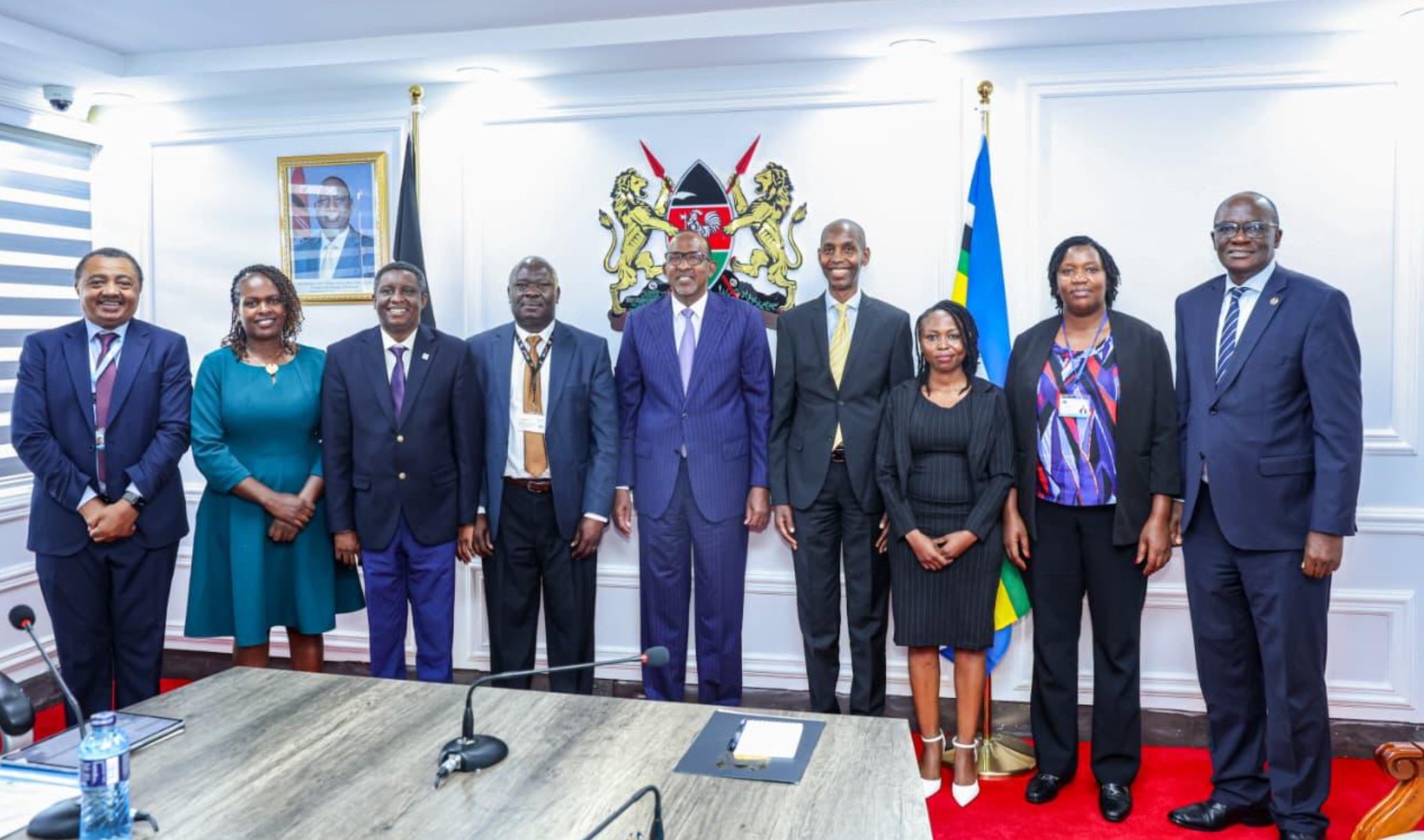
 From left: Head of nursing and curative services Dr Andrew Toro, Caroline Okumu (Operation Eyesight), country director, The Fred Hollows Foundation Kenya, country director, Peter Milo, David Munyendo (country director, CBM), Health CS Aden Duale, Moses Chege (country director, Sightsavers), International Agency for the Prevention of Blindness (IAPB), Kristine Nyabera, Dr Monica Bitok, head of ophthalmic services unit, MOH and Director General of Health Dr Patrick Amoth.
The Ministry of Health says blindness prevalence has dropped by 47 per cent, from 0.7 per cent in the 1990s to 0.37 per cent today, according to the Rapid Assessment of Avoidable Blindness (RAAB) report.
The gains were highlighted when international eye health partners met Health CS Aden Duale in Nairobi, as part of preparations for a major global eye health meeting set for June.
The delegation, led by The Fred Hollows Foundation Kenya, brought together multiple organisations working in eye care, alongside senior Ministry officials, in a meeting that underscored both progress and persistent gaps in access to services.
Speaking during the engagement, Duale said Kenya’s progress demonstrates the impact of sustained collaboration.
“Eye health is not just a medical issue; it is central to education outcomes, work productivity, road safety and our country’s economic resilience," the CS said.
"Over the past three decades, we have reduced the prevalence of blindness in Kenya by nearly 50 per cent, demonstrating what strong partnerships and government commitment can achieve.”
However, the RAAB report paints a more complex picture behind the progress, showing that access to services remains limited for the majority of Kenyans.
Currently, only about 20 per cent of the population accesses eye health services, highlighting a major gap in coverage despite years of interventions.
The report further shows more than 80 per cent of blindness cases in Kenya are due to preventable or treatable conditions such as cataract, uncorrected refractive errors and glaucoma.
Among people aged 50 and above, the group most affected, an estimated 2.87 per cent are blind, with sharp regional disparities.
In Turkana, prevalence reaches as high as 6.2 per cent, compared to just 0.8 per cent in Nakuru.
Visual impairment is also widespread, ranging from 11 per cent in some counties to as high as 37.5 per cent in others.
Experts say many of these cases could be easily treated with relatively simple interventions such as surgery or prescription glasses, but barriers continue to lock patients out of care.
The RAAB survey identifies cost as the leading obstacle, alongside lack of awareness and what researchers describe as “unfelt need,” where patients do not seek treatment despite having symptoms.
In some regions, access is further constrained by severe shortages of specialists.
For example, in Vihiga county, there is only one ophthalmologist serving a population of nearly 600,000 people, illustrating the scale of workforce gaps.
Duale acknowledged these challenges, saying more work is needed to expand access and strengthen the health system.
“To achieve universal health coverage, eye health must be fully integrated into our health system, ensuring equitable access for all, especially the most vulnerable populations.
Despite the progress we have made, there is still work to do, especially in expanding access, strengthening the workforce and eliminating avoidable blindness.”
The meeting also focused on preparations for INSIGHT Live 2026, a global event that will bring together policymakers, practitioners and development partners to accelerate efforts to eliminate avoidable blindness.
Duale confirmed he will attend the event and said he plans to invite the presidency, signalling high-level political backing for eye health initiatives.
“As a leader in healthcare in the region, Kenya must continue investing in eye health to meet global targets and protect the sight of our people.”
The INSIGHT Live forum, scheduled for June 1–5, is expected to showcase Kenya’s progress while also drawing attention to the urgent need for investment in services, workforce and awareness.
Health officials say the RAAB findings will be used to guide policy decisions, resource allocation and county-level planning as the country works toward universal health coverage.
While Kenya’s progress offers a model for the region, the data make clear that without expanded access, millions will continue to live with preventable vision loss—despite the availability of simple and cost-effective solutions.