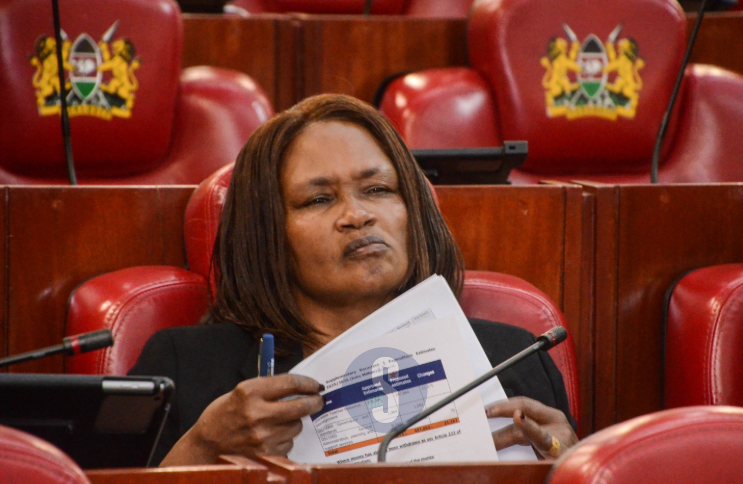
 Teachers Service Commission acting CEO Eveleen Mitei. /FILE
The Teachers Service Commission (TSC) has dismissed as false claims circulating online that it is facing a Sh7.9 billion “financial meltdown", pushing back against a blog report that drew from an audit review by the Auditor General.
In a brief response, the commission rejected the characterisation as a “financial meltdown,” stating, "Please be advised that the information circulating regarding a ‘Sh.7.9 Bn Financial Meltdown’ at the Teachers Service Commission is false!”
The claim stems from a blog post headlined “Audit bombs fall: TSC's Sh7.9bn financial meltdown,” following earlier reporting on findings contained in the Auditor General Nancy Gathungu's review for the financial year ending June 30, 2025.
According to the audit, the commission recorded a budget deficit of Sh4.38 billion during the year, pushing its accumulated deficit to Sh7.34 billion.
The report further indicated that TSC’s current liabilities stood at Sh12.3 billion during the period under review, against current assets of Sh4.4 billion, resulting in a negative working capital position of Sh7.9 billion.
Gathungu noted that this position was “indicative of the commission’s inability to meet its obligations as and when they fall due", raising concerns over short-term liquidity.
While these figures are drawn directly from the audit, TSC appears to have taken issue with how they have been interpreted.
A financial meltdown, in its literal sense, refers to a sudden and severe collapse of financial systems, marked by crashing asset values, widespread bankruptcies, extreme market instability, and a rapid contraction of available capital.
The audit highlights deficits and administrative weaknesses but does not indicate a sudden collapse or insolvency of the scale implied by "meltdown".
Beyond the deficit position, the audit flagged a range of financial and operational concerns at the commission. These included overspending beyond approved budgets, with recurrent expenditure exceeding allocations by Sh4.48 billion in breach of the Public Finance Management (PFM) Act, and pending bills amounting to Sh12.3 billion.
The report also highlighted long-outstanding obligations, including Sh186 million in compensation claims under the Workers’ Injury Benefits Act, some dating back to 2001, exposing the commission to potential legal and financial penalties.
Further scrutiny was directed at TSC’s Sh53.58 billion medical insurance scheme, where the auditor questioned the exclusion of most public hospitals and the absence of actuarial reports to justify premiums, raising concerns over value for money and sustainability.
Weaknesses in internal controls were also cited, including Sh236 million in salary overpayments and discrepancies in payroll data, where individuals could not be traced in the official teachers’ database.
Operational gaps were equally noted, with 199 schools lacking substantive administrators and delays in processing pensions and teacher transfers, pointing to systemic inefficiencies that could affect service delivery.
While the audit paints a picture of significant financial and administrative strain, in TSC's opinion, the “meltdown” narrative is misleading, underscoring a distinction between audited financial observations and how those findings are interpreted.