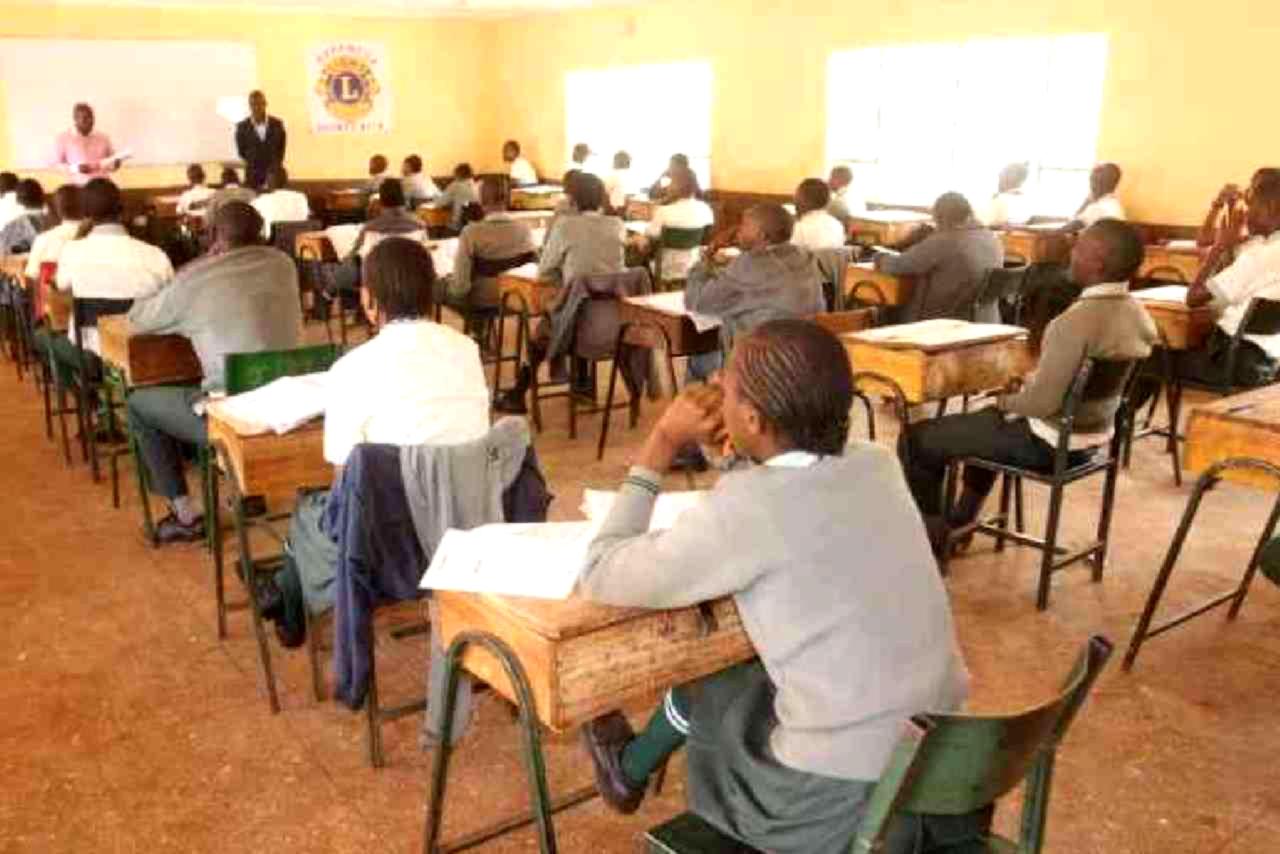
 Grade 10 pupils during exams
The Kenya Institute of Curriculum Development has directed senior school principals to submit data on the number of Grade 10 learners in their institutions per subject to guide the second phase of textbook distribution scheduled for the second term.
In a notice, KICD chief executive officer Charles Ong'ondo said school heads have until Friday, April 10, 2026, to submit the data via https://forms.office.com/r/MqThQtBxQh .
"This will inform the second phase of distribution of Grade 10 textbooks in order to ensure that all learners have received textbooks in all subjects on a One-to-One ratio as per government policy," Ong'ondo said.
"Therefore, all principals of public senior schools are requested to submit current number of Grade 10 learners by subject and textbooks received per subject," he added.
He confirmed that the first phase of the distribution of Grade 10 textbooks has been completed, guided by the data initially provided by the Ministry of Education.
"Schools requiring assistance, yet to receive textbooks or that received excess textbooks should contact KICD through email: [email protected] or 0733 762 412."
Speaking on Thursday at KICD headquarters during the launch of values-based education by Mizizi Elimu Afrika, Ong'ondo said KICD has completed developing curriculum designs up to Grade 12 and for teacher education, and they are now being polished in readiness for distribution by mid next year.
"The deputy directors are, as of now, making sure that the curriculum designs for Grade 12 are polished, out of which in August, we shall be evaluating curriculum designs for Grade 12, and we want to give those books out by the latest May next year," he said.
"In September this year, we shall be distributing books for Grade 11. In terms of the core curriculum, we are almost at the tail end of the mission."
A total of 1,130,459 students who sat the inaugural Kenya Junior School Education Assessment (KJSEA) transitioned to Grade 10 in January, marking the start of the final phase of basic education, which will culminate in the Kenya Certificate of Basic Education (KCBE) exam in 2028.
The learners were placed in three pathways: Science, Technology, Engineering, and Mathematics (STEM), Social Sciences, and Arts and Sports Science.
Data from the Ministry of Education released in January showed that at a 96 per cent transition rate, 52 per cent of the learners were placed in the STEM pathway, 40 per cent in the Social Sciences pathway, and 11 per cent in the Arts and Sports Science pathway.
Each pathway focuses on specialised subjects aimed at preparing students for career pathways and higher education.
STEM covers pure and applied sciences as well as technical engineering. Social Sciences focus on humanities and business, while Arts and Sports emphasise creative arts and physical education.
Pure sciences include Biology, Chemistry, Physics and General Science, as well as Advanced Mathematics.
Technical studies include Aviation Technology, Building Construction, Electricity, Metal Work, Power Mechanics and Woodwork, while applied sciences include Computer Studies/Science, Agriculture, Marine and Fisheries, and Media Technology.
The Social Sciences pathway comprises English, Kiswahili, foreign languages (French, German, Arabic), Kenya Sign Language, History and Citizenship, Geography, Religious Education (Christian, Islamic, Hindu), Economics, Entrepreneurship and Accounting.
The Arts and Sports Science pathway includes Music, Dance, Theatre, Fine Art, Design, Graphic Design, Photography, Physical Education, Sports Management, Coaching, Media and Film Studies, Fashion and Textiles (Home Science), Leatherwork, and Carpentry/Woodwork.
Ong'ondo said after the completion of the distribution of Grade 12 books, KICD’s work will shift to reviewing the implementation process.
"When you are in the midst of reform, our focus has been every year producing curriculum designs for the next class. We have not had good moments to reflect on how that curriculum is being implemented. The curriculum is continuous, so we finish Grade 12, we start again," he said.
Ong'ondo said the review process will be better structured and holistic since they will now have the full picture of basic education under the Competency-Based Education (CBE).
"Part of what we will do from next year going forwards is that there are things we put in the basic education curriculum framework as pillars of curriculum reforms which have admittedly not given so much attention because we have been focusing on the classroom, and key among them is values-based education," he said.
In its 15-year strategic blueprint (2026–2040), Mizizi Elimu Afrika seeks to advance learning beyond textbook content by instilling virtues in learners such as ethics and accountability.
"We have seen more accountability from the learners, teachers, support staff and even parents. The entire school has been transformed. Ethical citizens will be a reality in the next decade because we have got it right at the foundational level," said Mary Macharia, principal, Ngei Comprehensive School, Nairobi.
The school is among 79 institutions across 19 counties where Mizizi Elimu Afrika piloted values-based education ahead of a nationwide rollout.