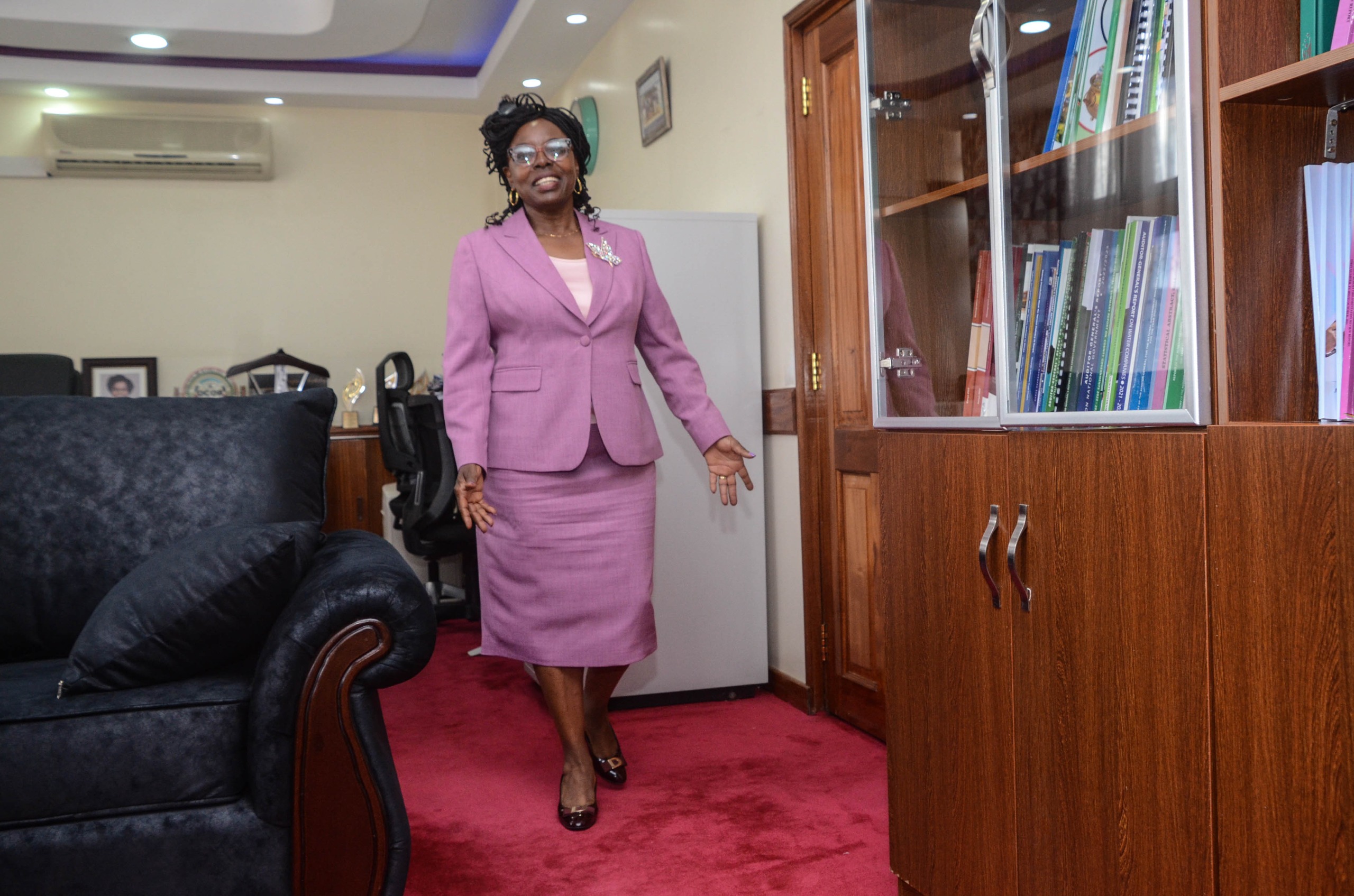
Controller of Budget Margaret Nyakang’o has emerged as one of the most formidable figures in Kenya's public finance oversight space. Often described as an “iron lady,” Nyakang’o has built a reputation for her uncompromising stance on accountability, transparency, and the prudent use of public resources.
In this candid and wide-ranging interview, she opens up about the pressures of her office, the persistent misuse of public funds, systemic weaknesses in county governments, Kenya’s growing debt burden, and the difficult decisions that have, at times, pushed her to the brink of walking away from the job.
We found you juggling calls while signing documents. Your phones haven’t stopped ringing. How do you balance such a demanding role with your personal life? This has always been my life—it’s not something that just started becoming a challenge. My schedule is extremely busy and operates in a continuous cycle between office, home, and social responsibilities.
On a typical day, I work about 12 hours. I usually carry my lunch to save time and leave the office around 6 or 6:30 pm. But even after that, my responsibilities don’t end. At home, I still have to ensure my family is well taken care of—making sure meals are planned, the household is running smoothly, and everything is in order.
Sometimes, I carry work home, especially during reporting periods. I try to maintain some balance through social activities. I play golf—usually on weekends—and Sundays are often reserved for hosting family and catching up on domestic duties. It’s a full schedule, but I’ve learned to manage all aspects without neglecting any.
When you are away on leave and your signature is required, how does the office function? The law is very clear on that. I have a deputy and, more recently, a Director General who can step in—but only under written instructions from me.
Without those instructions, they cannot act on my behalf. This is a safeguard to ensure accountability. Even when I delegate, I remain fully responsible for the decisions made.
Once you approve withdrawals, cases of misuse often emerge later. What action do you take?
I don’t hear it. I see it. I rely on what we establish through data. My office reviews reports submitted by spending entities and compares actual expenditure against approved budgets and work plans.
Where there are variances, we highlight them in our reports. These reports are public and serve to inform citizens, policymakers, and oversight institutions about how funds are being used.
If there are serious irregularities—especially those of a criminal nature—other agencies take over. These include the EACC, the DCI, and ultimately the ODPP.
No single institution handles everything. We each play our role within a broader accountability framework.
Have you had to facilitate investigations into misuse of funds? Yes, quite often. My office plays a critical role in supporting investigations. We provide essential data—budgets, disbursements, and expenditure reports—to agencies like the EACC.
We act as a central repository of financial information. Investigative agencies rely on our data because spending entities themselves may not always provide complete or accurate information.
From your vantage point, how widespread is misuse of public funds? Misuse occurs in many forms and at different stages of the expenditure process.
There is misallocation, where funds are diverted from their intended purposes. There are also cases of abandoned projects, which result in wasted resources and unmet objectives.
Then there is outright embezzlement, revenue leakage, and spending outside approved plans. In some cases, funds are not necessarily stolen but are used in ways that do not align with the original budget.
When you go through our reports, you will see a wide range of these issues. It is a systemic challenge that requires continuous oversight.
How do you enforce financial discipline in government entities? The framework is provided by the law, particularly the Public Finance Management Act and its regulations for both national and county governments.
When we identify irregularities, we write to the concerned entities and demand corrective action. We also copy the Auditor-General so that persistent issues are captured during the annual audit. While we do not impose sanctions, our reports create accountability pressure and guide corrective measures.
Can ordinary citizens track how their county governments spend money? Yes, they can—through our quarterly reports. These reports are essentially the reference point for understanding public spending.
We had plans to produce simplified “popular versions” of these reports, but that has not been fully successful. For now, the media plays a crucial role in translating this information into formats that ordinary citizens can understand.
Some errors have been noted in your reports. Does that affect their credibility? Errors are rare and usually arise from manual data processing. We rely on data submitted by spending entities, which is then consolidated for analysis.
In the few instances where errors have occurred, we have explained them transparently. Over seven years, such cases have been minimal.
We are working towards greater automation to reduce the risk of human error and improve accuracy.
Pending bills remain a major concern. Why is this problem persistent? There are several reasons. One major issue is change of administration—new leaders often ignore liabilities inherited from their predecessors.
Another challenge is unrealistic revenue projections. Counties plan based on expected revenues that are never realised, leading to accumulation of unpaid bills.
There are also cases of disputed or even fraudulent claims. However, the shift to accrual accounting is expected to bring more discipline by ensuring that all liabilities are properly recorded and managed.
Why are counties struggling to meet their own-source revenue targets? The main issue is weak systems. Some revenue streams are poorly automated, which creates opportunities for leakages.
Where systems are fully automated—such as in health sector funds—collection is much more efficient and transparent.
In other areas, revenues may be collected but not recorded, or they may be spent at source without accountability. This creates the illusion of low revenue while, in reality, funds are being lost.
How common is diversion of funds after withdrawal? It happens more often than it should. Funds may be approved for specific purposes, but payments are redirected elsewhere.
We have been advocating for system reforms to ensure that once a requisition is approved, it is matched directly to payment without alterations. While progress has been made at the national level, counties are yet to fully implement these safeguards.
You once revealed that you signed off on funds under duress. Is that still happening? No. After exposing those incidents publicly, such attempts stopped completely.
People now understand that any form of intimidation will be made public. Since then, I have been able to perform my duties without undue pressure.
What about the frequent use of Article 223, where funds are spent before parliamentary approval? Every request under Article 223 must be justified. I require written explanations before approving such expenditures.
However, the frequent use of this provision raises concerns about fiscal discipline, as it effectively allows spending outside the original budget.
With high wage bills and growing debts, is meaningful development still achievable? Development has been affected. In many cases, spending is skewed towards recurrent expenditure, leaving limited resources for development projects.
This situation tends to worsen as elections approach. While some counties make efforts to improve, overall progress remains uneven.
What has been the most difficult decision you have had to make? [Laughs] I make decisions, especially decisions involving a lot of money. They are actually quite nerve-wracking, and sometimes I have contemplated even running away from the office, leaving the job altogether. But let's just say I've weathered the storm. There have been some very large payments that I'm asked to make, especially when we were doing the buyback of the euro bonds. I was really feeling like, I do not understand this thing, and I do not understand why they're asking for the money. They could not produce any analysis to show me why we were doing the buyback. You see, what I was asking the national treasury was to tell me how they arrived at the decision and how the decision was going to benefit the country. They could not give me a single scrap of paper, not even a short analysis, showing me how that Eurobond buyback was going to benefit us. I found myself in a very difficult position. However, I insisted that they provide me with the analysis afterwards, and they have since submitted it. I confirmed that it costs the country a lot of money to buy back those bonds. There are a lot of expenses that go into it.
How much did we spend to buy back the Eurobond?
There was a lot of money. I may not tell you now, because there's an analysis, but allow me to put it together.
How serious is Kenya’s public debt situation? It is not sustainable. Our debt currently stands at about 67.8 per cent of GDP, which is significantly above the recommended threshold of 55 per cent.
We are effectively borrowing to repay existing debt, which creates a cycle that is difficult to break. In the next year alone, about Sh3.3 trillion will fall due.
This is a serious challenge that requires careful management.
Are austerity measures being implemented effectively? [Laughs off] Austerity implies spending less, isn't it? Yeah, and collecting some more so that at the end of the day, the net off between what you are collecting and what you are spending can be seen. We call the whole process fiscal consolidation. It hasn't happened. I have not seen it at all. If you see a whole analysis of the supplementary budget that is currently under discussion in Parliament, you will see that we have increased the original budget by almost Sh300 billion. So what austerity is there? Zero? There is no austerity.
Do you face political pressure in your role? I receive calls from officials, but mostly for clarification or follow-up. That is expected.
However, no one has successfully pressured me to act outside the law. Processes must be followed, and I make that very clear.
What message would you like to leave Kenyans with? Kenyans need to take an active interest in public finance. Read our reports, understand how resources are being used, and hold leaders accountable.
An informed public is the strongest safeguard against misuse of resources. If citizens are aware, they can demand better governance and ensure that public funds are used for their intended purposes.