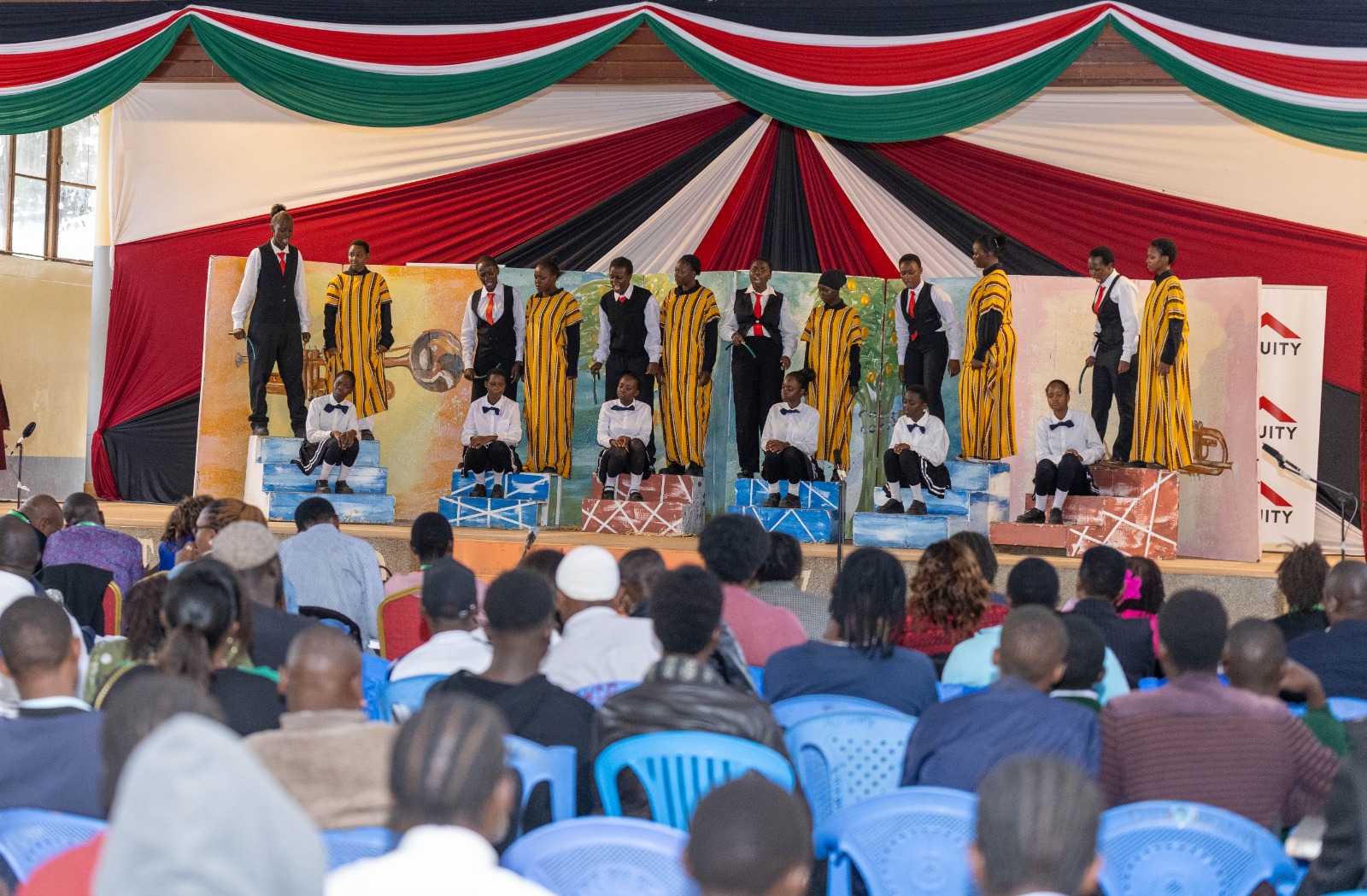
 Students perform a drama piece during the 2026 Kenya National Drama and Film Festival at Dagoretti High School, Nairobi. /HANDOUT
Thousands of learners and teachers are streaming into Kagumo Teachers Training College in Nyeri county ahead of the 64th edition of the Kenya National Drama and Film Festival, which opens on Tuesday.
Daily performances by schools and colleges will run from April 7 to 13, culminating in gala showcases on April 14 and 15.
The annual event, organised by the Ministry of Education in partnership with the Kenya Institute of Curriculum Development (KICD) and other partners including Equity Bank, brings together participants from pre-school to university level, making it one of the country’s largest co-curricular gatherings.
This year’s festival is themed “Bold Storytellers, Digital Stages: Driving Kenya’s Development through Theatre and Film,” with learners expected to present plays, films, spoken word and thematic productions aligned to curriculum goals and contemporary social issues.
Organisers say the theme underscores the growing influence of creative arts in shaping national identity and development discourse.
Politics is expected to feature prominently in this year’s productions, albeit in more subtle forms, reflecting the heightened political climate.
“Being a political year, we expect political themes, but in a very salient way. It will not be pronounced as it was last year,” said Vincent Akuka, Nairobi Region festival chairman and State House Boys principal.
Last year’s festival was overshadowed by controversy when Butere Girls High School’s play Echoes of War failed to take to the stage after students protested the arrest of their director, former Kakamega senator Cleophas Malala.
Allegations of police harassment, including the use of tear gas, dominated the day as audiences waited for the politically charged satire centred on youth agitation for change.
Akuka said lessons from that episode are likely to shape this year’s performances, with students expected to lean more on symbolism and satire than overt political messaging.
“Students of literature are very clever. They will use symbols to represent what is happening on stage. It will not be very direct. It will be satirical. They may use a school principal to illustrate how a president or a minister should behave,” he said.
He added that theatre inevitably reflects lived realities. “What we see on stage mirrors what happens in society, and we cannot run away from it,” he said, noting that satire remains a tool “to correct the leaders.”
Kenya National Drama and Film Festival executive secretary Janet Langat said this year will also see the piloting of standardised backdrops and backcloths in selected halls to improve uniformity and enhance visual quality.
“The pilot will be conducted in a few selected halls to allow room for a smooth transition. Findings from this pilot will inform future directions on this matter,” she said.
Beyond politics, recurring social issues are expected to dominate the stage, including gender-based violence, body shaming, poverty and the pressures families face in supporting education, as well as interpersonal dynamics among learners.
These themes will sit alongside topics on banking, insurance, savings and technology, in line with the festival’s broader focus.
Through its partnership with the Ministry of Education, Equity Bank is encouraging students to explore the role of technology-enabled banking in everyday life under the sub-theme “Leveraging Technology to Make Banking a Lifestyle.”
The Ministry of Education has issued strict participation guidelines, requiring that only registered, mature and responsible teachers accompany student teams and remain with them throughout the festival.
Director General Elyas Abdi said the programme has been structured to ensure punctuality and smooth flow, given the large number of participating teams.
“Only registered teachers will be considered official team leaders at any stage of the festival. Teachers accompanying students will stay with them at the festival accommodation villages,” he said.
He warned that teachers and accompanying officials will be held accountable for any malpractice involving students under their supervision during travel and throughout the festival period.
The event will culminate in a closing ceremony on April 17, following the gala festival to be hosted by Education CS Julius Ogamba and Equity Group CEO and MD Dr James Mwangi.
Winners in the Equity-sponsored categories will receive Sh100,000 and trophies, with runners-up earning Sh50,000 and third-place finishers Sh30,000.
Trainers will also be rewarded, with the best taking home Sh30,000, followed by Sh20,000 and Sh10,000 for second and third place respectively.
Top performers will crown the season with a special gala at State Lodge, Nyeri, expected to be attended by President William Ruto.