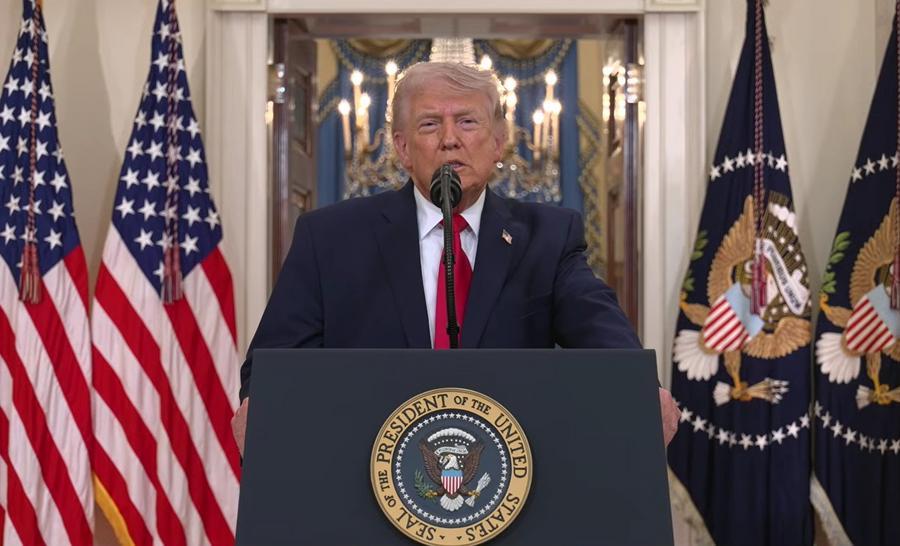
 This video snapshot shows U.S. President Donald Trump giving an address to the nation at the White House in Washington, D.C., the United States, April 1, 2026. (Xinhua)
US President Donald Trump has issued an expletive-laden threat against Iran's infrastructure if the Strait of Hormuz is not opened .
In a post, Trump says "Tuesday will be Power Plant Day, and Bridge Day, all wrapped up in one" in Iran if the key shipping lane is not reopened.
The post comes ahead of Trump's self-imposed deadline to Tehran to reopen the strait by Monday, which has been effectively closed since war broke out at the end of February.
He reiterates his earlier threat to unleash "hell" if the country does not meet his 6 April deadline—previous deadlines given by the president have shifted, and Trump tells Fox News there's a "good chance" of a deal being reached.
However, Mahdi Tabatabaei, an aide at Iran’s President’s Office, says the Strait of Hormuz “will be reopened” when “a portion of transit tolls is used to compensate for all the damage caused” by the war.
Iranian officials and lawmakers have previously raised the possibility of imposing transit fees or tolls on vessels using the strait.
Responding to Donald Trump's latest comments, Tabatabaei says the US president "has instigated a full-scale war in the region and is still issuing threats”.
He says Trump’s “insults and nonsense” are born of “sheer desperation and anger”.
Trump's shifting deadlines over the Strait of Hormuz
Trump has just repeated his threats to Iran unless it opens the Strait of Hormuz by 6 April. He has shifted his deadlines during the war—here's a recap.
Deadline 1: On 21 March, Trump said he would "hit and obliterate" power plants, "starting with the biggest ones first", if Iran didn't reopen the waterway within 48 hours.
Deadline 2: Two days later, he said there had been "very good and productive conversations" between the countries and postponed strikes against energy infrastructure for five days.
Deadline 3: On 27 March, Trump said he would postpone attacking energy plants for 10 days, "as per [an] Iranian government request", bringing the deadline to 6 April.
48-hour warning: Yesterday, with the 6 April deadline looming, he warned that Iran had "48 hours" before he unleashed "all hell"
Latest threat: In a post laden with offensive language, Trump reiterated this threat today
The key battleground between the two countries may now be at sea, Orla Guerin writes, as she reports seeing ships at anchor close to the mouth of the strait.
The narrow waterway, which connects the Gulf and the Arabian Sea, used to be the route for one fifth of global oil supplies. Not anymore.
With the US countdown under way, we headed for the strait—or as close as we could get—setting sail from the port of Khasab, on the coast of Oman.
The view from our dhow, a traditional wooden sailing boat, was of ships at anchor close to the mouth of the strait.
We counted eight vessels just one nautical mile ahead of us. Maritime organisations say as many as 2,000 are stranded in the area.
Under clear blue skies, with the sun glinting on the waves, the strait looked calm and peaceful - but is now perhaps the most powerful weapon in the hands of Iran.
Meanwhile, Trump says an American crew member rescued after a fighter jet was shot down over Iran is "SAFE and SOUND"—ending a high-stakes mission that began on Friday.
The crew member was "seriously wounded" when they were rescued "from deep inside the mountains of Iran", he adds.
Why the Strait of Hormuz is so important
The Strait of Hormuz is a key trade artery through which around 20% of the world's oil passes. Since the beginning of the US-Israeli war with Iran, numerous ships have come under attack in the area.
About 3,000 ships usually sail through the strait each month but this has dramatically decreased recently, with Iran threatening to attack tankers and other ships.
About one-third of the world's fertiliser trade also passes through the strait, and it is a vital channel for imports to the Middle East, including food, medicines and technological supplies.
The effective blockade of the the strait has caused energy prices to spike. There are fears it could fuel higher inflation.