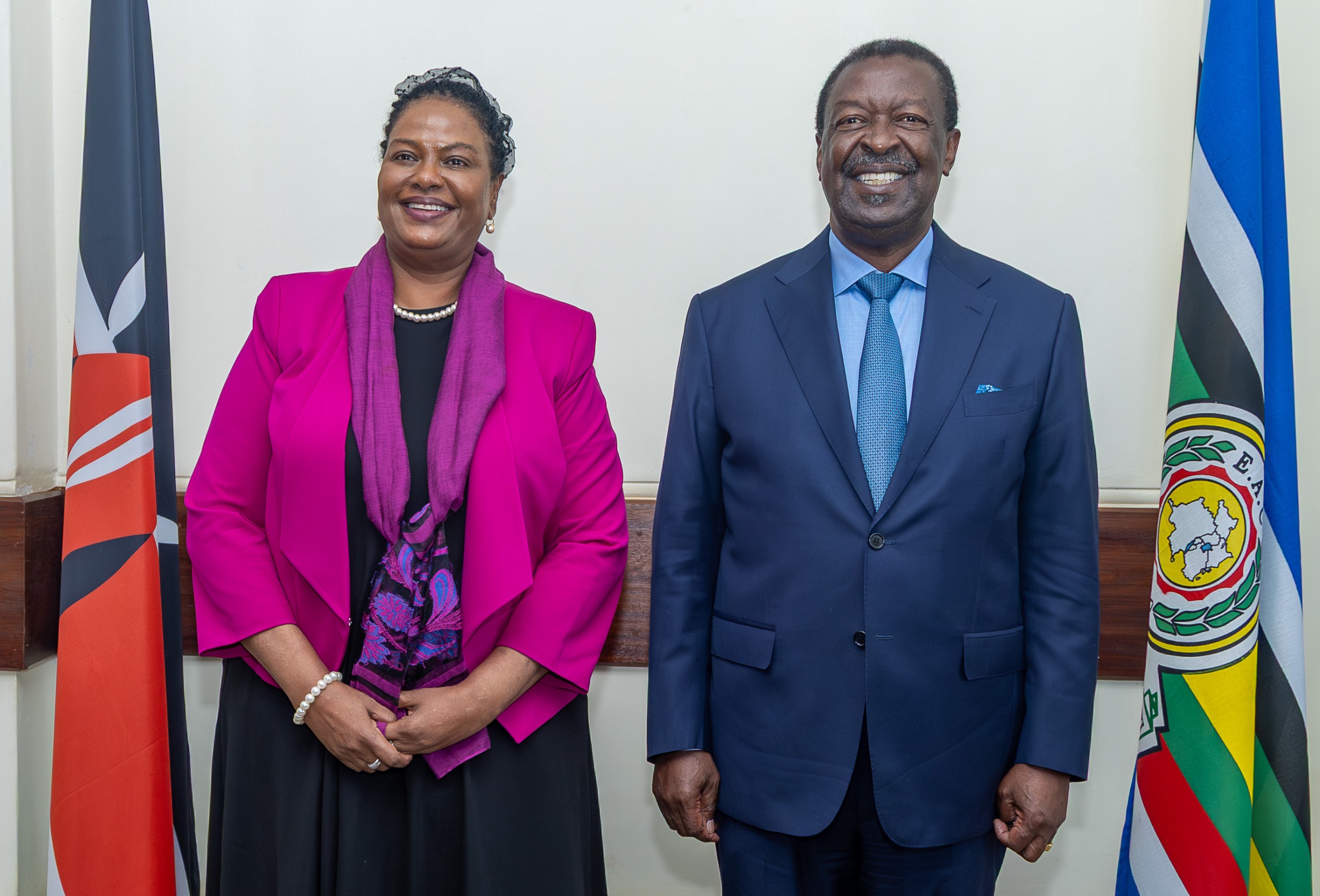
Prime and Foreign Affairs CS Musalia Mudavadi on Thursday announced the government has activated a coordinated diplomatic push to secure Justice Ndung’u a seat at The Hague-based court in December.
Speaking after a meeting attended by Chief Justice Martha Koome, Mudavadi said President William Ruto is leading the charge.
“I reaffirmed that Justice Ndung’u’s bid has the full backing of the President and Cabinet, reflecting Kenya’s confidence in her distinguished judicial experience and global outlook,” he said.
The meeting also brought together senior diplomatic and legal figures, including ambassadors posted to strategic missions.
These are Ambassadors Halima Mucheke (Netherlands), Galma Boru (Ethiopia) and Yabesh Monari (Deputy Permanent Representative, UN).
The move signalled a concerted state effort to elevate Kenya’s presence in global judicial institutions.
But even as the government ramps up its campaign, the Law Society of Kenya has warned against the venture and advised against fielding a candidate for the ICC race this year.
In a February 25 letter to Attorney General Dorcas Oduor, then LSK president Faith Odhiambo warned that sponsoring multiple candidates for international judicial positions within the same election cycle could undermine Kenya’s broader diplomatic strategy.
LSK said that Kenya’s ongoing campaign to secure the re-election of Prof Phoebe Okowa to the International Court of Justice, where she is serving following her election in 2025, risks being compromised by an additional ICC bid.
The ICJ elections are scheduled for November, just weeks before the ICC vote, raising fears that Kenya risks overextending its diplomatic capital.
“It would be imprudent for Kenya to nominate candidates for elections to two international courts in the same year,” Odhiambo cautioned, arguing that such a move could jeopardise Okowa’s chances despite her strong standing.
The LSK further noted that Kenya had already made concessions and secured commitments from other states during the campaign that saw Okowa elected in the first place, agreements that could now be strained if Nairobi shifts focus or appears to double its ambitions.
Ndung’u will face Evelyn Ankumah (Ghana), Guénaël Mettraux (Switzerland), Rosette Muzigo-Morrison (Uganda), Deo John Nangela (Tanzania), Diana Carolina Olarte Bacares (Colombia) and Yoshimitsu Yamauchi (Japan).
Legal experts say the government’s decision to proceed regardless points to a potentially flawed diplomatic gamble.
“You cannot force other states to vote for you,” an international law expert familiar with the process told the Star on Thursday.
“Votes are negotiated and often traded. Kenya has already invested heavily in the ICJ race, which comes first. This ICC bid risks spreading its influence too thin.”
The expert warned that the move could mirror past failed attempts by Kenya to secure top international positions, where strong domestic backing did not translate into global support.
He added that the ICC bid certainly complicates things for Prof Okowa.
“But I think other states are likely to stick to their earlier commitments and disregard this ICC bid,” he said.
In recent years, Kenya has suffered a string of high-profile losses on the multilateral stage.
They include unsuccessful bids involving former Cabinet Secretaries and senior officials in institutions such as the African Union Commission, the World Trade Organization and the International Fund for Agricultural Development.
These setbacks have raised questions about the country’s ability to effectively marshal diplomatic support in competitive global elections.
The recent appointment of former National Security Adviser to the President Monica Juma signals some success. She was named executive director of the UN Office on Drugs and Crime and director general of the UN Office at Vienna.
However, it could also be counterproductive if Nairobi is seen to have too much appetite for top global jobs.