
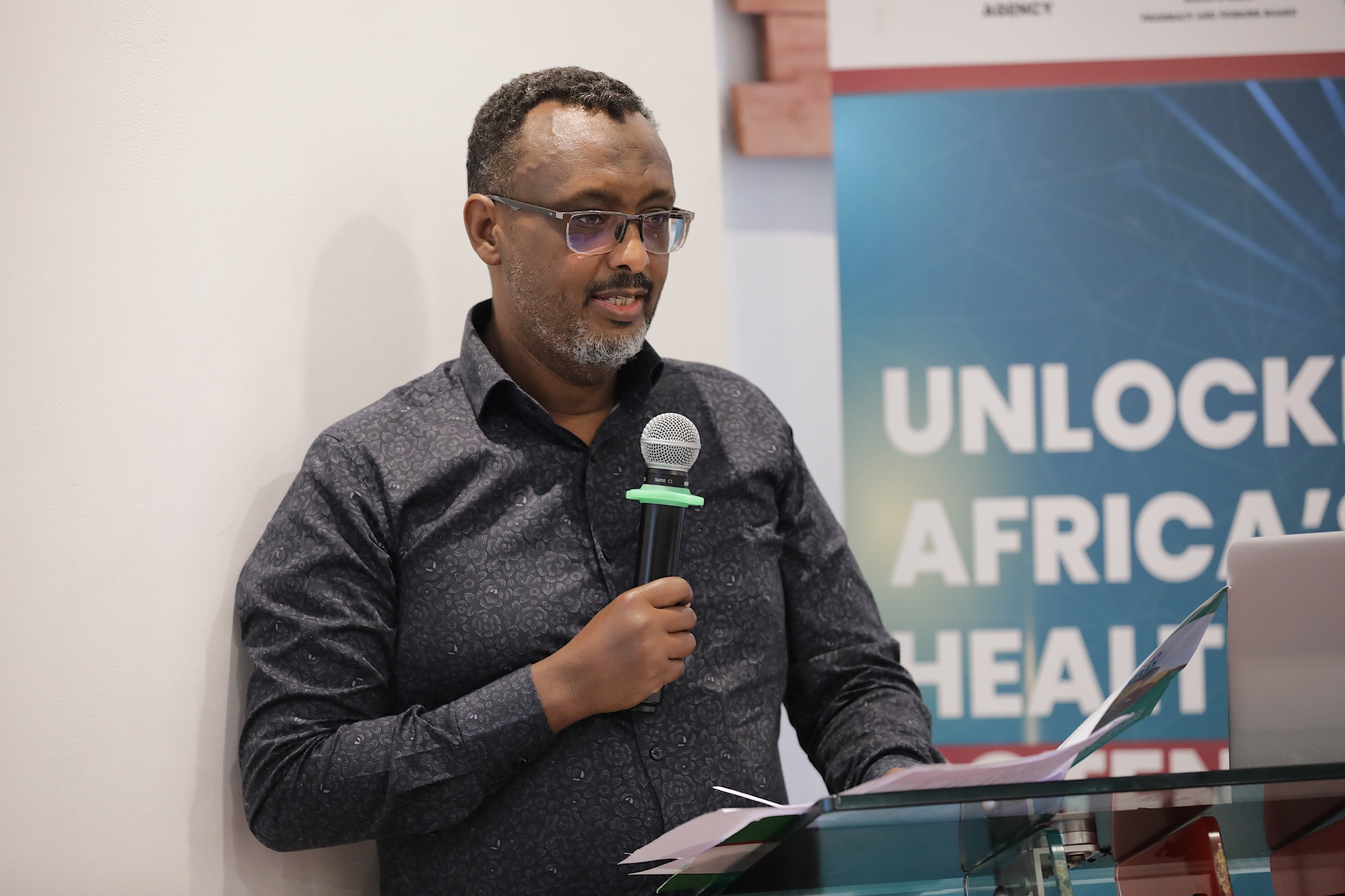
 Pharmacy and Poisons Board chief executive officer Dr Ahmed Mohamed.
The Pharmacy and Poisons Board says, apart from the 31 drug manufacturers already operating locally, 10 new entrants are building state-of-the-art facilities to make medicines and related products.
PPB acting chief executive officer Dr Ahmed Mohamed said the surge in investment is expected to shift Kenya from a heavy importer of medicines to a regional supplier within a few years.
"Currently, we have more than 31 manufacturers. However, because of the regulatory framework we have established, we are seeing about 10 new state-of-the-art facilities coming up,” Ahmed said.
“There is ongoing investment of about Sh1 billion in the pharmaceutical sector. These are new players, separate from the original 31, which demonstrates the growing confidence in our regulatory processes and the protection we offer to the industry.”
Imports currently dominate medicines in Kenya, but rising demand, supply chain disruptions during Covid-19 and government policy shifts are pushing for more local production.
Ahmed told the Star that building manufacturing capacity is no longer optional.
“Health products and technology are a matter of national security. We remember what happened during the Covid-19 pandemic, when countries locked down and exports ceased,” he said.
“The only way to prevent such a crisis in the future is to develop local capacity. We train manufacturers on good manufacturing practices and quality assurance, and fast-track the registration of their products.”
He said the rapid growth comes with pressure on the regulator to ensure standards are not compromised. The PPB is responsible for checking every medicine before it reaches patients, and monitoring it even after it is in the market.
Ahmed, who recently took over as CEO, said his approach is to refocus the institution on the patient.
“Our mandate is built on three pillars: ensuring the safety, quality and effectiveness of every product. Our current strategy is focused squarely on the patient rather than the commercial interests of the pharmaceutical industry, because that is the fundamental reason for our existence. In this process, we have expanded our human resource capacity and are operationalising our regional offices,” he said.
Part of that shift involves moving services closer to the public.
Ahmed said the board is devolving services closer to the people so that citizens can easily access its offices, interact with officers and report illegal practices, such as unauthorised premises or substandard products.
“You do not need to be certain that a drug is bad; you only need to suspect it, and that is where we take over the investigation,” he said.
The regulator has also strengthened its surveillance systems, with more frequent testing of medicines already on sale.
“We are strengthening our laboratories specifically for post-market surveillance. This means that once a product is registered and enters the market, we continue to follow up on its quality,” he said.
“We identify critical products, such as antibiotics or anti-hypertensive medicines, and sample them throughout the country for analysis in our lab.”
Drug registration globally can take between two and five years, but Ahmed said Kenya has set a two-year timeline.
“Drug registration involves many complex processes, including bioequivalence studies, stability testing and manufacturing audits to ensure compliance with good manufacturing practices,” he said.
“It is not a matter of simply sitting and approving a file; it takes time. Our two-year timeline actually makes us one of the best and most efficient regulators in the world.”
To speed up access to critical treatments, the board relies partly on approvals from trusted global regulators, though it insists it still conducts its own checks.
“We use a system called reliance, where we rely on mature regulatory authorities like the US Food and Drug Administration, the WHO pre-qualification system or the UK’s Medicines and Healthcare products Regulatory Agency (MHRA).”
“However, reliance does not mean we do not review the scientific documentation. An applicant must submit the entire dossier for our own assessment.”
Companies based in Kenya currently supply 30 per cent of the overall market, which is valued at about Sh76 billion, according to the International Finance Corporation (IFC). The remaining 70 per cent of medicines are imported.
Ahmed said the goal is not just to grow the industry, but to ensure it delivers safe and effective products.
“We are also supporting local manufacturers from a regulatory standpoint. The government’s intention is for Kenya to become a net exporter of health products rather than a net importer,” he said.