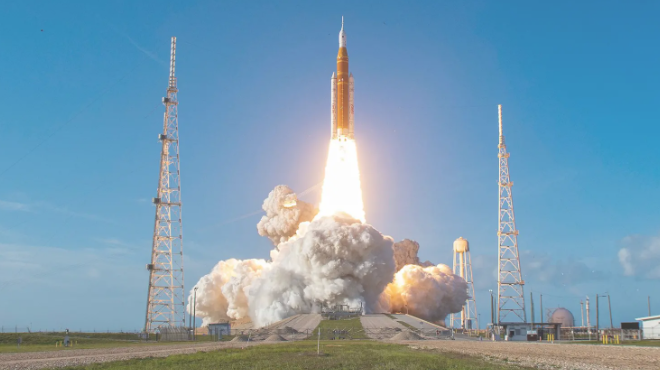
Nasa's Artemis II spacecraft has blasted off and is now orbiting the Earth in the first crewed mission to the Moon in half a century.
"We go for all humanity," astronaut Reid Wiseman said as they launched - see the moment the rocket blasted off.
Take-off was spectacular - you could feel the rocket lift-off passing through your body, our (rather excited) science editor writes from Florida.
From "epic views" to problems with the on-board toilet, we recap the launch.
What happens now? They will remain in orbit for 24 hours as the crew carries out checks - if all goes well it will get the green light to head around the Moon.
The crew are "safe, secure and in great spirits", a Nasa official says - they won't land on the Moon during their 10-day mission, but plan to circle it, and could travel further from Earth than anyone has ever been before.
'The start of a new chapter'
Libby Jackson, head of space at the Science Museum in London, has been looking forward to this mission her "whole life".
"I saw Apollo 10 in the Science Museum when I was young, and I've been working on this mission in my different roles over the years," she tells BBC Radio 5 Live.
Jackson was previously the UK Space Agency's head of space exploration.
Focusing on the astronauts, Jackson says they will have been training for this moment, including being on a specific sleep schedule "for the past week or two".
"I really can't quite believe that Artemis II is on its way," she adds. "This is the start of a new chapter."
A lunar loo for the Artemis II crew
The lack of gravity in space can pose a number of challenges - one of which includes astronauts being able to go to the toilet. There was a small issue before launch with the loo - but after engineers took a look, systems were cleared to go.
"We do recommend letting the system get to operating speed before donating fluid", mission control told the astronauts just before launch.
Nasa has spent more than $23m (£17.4m) to address the issue, which has resulted in the "Universal Waste Management System".
Men and women are able to use the system, which includes a funnel attached to a hose to process urine while using gentle airflow to eliminate spills.
A specialised seat allows for stools to be sucked into a sealed container, with a variety of tethers and restraints being used to stop the crew from floating away while using the system.
How long does it take to get to the Moon?
The Artemis II crew are due to fly around the Moon on 6 April.
The unmanned Artemis I flight, the predecessor to this year's mission, reached the Moon on day six of its mission in 2022.
Apollo 8 currently holds the record for being the fastest crewed mission to the Moon after taking just under three days - 69 hours and eight minutes.
It was also the first crewed flight to orbit the celestial body.
Unmanned objects can reach the Moon more quickly, with Nasa's New Horizon's probe passing the moon in eight hours and 35 minutes when it departed for Pluto in 2006 - though it didn't approach lunar orbit.