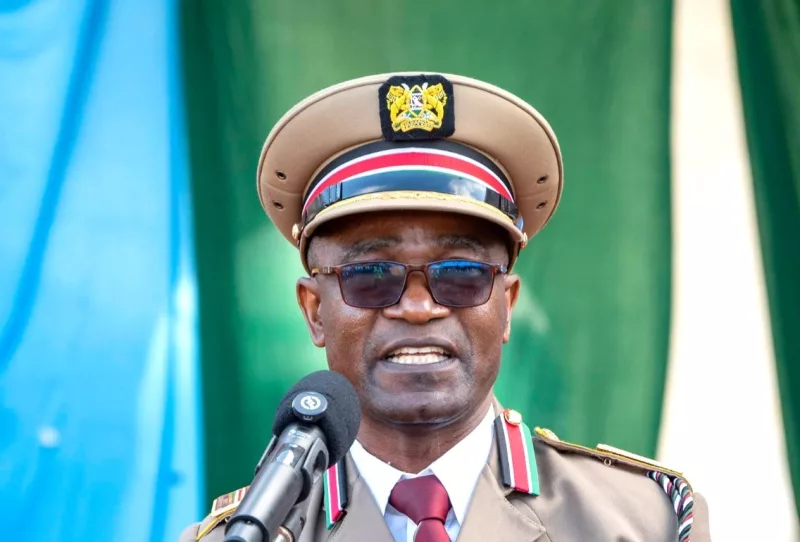
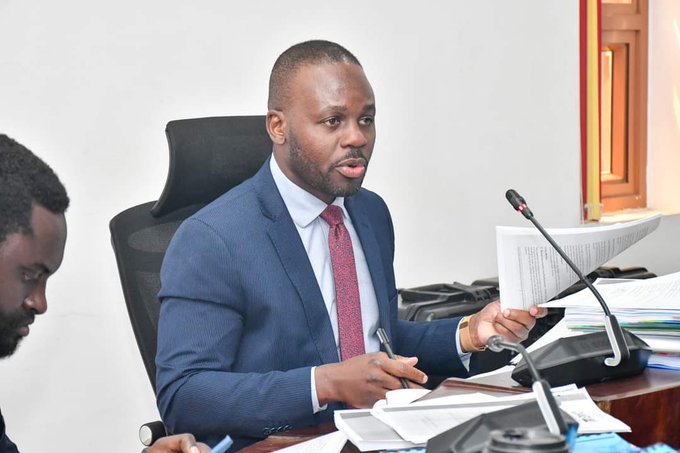
 CPAC chairman Moses Kajwang's/FILE
At least two governors risk being declared unfit to hold public office, while 25 others face fines, sanctions and possible criminal prosecution in a sweeping accountability crackdown by the Senate.
Senators have asked investigative agencies, including the EACC and DCI, to move with speed and probe what lawmakers describe as widespread misuse of public funds in the counties.
The radical stance follows the adoption of a scathing report by the Senate County Public Accounts Committee, which exposed deep-rooted financial and governance failures across county governments.
At the centre of the storm are Nairobi Governor Johnson Sakaja and his Samburu counterpart Lati Lelelit, who now risk being declared unfit for office if found culpable of financial misappropriation.
The two governors are already facing arrest warrants issued by the committee after repeatedly snubbing summons to appear and account for the use of public resources.
“The committee observed that the governor did not appear before the committee despite several invitations and summons,” committee chairman Moses Kajwang ’said, while tabling the report on Tuesday.
Senators have now directed the two to submit detailed responses on queries raised by Auditor General Nancy Gathungu in the 2024-25 financial year within strict timelines or face prosecution.
“Upon conviction, the Senate resolves that the governor is unfit to hold office for breach of the Constitution and the Parliamentary Powers and Privileges Act,” the report warns.
However, in a letter to the Senate dated Tuesday, Sakaja regretted his failure to appear before the committee, stating that he was attending a funeral of a close relative.
The governor expressed readiness to appear before the committee at its own convenience.
“Notwithstanding this situation, I remain available to Parliament as a law-abiding citizen, former senator and serving governor who upholds the Constitution and supports parliamentary processes,” he said in the letter.
He added, “As efforts continue to resolve the stalemate, I wish to confirm my availability to appear before the committee on a convenient date for members.”
Kericho Governor Eric Mutai is also on the spot, with the Senate recommending the suspension of funds to his county after he failed to appear before the committee to respond to adverse audit findings.
Lawmakers have urged the National Treasury to halt disbursements to Kericho county, citing provisions of the Constitution and public finance laws.
“The Senate urges the Cabinet Secretary for Finance and Economic Planning, pursuant to Article 225 of the Constitution and sections 96 and 97 of the PFM Act, immediately stops the transfer of funds to Kericho county executive due to the adverse opinion of the Auditor-General,” the report states.
Another 13 governors have been given 60 days to appear before the committee or risk referral to anti-graft agencies.
They include Irungu Kang’ata, Mahamud Ali, Ahmed Abdullahi, Kimani Wamatangi, Issa Timamy, Amos Nyaribo, Jonathan Bii, Paul Otuoma, Simba Arati, Joseph Lenku, Fernandes Barasa, James Orengo and Andrew Mwadime.
A further 14 governors have been slapped with a Sh500,000 personal fine each for failing to honour Senate summons, with the penalty payable directly to Parliament.
This is besides facing the risk of anti-graft agencies should they fail to respond to the audit queries within 30 days.
Those fined include Anyang’ Nyong’o, Anne Waiguru, Ochillo Ayacko, Abdulswamad Nassir, Stephen Sang, Susan Kihika, Benjamin Cheboi, Muthomi Njuki and Nadhif Jama.
“The county governor… pays a fine of Sh500,000 in their personal capacity,” the report states, signalling a shift toward personal accountability.
However, the committee singled out Makueni Governor Mutula Kilonzo Jr. for praise after his county received a clean audit, standing out as a rare case of compliance.
Beyond individual culpability, the report exposes a systemic crisis in county finances.
Senators flagged widespread financial mismanagement, ballooning debts and governance failures that cut across devolved units.
“These systemic challenges indicate deep-seated weaknesses in financial management, internal controls, and governance frameworks,” the committee said.
At the centre of the findings is a Sh32.3 billion in pending bills across 15 counties, with lawmakers warning that the actual debt could be much higher due to unsupported claims.
“Many of these liabilities are long outstanding and lack proper documentation, making financial statements inaccurate and unverifiable,” the report states.
The committee has directed counties to prioritise payment of verified bills and submit structured repayment plans to the Controller of Budget, failure to which funding could be withheld.
The report also reveals a shocking inability by counties to account for public assets, with many lacking updated registers or ownership documents for land hosting major projects.
In some cases, counties have invested billions in projects on land without title deeds, exposing public funds to legal risks and possible loss.
Revenue collection systems were also found wanting, with counties relying on outdated valuation rolls and weak, poorly integrated systems that allow leakages and manipulation.
At the same time, a pension crisis is looming, with counties owing pension schemes Sh115.7 billion, much of it inherited but significantly expanded under devolved governments.
The wage bill has also spiralled out of control, with counties spending far above the legal threshold of 35 per cent of revenue on salaries—some exceeding 50 per cent—leaving little room for development.
The Salaries and Remuneration Commission has now been tasked with crafting measures to rein in the ballooning wage bill.
Further, senators cited delays by the National Treasury in releasing funds and weak local revenue collection as key factors crippling service delivery.
The committee also flagged widespread violations of diversity laws, payroll irregularities, and failure to act on previous audit queries—painting a picture of counties struggling with both compliance and accountability.
INSTANT ANALYSIS
The Senate of Kenya has escalated its crackdown on governors, citing widespread financial mismanagement, Sh32.3 billion in pending bills, and systemic governance failures. Two governors risk being declared unfit for office, while others face fines, probes by the Ethics and Anti-Corruption Commission and Directorate of Criminal Investigations, and possible funding cuts. The report exposes weak controls, ballooning wage bills, and pension debt, signaling a decisive push for accountability and stricter oversight in county governments.