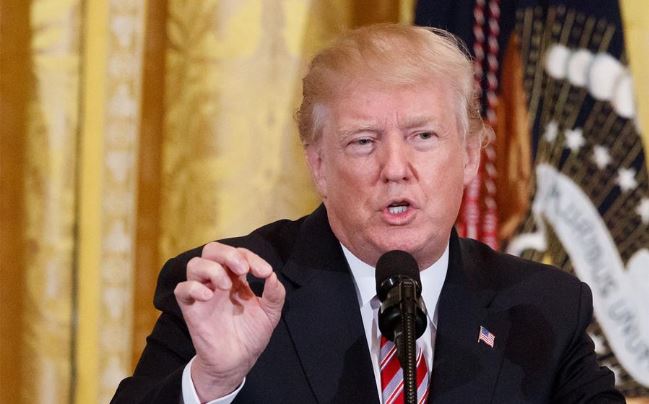
President Donald Trump says the US will "leave" Iran in "two to three weeks" when they are certain the regime cannot build a nuclear weapon "for years"
Speaking from the Oval Office, Trump says Iran is "begging to make a deal" but whether it happens or not is "irrelevant" to America's timetable.
Earlier, Iranian President Masoud Pezeshkian said Tehran had the "necessary will" to end the war provided its enemies guaranteed it would not flare up again.
China's Xi Jinping is stepping up efforts to push for a ceasefire - our correspondent in Beijing explains why.
Lebanon's Ministry of Health said at least seven people had been killed by Israeli strikes as the IDF says it struck a Hezbollah commander and another senior figure in two attacks across Beirut.
Trump is set to give an "important update on Iran" in a national address scheduled for Wednesday night.
'The Strait of Hormuz will certainly reopen but not for you' - Iran MP to Trump
The head of Iranian Parliament's National Security Committee, Ebrahim Azizi, has used his X account to send a message to Donald Trump, telling him: "The Strait of Hormuz will certainly reopen, but not for you; it will be open for those who comply with the new laws of Iran."
Azizi has said the "47 years of hospitality are over forever", referring to the period since Iran’s 1979 Revolution.
Azizi added: "Trump has finally achieved his dream of 'regime change'—but in the region's maritime regime!"
Iran's National Security Committee has approved a plan to toll vessels crossing through the Strait of Hormuz, the semi-official Fars News Agency reported on Monday.
Israel's 'Gaza model' for Lebanon
Israel's Minister of Defence has said a buffer zone will be set up inside southern Lebanon and that Israel will keep security control over a swathe of the territory, even after the end of the current war against the armed group Hezbollah.
Israel Katz said the area to be occupied would go up to the Litani River - about 30km from the border with Israel. The plan has drawn criticism from the UN, European nations and Canada - who called it "a violation of territorial sovereignty".
Katz said more than 600,000 displaced Lebanese residents would be "completely prohibited" from returning to that area until the safety of residents of northern Israel was guaranteed. He added that all the houses in Lebanese villages near the Israeli border would be demolished, "according to the model of Rafah and Beit Hanoun in Gaza".
Brent crude makes highest monthly gain since 1990 Gulf war
The price of Brent crude oil to be delivered in May rose by a record 64% in March - the highest monthly gain since the Gulf war in 1990.
The global benchmark for oil is a contract to buy a barrel of Brent crude one month in the future. When this price rises, it typically pushes up fuel prices too as oil is a key component in its production.
On Wednesday, the price of Brent for June delivery was trading 1.2% higher to $105.36 (£79.61).
Brent's previous highest monthly gain was in 1990 during Iraq's invasion of Kuwait, which disrupted the global supply of energy and sparked fears of a broader Middle East conflict, said Alberto Bellorin from InterCapital Energy.
These conditions mirror those seen in the ongoing conflict with Iran, which has driven up oil prices as markets take account for the heightened geopolitical risk, he said.
Oil prices are likely to continue to rise if shipping flows remain disrupted and if the conflict does not ease, said Goh Jing Rong from the Singapore Management University.
Meanwhile, Asian stock markets jumped this morning after President Donald Trump said the US will leave Iran in "two to three weeks".
Japan's Nikkei 225 index gained by 4%, while the Kospi in South Korea rose by more than 6%.