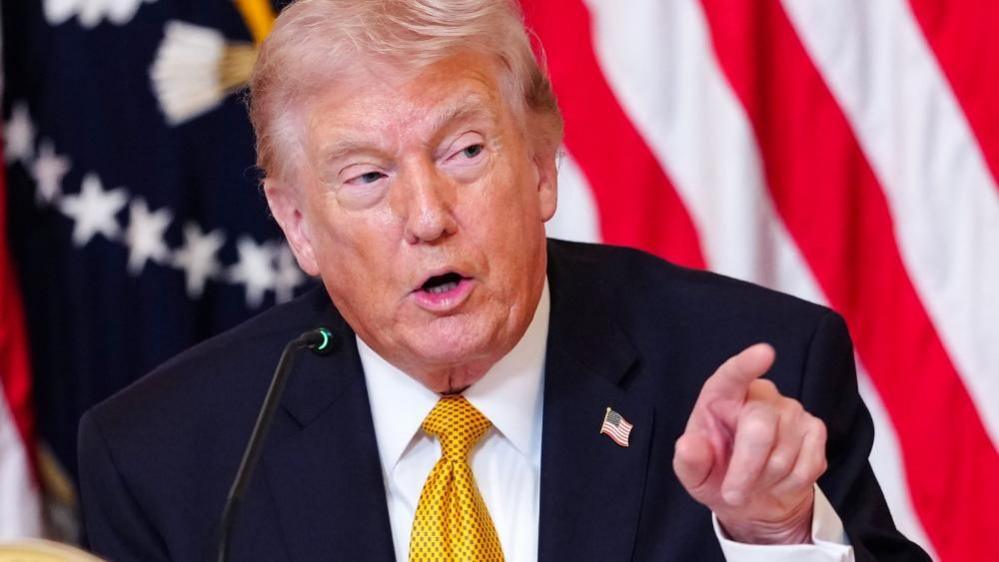
President Trump says the US will be Iran's "worst nightmare" if it doesn't agree to a peace plan and repeats that Tehran is "begging" for a deal.
During that cabinet meeting, Trump again insisted that Iran should negotiate a deal to end the war while also warning that the US will keep “blowing them away” if Tehran doesn’t come to the negotiating table.
Trump’s remarks raised new questions about the state of indirect talks between the US and Iran.
The president insisted, as he has for days, that Iran wants to reach a deal to end the war. But Iranian officials have said the country isn’t negotiating with the US.
On Wednesday, Iran also dismissed a US peace plan that reportedly demanded the regime give up its nuclear programme and limit its ballistic missiles. At the cabinet meeting, Steve Witkoff, Trump’s special envoy, confirmed that the US presented Iran with a 15-point peace plan. Witkoff didn’t offer details on the proposal.
Trump didn’t mention Iran’s initial rejection of the plan, or his decision to deploy ground troops to the Middle East - he simply argued the ball was in Iran’s court and warned the regime would face dire consequences if it doesn’t agree to a ceasefire.
“If they don’t, we’re their worst nightmare,” Trump said. “We’ll just keep blowing them away. Unimpeded, unstopped.”
Left unsaid was how the US plans to bring Iran to the negotiating table - or why a new wave of attacks will change Tehran’s calculus if nearly four weeks of war hasn’t.
Iran has effectively blocked the Strait of Hormuz, one of the world's busiest oil shipping channels, where about 20% of the world's oil usually passes through.
Bounded to the north by Iran and to the south by Oman and the United Arab Emirates (UAE), the oil shipping channel - only about 50km (31 miles) wide at its entrance and exit, and about 33km wide at its narrowest point - connects the Gulf with the Arabian Sea.
In 2025, about 20 million barrels of oil and oil products passed through the Strait of Hormuz per day, according to estimates from the US Energy Information Administration (EIA). That is nearly $600bn (£447bn) worth of energy trade per year.
About 3,000 ships usually sail through the strait each month but this has dramatically decreased recently, with Iran threatening to attack tankers and other ships.
As a result, energy prices are volatile and remain well above levels before the conflict. Brent crude rose to $108 a barrel on Thursday, as we reported earlier, and was hovering just under this level at 15.30 GMT.
Gulf countries, including Iran, rely heavily on energy exports for their income. A blockade of the strait has also hit Asia hard, with China alone estimated to buy around 90% of the oil that Iran exports to the global market.