
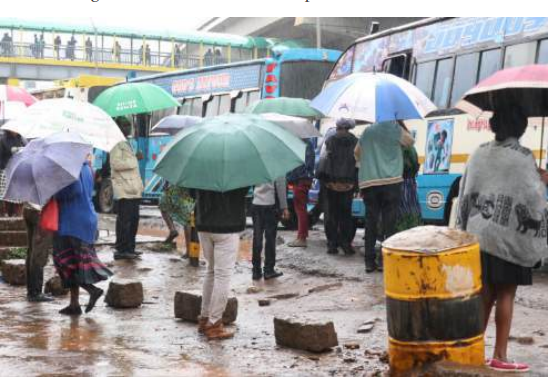
 Pedestrians brave the rain as they wait to board matatus in Nairobi’s
Westlands area /LEAH MUKANGAI
Pedestrians brave the rain as they wait to board matatus in Nairobi’s
Westlands area /LEAH MUKANGAI
Rainfall is expected to reduce across the country this week, offering relief after destructive downpours that left dozens dead and thousands displaced.
However, authorities warn that the danger is far from over as waterlogged soils continue to pose a serious risk of mudslides and flooding.
“Rainfall is expected to continue in several parts of the country, though rainfall amounts are likely to reduce as the forecast period progresses,” the Kenya Meteorological Department said in its latest forecast that covers seven days until Monday next week.
The forecast indicates that while rains will persist in different regions, their intensity will decline. Intermittent showers and thunderstorms are still expected in several areas, especially in the afternoons and at night.
“Occasional morning rains are likely to occur over few places. Afternoon showers and thunderstorms expected over few places occasionally spreading to several places. Night showers are likely to occur over few places,” said Ezekiel Muigai, the acting deputy director of forecasting services.
The pattern is expected to play out across multiple regions, with cloudy mornings in some areas giving way to sunny intervals before rains resume later in the day.
The outlook comes after a week of unusually heavy rainfall in most parts of the country. Muigai said highest amounts were recorded in the Southeastern Lowlands, which cover Ukambani and Taita Taveta.
At the same time, the Nairobi-based IGAD Climate Prediction & Applications Centre (Icpac) predicted the whole country will be wetter than normal in April.
Icpac said the wetter-than-normal conditions would continue in Kenya until June.
“Wetter than normal conditions expected over most parts of Ethiopia, Eritrea, central to southern and part of north-western Somalia, southern Sudan, South Sudan, Kenya, much of Uganda, Rwanda, Burundi, and Tanzania,” Icpac said in a regional forecast.
It also noted temperatures would be higher than normal over most parts of Kenya.
The ongoing rains continue to cause damage to infrastructure across the country.
At least 81 people have died and more than 68,000 have been displaced in 21 counties, according to the Ministry of Interior and National Administration.
Data released on March 22 shows that seven people remain missing while 68,975 households have been displaced.
Counties hardest hit include Nairobi, Kisumu, Narok, Kiambu, Migori, Siaya, Makueni, Busia, Wajir, Kisii, Homa Bay, Taita Taveta, Baringo, Kajiado, Kitui, Kwale, Machakos, Kericho, Embu, Tharaka Nithi and West Pokot.
The floods have severely disrupted essential services, with roads and bridges rendered impassable, power outages reported in several regions and water supply systems damaged. Schools have also been affected, compounding the humanitarian crisis.
Authorities say key infrastructure has suffered significant damage, including widespread flooding of residential areas, destruction of farms and inundation of markets and businesses. This has raised growing concerns over food security and livelihoods.
Regional data shows Nairobi has recorded the highest number of fatalities at 37, followed by the Eastern region with 21 deaths and the Rift Valley with eight. The Nyanza region has reported seven deaths, while the Coast region has recorded five. The Central region has three fatalities, with no deaths reported so far in the Western region.
Even as rainfall reduces, experts warn that the saturated ground increases the likelihood of landslides, particularly in hilly and flood-prone areas. Rivers and drainage systems also remain swollen, meaning even moderate rains could trigger fresh flooding.
Meanwhile, temperature variations are expected across the country during the forecast period. The Meteorological Department said, “Daytime (maximum) average temperatures of more than 30°C are expected in the Coast, the Southeastern lowlands, North-eastern and North-western Kenya.”
At the same time, cooler conditions are expected in some regions, with the agency noting that “Night-time (minimum) average temperatures are expected to be less than 10°C in a few parts of the Highlands East of the Rift Valley and in the vicinity of Mt. Kilimanjaro.”
Emergency response efforts are ongoing, with the government working alongside agencies such as the Kenya Red Cross Society and the National Disaster Operations Centre. The operations include rescue missions, distribution of humanitarian aid and efforts to restore damaged infrastructure.
As the rains begin to ease, attention is now shifting to recovery and prevention. Authorities are urging residents in vulnerable areas to remain cautious, avoid flooded zones and heed safety advisories.