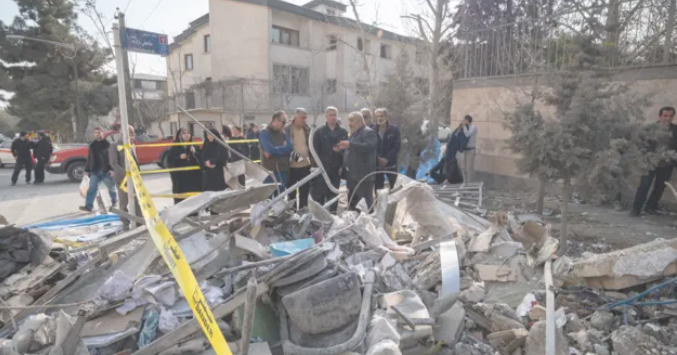
Overnight, blasts have been heard in Jerusalem and in the Iranian capital Tehran as Iranians mark Nowruz - the Persian New Year.
Israeli Prime Minister Benjamin Netanyahu says Israel will "hold off" attacks on Iranian gas fields after being asked to by US President Donald Trump.
Elsewhere, the United Arab Emirates, Kuwait, Saudi Arabia and Bahrain all reported missile or drone attacks. A drone attack at a Kuwaiti oil refinery has caused a fire, according to state media.
Iran tells the UK that allowing the US to use British military bases will be considered "participation in aggression", according to the Iranian foreign ministry.
"I wish everything could be wiped from our memories like we just woke up from a bad dream": As Persian new year approaches, Iranians describe their fears to the BBC.
Israeli oil refinery operator says most facilities operational after Iranian attack
The operator of an Israeli oil refinery in Haifa says it is has been damaged in an Iranian missile strike on Wednesday, but that most of its production facilities remain operating, reports news agency Reuters.
Oil Refineries Ltd says that essential infrastructure was damaged in "localised hits" in Thursday's attack, but reports that there were no injuries or casualties.
It adds that the production facilities that have stopped operating are currently being restarted.
The refinery, located in northern Israel's Haifa Bay, is the largest oil processing facility in Israel.
One of only two refineries in the country, Haifa is a critical facility as it supplies around 60% of Israel's diesel and 50% of its gasoline, according to a report from S&P Global.
Rise in Iranian missile attacks on Jerusalem
There has been an uptick in Iranian rocket attacks on Jerusalem – there were four last night within the space of an hour and a half, and there have been two more this morning, with no reports of casualties.
Other Iranian salvos have been directed at northern and southern Israel.
Overnight, Israel struck Tehran, again targeting what it said was the “infrastructure” of the Iranian regime. Israel’s military assesses that Iran still has more than 150 functioning missile launchers and several hundred ballistic missiles.
Israel’s Kan News reported last night that, since the war began, the Iranians have fired about 900 ballistic missiles - 350 aimed at Israel and nearly all the others at the Arab Gulf states.
A new video shared by Iran’s WANA news agency appeared to show Iran launching missiles overnight from an undisclosed location.
Although Israel says it has stopped Iran being able to manufacture new missiles, an Islamic Revolutionary Guards Corps spokesperson said that even during wartime Iran’s missiles industry is performing at a high level, with no concerns over production or stockpiles.