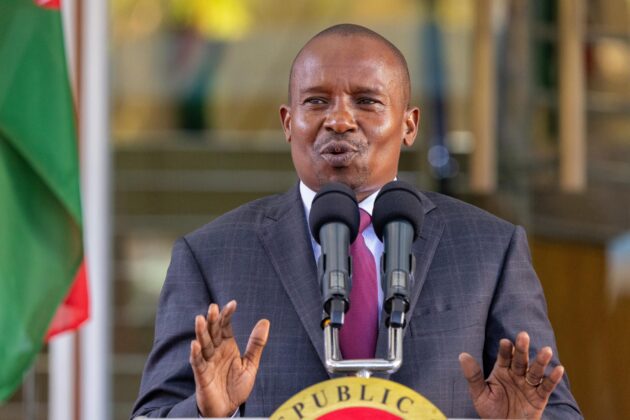
 Deputy President Kithure Kindiki/FILE
Petitioner Joseph Enock Aura has signalled his intention to appeal after the High Court declined his request to have an expanded bench of five judges hear his amended constitutional petition seeking the removal of Kithure Kindiki as Deputy President.
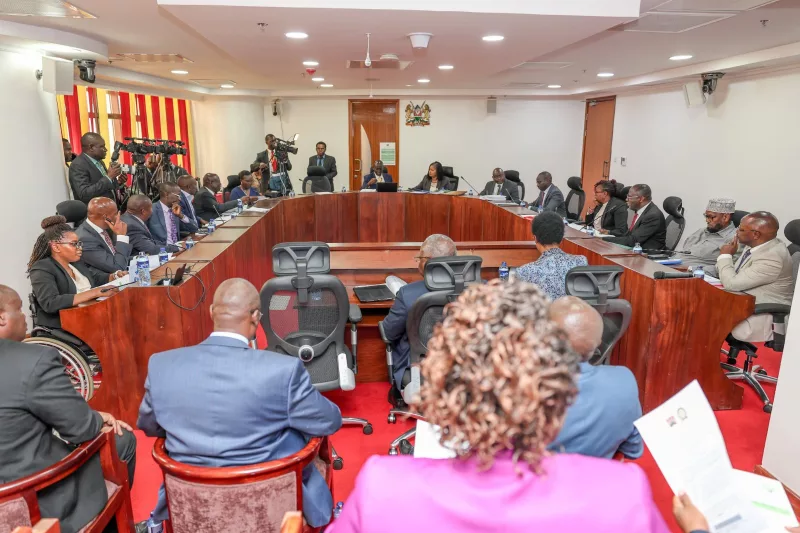
A three-judge bench comprising Justices Anthony Mrima, Eric Ogola and Freda Mugambi on Thursday dismissed Aura’s application, which sought the expansion of the bench and a stay of proceedings in related consolidated petitions.
Aura claimed he had been locked out of those proceedings, which involve the same core issue of the impeachment of Rigathi Gachagua.
The court held that it lacked jurisdiction to order the expansion or reconstitution of the bench, noting that the power to empanel judges lies exclusively with the Chief Justice under Article 165(4) of the Constitution.
In their ruling, the judges drew a distinction between the judicial role of certifying whether a matter raises substantial constitutional questions and the administrative function of empanelling a bench.
“Once the High Court has discharged its judicial duty by certifying a petition as raising a substantial question of law, and the Chief Justice has thereafter exercised her constitutional mandate by empanelling a bench, the process is complete,” the judges stated.
Aura, through his lawyer Harrison Kinyanjui, had sought certification of the amended petition for hearing by a five-judge bench, arguing that the case raises novel and weighty constitutional issues surrounding Kindiki’s appointment.
He contends that Kindiki’s appointment as Deputy President earlier in 2024 is unconstitutional on the grounds that he had not formally resigned from his position as Cabinet Secretary for Interior before taking office.
Aura further argues that no gazette notice was issued to formalise Kindiki’s exit from the Cabinet.
He also contends that Musalia Mudavadi was appointed on 31st October 2024 as acting Cabinet Secretary to replace Kindiki through Executive Order Number 5 of 2024, yet a similar Executive Order Number 5 of 2024 had been published on 5th July 2024, and that no two executive orders can lawfully issue.
Aura argues that because of this, Mudavadi could not assume the position, and therefore no lawful public holiday was declared on November 1, 2024, for the swearing-in of Kithure Kindiki as Deputy President.
The respondents, including Parliament and the Speaker of the National Assembly, opposed the application, arguing that the Chief Justice has the sole discretion to empanel judges and that the court has no jurisdiction to supervise or alter that process.
Aura had insisted that his request for certification of the issues raised for referral to the Chief Justice had been directed by the Chief Justice herself.
He added that he was not asking the court to direct the Chief Justice to exercise her discretion in any way beyond what the Constitution mandates.
The court found that once a matter has been certified and a bench empanelled by the Chief Justice, the process is complete and cannot be revisited through fresh applications.
Allowing such applications, the judges warned, could lead to a proliferation of interlocutory disputes and undermine judicial efficiency and finality.
“The constitutional text does not contemplate a scenario in which parties may repeatedly return to court seeking fresh certification or referral with the object of securing a differently constituted bench,” they stated.
Shortly after the ruling, Kinyanjui sought leave to appeal, indicating that his client was dissatisfied with the decision.
The bench granted the request and directed the Deputy Registrar to provide certified copies of the ruling and proceedings to facilitate the appeal.
In a notice of appeal filed the same day, Aura signalled his intention to challenge the ruling and orders before the Court of Appeal.
Aura’s amended petition is among several related cases involving former Deputy President Rigathi Gachagua, with the lead petition seeking compensation over his impeachment.
Lawyer Kinyanjui also raised concerns that separating the cases could prejudice his client, potentially limiting his ability to fully present his arguments due to the res judicata rule.
“My client is very apprehensive about the clear, and unequivocal injustice that may be visited upon him. The prejudice is that the guillotine of res judicata will cut him off from ventilating issues which another bench may determine on the same issues he is raising,” he said.
Despite the setback on the question of bench composition, the amended petition challenging Kindiki’s tenure remains active and will proceed for hearing unless the appellate court intervenes.
The matter is scheduled for mention on April 23, 2026, for further directions.