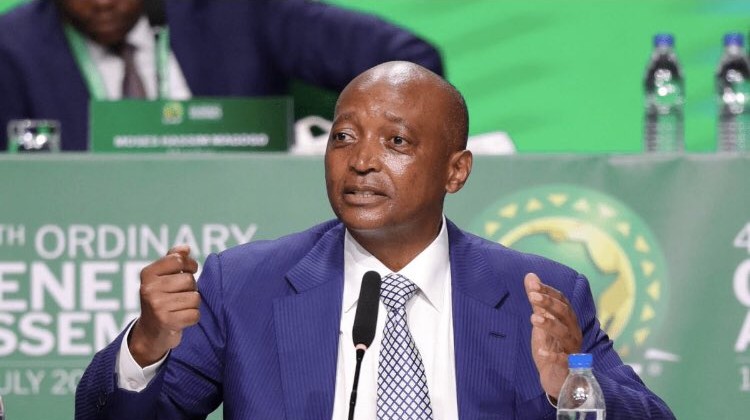
 Dr. Patrice Motsepe, the CAF president.
Confederation of African Football (CAF) President Patrice Motsepe has defended the independence of CAF’s judicial bodies while acknowledging the existence of “legacy distrust” issues that continue to cast doubt over key decisions.
Speaking in the wake of the controversial ruling on the 2025 AFCON final between Senegal and Morocco, Motsepe said the perception problem remains one of CAF’s biggest challenges despite ongoing reforms.
“When I became president, one of the major concerns was the impartiality, the independence and the respect of referees and match commissioners. A lot of good work has been done, but there continues to be suspicion because it is a legacy issue,” he said.
Morocco has been declared the winner of the 2025 Africa Cup of Nations after the Confederation of African Football (Caf) overturned the result of the final following Senegal's controversial walk-off.
Senegal beat Morocco 1-0 in the final on 18 January in a match that was overshadowed when the Senegalese players refused to play after the hosts were awarded a stoppage-time penalty with the match goalless.
Following a delay of around 17 minutes, the players did eventually return, and Brahim Diaz's penalty was saved before Senegal's Pape Gueye scored an extra-time winner.
However, that result has now been overturned after a decision by an appeal board at African football's governing body.
A statement from Caf said that Senegal are "declared to have forfeited the final match" with the "result of the match being recorded as 3-0 in favour" of Morocco.
Motsepe noted that the incidents surrounding the final match not only sparked outrage but also revived long-standing concerns about fairness and credibility in African football administration.
“I was extremely disappointed with what happened,” he said, adding that the events during the final undermined years of effort to build integrity, respect and ethical standards within the game.
According to him, the controversy exposed deep-rooted issues that CAF continues to confront, particularly around trust in officiating and decision-making processes.
Central to Motsepe’s defence was the independence of CAF’s judicial structures, including the disciplinary and appeals boards.
He explained that the two bodies operate separately and are composed of highly respected legal professionals drawn from across the continent.
“If you look at the composition of those bodies, they reflect some of the most respected lawyers and judges on the continent,” he added.
Motsepe pointed to the differing outcomes reached by the CAF Disciplinary Board and the Appeals Board as evidence that the system is functioning independently.
While one body arrived at an initial decision regarding the AFCON final, the Appeals Board later took a different position, ultimately ruling in favour of Morocco.
For Motsepe, this divergence reflects a process guided by legal reasoning rather than predetermined outcomes.
To further reinforce credibility, he revealed that CAF had deliberately restructured how members of its judicial bodies are selected.
Member associations and the six regional zones were invited to nominate experienced judges and lawyers with proven integrity.
The goal, he said, was to create panels whose decisions would command respect across all 54 member nations.
Despite these efforts, Motsepe admitted that perception remains a major hurdle.
He said distrust in African football governance predates his leadership and cannot be resolved overnight.
He stressed that CAF is committed not only to implementing best practices but also to ensuring that those efforts are recognised and trusted by the public.
The CAF president also addressed Senegal’s intention to challenge the ruling at the Court of Arbitration for Sport (CAS), affirming that every member association has the right to seek further legal recourse.
He pledged that CAF would respect whatever decision is ultimately reached at the highest level of sports arbitration.
Motsepe reiterated that fairness across all nations is a guiding principle for CAF, insisting that no country would receive preferential treatment.
“A critical factor is that not a single country in Africa will be treated in a manner that is more preferential or more advantageous or more favourable than any other country on the African continent,” he said.
He acknowledged that the controversy had highlighted areas in need of improvement, prompting the organisation to review its processes and implement corrective measures.
Ultimately, Motsepe stressed that restoring trust among fans is paramount.
He said CAF’s success will not be measured solely by internal reforms, but by whether supporters across Africa believe in the integrity and impartiality of the game.